Production schedules look neat on paper. But on the shop floor, priorities can change several times a day.
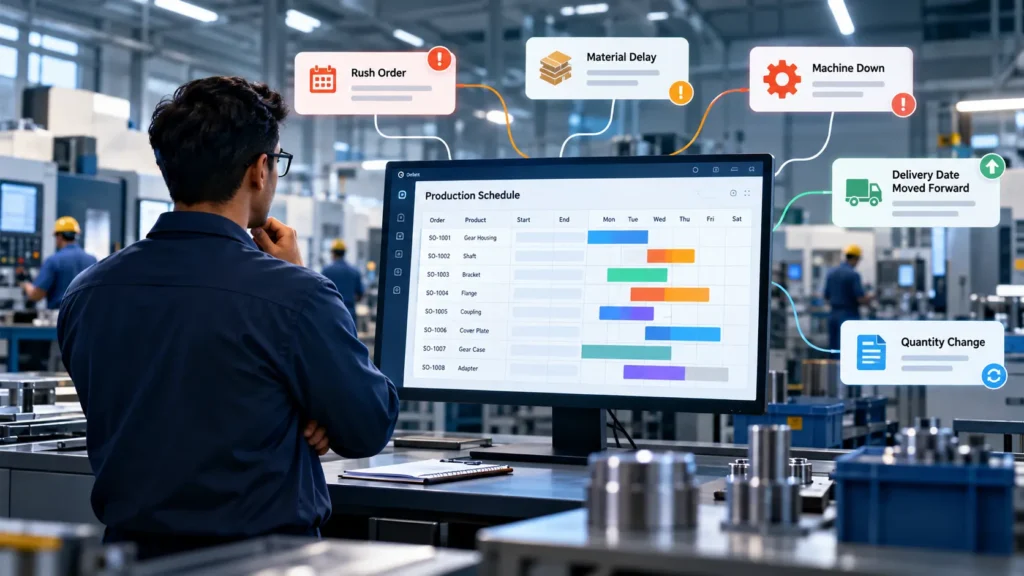
A customer moves a delivery date forward. A rush order arrives. Raw material is delayed. A machine goes down. A high-priority customer changes the quantity. Suddenly, the schedule created in the morning no longer matches what the factory needs to produce.
For manufacturers handling frequent order changes, production scheduling is becoming less about creating a fixed plan and more about continuously adjusting the plan without disrupting the entire operation.
Here are some of the approaches manufacturers are using.
1. Moving From Fixed Schedules to Dynamic Scheduling
Traditional production planning often works like this:
Orders → Production Plan → Machine Schedule → Production
The problem is that the plan can become outdated quickly.
Modern manufacturers are moving toward dynamic scheduling, where production plans can be adjusted when important changes occur.
For example, imagine a manufacturer has planned:
- 100 units of Product A
- 200 units of Product B
- 150 units of Product C
A major customer suddenly requests 100 additional units of Product A within three days.
Instead of manually rebuilding the entire schedule, the production team can evaluate available machines, materials, labour and existing commitments and determine where the additional production can fit.
The goal isn’t simply to change the schedule. It is to understand what the change will affect before making it.
2. Prioritising Orders Based on Real-Time Requirements
Not every order needs to be treated equally.
Manufacturers may prioritise production based on:
- Customer delivery commitments
- Order urgency
- Available raw materials
- Production lead time
- Machine availability
- Customer importance
- Current work-in-progress
- Shipping requirements
For example, an order due tomorrow may need to take priority over an order due next week.
Without a central view of these factors, production managers often depend on spreadsheets, phone calls and messages to determine what should run next.
This becomes difficult when the number of orders increases.
3. Connecting Production With Inventory
One of the biggest problems with changing orders is discovering that the required material isn’t available.
A production manager may receive an urgent order and schedule it immediately. Later, the team discovers that a critical component is short.
The schedule then changes again.
This is why manufacturers are increasingly connecting production planning with inventory information.
Before scheduling an order, the team can check:
What needs to be produced?
What materials are required?
What is currently available?
What is already on order?
When will the required material arrive?
This reduces situations where production schedules are created around materials that aren’t actually available.
4. Considering Machine Capacity Before Changing the Schedule
Changing one order can have a domino effect.
Suppose Machine A is already scheduled for three jobs. A new urgent order requires the same machine.
Simply adding the new order isn’t enough.
The production team needs to understand:
- Which job should move?
- How much delay will it create?
- Is another machine available?
- Will setup time increase?
- Will overtime be required?
- Will downstream processes be affected?
Manufacturers therefore need scheduling decisions to consider actual machine capacity rather than simply adding another job to a list.
5. Using Production Data Instead of Guesswork
Another major change is the way production managers make scheduling decisions.
Instead of asking:
“What should we run next?”
they can look at current production information and ask:
“Which job gives us the best outcome considering delivery commitments, machine availability, materials and current production status?”
Useful information can include:
- Machine utilisation
- Production progress
- Downtime
- Work-in-progress
- Material availability
- Pending orders
- Expected completion times
- Rejection or rework rates
- Operator availability
When this information is available in one place, schedule changes become easier to evaluate.
6. Keeping Sales and Production on the Same Page
Changing customer orders often creates conflicts between sales and production.
Sales may promise an earlier delivery date without knowing the current production load.
Production may then receive the updated requirement and discover that the requested date is difficult to achieve.
A connected system can give both teams visibility into the same information.
Sales can see what is already being produced.
Production can see new and changed orders.
Management can see whether additional capacity, overtime or subcontracting may be required.
This creates a more realistic conversation around delivery commitments.
7. Managing Change Without Losing the Original Plan
Another challenge is traceability.
When schedules are changed repeatedly, manufacturers need to know:
- What was originally planned?
- What changed?
- Why was it changed?
- Which orders were affected?
- What is the current schedule?
This becomes particularly important in industries where production history and traceability matter.
A scheduling system should therefore not only show the latest plan. It should also help teams understand how production decisions evolved.
8. Using ERP to Connect the Entire Production Process
For manufacturers dealing with frequent order changes, an ERP system can bring different pieces of the planning process together.
Instead of maintaining separate information in spreadsheets, emails and production boards, an ERP can connect:
Customer Orders → Inventory → Materials → Production Planning → Machines → Work Orders → Quality → Dispatch
For example, when a new order is entered, the production team can evaluate its material and production requirements against existing commitments.
If an existing order changes, the impact can be evaluated before the schedule is updated.
A manufacturing-focused ERP can also bring production planning, inventory, shop-floor visibility, quality management and procurement into a connected workflow. Jurysoft’s custom ERP approach is designed around these operational workflows rather than forcing manufacturers into a fixed software template.
Explore Jurysoft’s Custom ERP Development to see how production, inventory, quality and operations can be connected in one system.
This doesn’t mean that software automatically solves every scheduling problem. Manufacturing still requires human judgement.
The difference is that planners can make those decisions using current production information rather than disconnected spreadsheets and assumptions.
9. What Manufacturers Are Ultimately Trying to Achieve
The goal isn’t necessarily to create a production schedule that never changes.
In a real manufacturing environment, that may be impossible.
The real objective is to create a scheduling process that can absorb change without creating chaos.
A strong production scheduling process should help manufacturers answer questions such as:
- What should we produce today?
- Which orders are at risk?
- Do we have the required materials?
- Which machines are available?
- What happens if we prioritise this order?
- Which deliveries will be affected?
- Can we meet the customer’s requested date?
- Where is production currently delayed?
When these answers are available quickly, production teams can respond to changing orders with greater confidence.
Final Thought
Changing customer requirements are part of modern manufacturing. Trying to eliminate every schedule change isn’t realistic.
The better approach is to build a production planning process that can respond quickly when change happens.
Manufacturers that connect orders, inventory, production capacity, materials and shop-floor progress can make scheduling decisions faster and with better visibility.
And when production planning moves from a static spreadsheet to a connected system, changing an order doesn’t necessarily mean rebuilding the entire production plan from scratch.
If frequent order changes, production delays or disconnected planning processes are making scheduling difficult, it may be time to evaluate whether your current systems are giving your production team enough visibility.