Electronics manufacturing is becoming more complex as manufacturers handle changing customer requirements, multiple component suppliers, strict quality standards, and increasing pressure to deliver products on time. From printed circuit board (PCB) assembly to electronic component production and final product testing, every stage requires accurate information and proper coordination.
When production data is scattered across spreadsheets, disconnected software, and manual records, even a small mistake can lead to production delays, component shortages, quality issues, and increased operating costs.
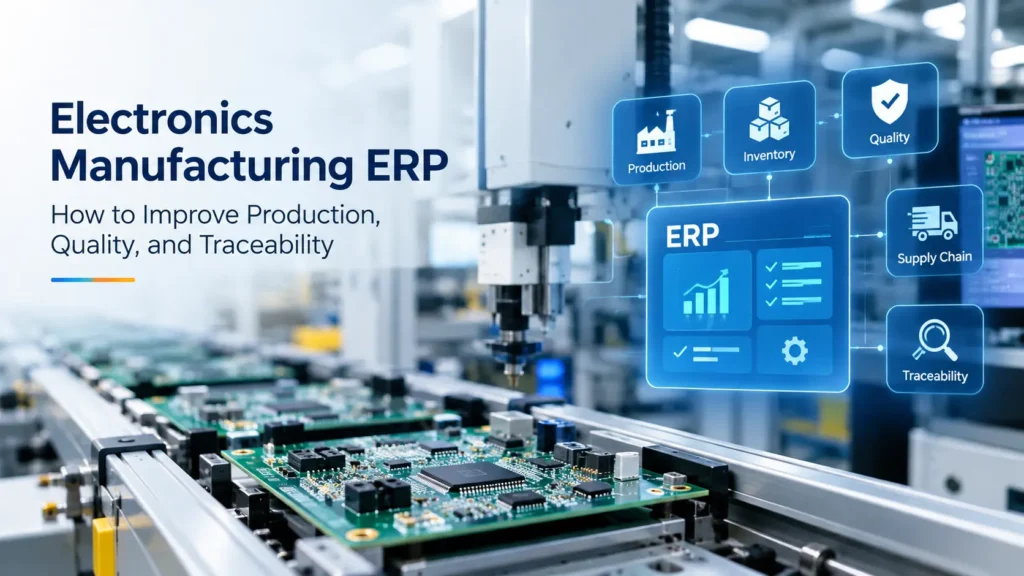
This is where an Electronics Manufacturing ERP system can help. It connects production, inventory, procurement, quality control, and order management in one system, giving manufacturers better control over their operations.
Why Electronics Manufacturers Need Better Production Management
Electronics manufacturing depends on the availability of the right components, accurate production planning, and consistent quality checks. A single missing component can delay an entire production order, while an incorrect component batch can affect multiple finished products.
Many manufacturers face challenges such as:
- Component shortages: Resistors, capacitors, integrated circuits, and other components may not be available when production begins.
- Changing customer orders: New priorities and specification changes can disrupt existing production schedules.
- Inventory inaccuracies: Differences between physical stock and recorded quantities can cause unnecessary purchasing or production delays.
- Quality control challenges: Identifying where a defect originated becomes difficult when inspection records are maintained manually.
- Limited traceability: Tracking component batches, suppliers, and finished products can take considerable time.
- Delayed reporting: Managers may not have an accurate, up-to-date view of production progress and operational costs.
These challenges can affect productivity, customer satisfaction, and profitability. Manufacturers need a connected approach that helps them monitor operations and respond quickly when problems occur.
How an ERP System Helps Electronics Manufacturing
An ERP system connects important business and production activities, allowing teams to work with consistent, up-to-date information instead of maintaining separate records.
1. Improve Production Planning and Scheduling
Production schedules often change because of urgent customer orders, machine downtime, component shortages, or unexpected quality issues.
An ERP system helps manufacturers plan production based on available materials, current orders, production capacity, and delivery commitments. When priorities change, production managers can review the impact on existing schedules and adjust plans accordingly.
For example, if a manufacturer receives an urgent PCB assembly order, the team can check component availability and production capacity before committing to a delivery date.
2. Maintain Accurate Component Inventory
Electronic products can contain hundreds or thousands of individual components. Managing these materials manually makes it difficult to know what is available, what has been reserved for production, and what needs to be reordered.
With integrated inventory management, manufacturers can monitor component quantities, track stock movements, maintain batch information, and plan replenishment based on demand.
This helps reduce material shortages, minimize excess inventory, and improve coordination between purchasing and production teams.
3. Strengthen Quality Control
Quality is critical in electronics manufacturing, where defective components or assembly errors can lead to costly rework, product failures, or customer complaints.
An ERP system with quality management capabilities can support incoming material inspections, in-process quality checks, final product inspections, and non-conformance records.
When a defect is identified, teams can document the issue, investigate its source, and track corrective actions. This creates a more consistent quality process and helps manufacturers identify recurring problems.
4. Enable End-to-End Traceability
Traceability is particularly important when manufacturers need to identify which components were used in a particular product or production batch.
A suitable ERP solution can connect supplier and component batch information with production orders, inspection results, and finished goods records. Depending on the system configuration, serial number tracking can also support product-level traceability.
For instance, if a component batch is later found to be defective, the manufacturer can use recorded production data to identify affected products and determine the appropriate corrective action.
This can reduce investigation time and support customer audits and quality requirements.
5. Coordinate Procurement and Supplier Management
Electronics manufacturers often depend on multiple suppliers, and component lead times can vary significantly.
An integrated system helps purchasing teams compare material requirements with available stock, open purchase orders, and production demand. It can also maintain supplier records and provide visibility into purchasing activity.
Better coordination helps manufacturers identify potential shortages earlier and make more informed purchasing decisions.
6. Monitor Production Performance in Real Time
Managers need more than a completed production report to understand factory performance. They need timely information about order progress, machine utilization, material consumption, rejected products, and production delays.
ERP dashboards and production reports can bring these details together, depending on the modules and integrations implemented.
With better visibility, management teams can identify bottlenecks, investigate deviations, and make decisions based on operational data rather than waiting for manually prepared reports.
Key Features to Look for in an Electronics Manufacturing ERP
Not every ERP system is designed for the specific needs of electronics manufacturers. Before choosing a solution, evaluate whether it supports your production processes.
| Feature | Why it matters |
|---|---|
| Production planning and scheduling | Helps coordinate production orders, capacity, and delivery timelines. |
| Bill of Materials (BOM) management | Maintains component lists and material requirements for each product. |
| Inventory and batch tracking | Improves stock visibility and component identification. |
| Procurement management | Connects purchasing activities with material demand. |
| Quality management | Supports inspections, defect records, and corrective actions. |
| Serial number and lot traceability | Helps trace materials and finished products across production stages. |
| Cost tracking | Helps monitor material, labour, and production-related costs. |
| Reporting and dashboards | Provides visibility into production performance and operational trends. |
Manufacturers should also assess integration requirements for existing accounting software, machine data collection, warehouse systems, barcode scanners, and manufacturing execution systems (MES).
ERP Implementation: What Should Manufacturers Consider?
Implementing an ERP system requires more than installing software. Manufacturers should first understand their current workflows, identify recurring operational problems, and define what they want to improve.
Start by mapping how customer orders move through material planning, purchasing, production, inspection, and dispatch. Identify where information is duplicated, where delays occur, and which processes depend heavily on manual work.
Next, prioritize essential functions such as inventory accuracy, production planning, quality management, and traceability. Validate the system using real production scenarios before expanding it across the organization.
A phased implementation can help teams adapt to new workflows while minimizing disruption to ongoing production. Employee training, accurate data migration, and clearly defined responsibilities are also essential for long-term success.
How to Choose the Right ERP for Your Electronics Business
The right solution depends on your company’s size, product complexity, production model, compliance requirements, and growth plans.
A small electronics assembler may prioritize inventory accuracy and production scheduling, while a larger manufacturer may require advanced traceability, multi-level BOM management, supplier coordination, and detailed quality reporting.
Instead of selecting a system based only on its feature list, evaluate how well it handles your actual manufacturing processes. Ask for demonstrations using realistic examples, including component shortages, engineering changes, urgent orders, and defective material batches.
A configurable or custom ERP solution may be worth considering when standard software cannot accommodate your workflows or integration requirements.
Conclusion
Electronics manufacturers need accurate information and coordinated workflows to manage production efficiently. Disconnected systems and manual processes can make it difficult to control inventory, maintain quality, trace components, and respond to changing customer demands.
An Electronics Manufacturing ERP system brings these activities together, helping businesses improve operational visibility, strengthen quality processes, and make better production decisions.
The goal is not simply to digitize existing records. It is to create a connected manufacturing process that supports reliable production, better resource utilization, and sustainable business growth.
Looking to improve your electronics manufacturing operations?
Jurysoft helps businesses explore ERP solutions aligned with their operational workflows and manufacturing requirements.