The automotive supply chain involves multiple interconnected processes, from sourcing raw materials and managing component suppliers to manufacturing parts, maintaining quality standards, and delivering finished products to customers. When these processes operate independently, even a small disruption can affect production schedules, inventory levels, and customer commitments.
For automotive parts manufacturers and auto-component suppliers, the challenge is not simply moving materials from one location to another. It is ensuring that the right materials are available at the right time, production stays on schedule, suppliers meet their commitments, and finished components reach customers as planned.
Spreadsheets, disconnected software, and manual reporting can make it difficult to maintain accurate, up-to-date information across purchasing, inventory, production, and dispatch. These gaps become more difficult to manage as a business expands its product range, supplier network, or manufacturing operations.
This is where automotive supply chain software and ERP systems can help. An integrated ERP system connects essential business processes, giving teams better visibility into material availability, supplier performance, production requirements, and delivery schedules.
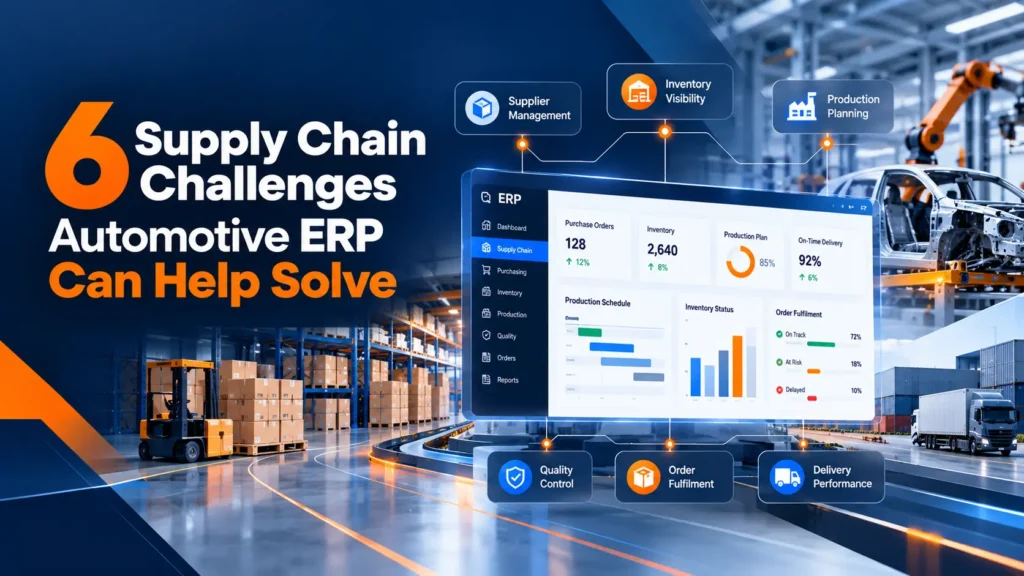
In this article, we explore six common automotive supply chain challenges and how ERP for automotive suppliers can help address them.
1. Supplier Delays and Unreliable Procurement Planning
The challenge
Automotive manufacturers depend on a network of suppliers for raw materials, machined components, electronic parts, fasteners, packaging materials, and other production inputs. A delay in receiving even one critical component can interrupt an entire production order.
Supplier delays may occur because of transportation issues, production constraints, inaccurate lead-time estimates, material shortages, or poor communication between purchasing teams and vendors.
When procurement is managed through emails, spreadsheets, and separate systems, purchasing teams may struggle to identify which orders are overdue and which production schedules are at risk.
For example, an auto-component manufacturer may plan a production run based on an expected delivery of steel components. If the supplier misses the committed delivery date, the manufacturer may need to reschedule work orders, keep machines idle, or arrange urgent procurement from another supplier.
How automotive ERP helps
Automotive ERP software can connect purchase orders, supplier information, inventory levels, and production requirements in one system.
Key capabilities include:
- Purchase order tracking: Monitor order status, quantities, promised delivery dates, and outstanding materials.
- Supplier performance monitoring: Record delivery reliability, lead-time variations, and quality-related issues.
- Procurement alerts: Flag overdue purchase orders and potential material shortages.
- Production-linked purchasing: Connect material requirements with planned production orders to support timely procurement.
- Supplier communication: Provide a consistent view of order requirements and delivery expectations, depending on available supplier portal or integration capabilities.
With better procurement visibility, purchasing teams can identify potential delays earlier and coordinate with suppliers before production is affected.
Business impact: Improved purchasing coordination, fewer unexpected material shortages, and better control over supplier commitments.
2. Inventory Inaccuracies and Poor Stock Visibility
The challenge
Inventory accuracy is critical for automotive parts manufacturers. Businesses must manage raw materials, work-in-progress components, finished goods, rejected materials, and spare parts while ensuring that production teams have access to the materials they need.
However, inventory records can become inaccurate when stock movements are recorded late, warehouse transactions are handled manually, or different departments maintain separate spreadsheets.
A material may appear available in the system but already be allocated to another production order. In other cases, stock may exist in a different warehouse or production location without the relevant team knowing about it.
These discrepancies can lead to unnecessary purchases, excess inventory, production interruptions, and delayed customer deliveries.
How automotive ERP helps
Automotive inventory management software integrated with ERP can provide a more consistent view of stock across warehouses, storage locations, and production operations.
Important capabilities include:
- Real-time stock updates: Update inventory records as receipts, issues, transfers, and dispatches are recorded.
- Multi-location inventory management: Track material availability across plants, warehouses, and storage locations.
- Lot and serial number tracking: Maintain traceability for components where applicable.
- Material allocation: Identify quantities reserved for specific production orders or customer requirements.
- Reorder planning: Use defined stock thresholds, lead times, and demand information to support replenishment decisions.
- Cycle counting: Compare physical stock with system records and investigate discrepancies.
For example, if a supplier delivers a batch of components to one warehouse, the system can help purchasing, inventory, and production teams understand the received quantities and their availability for upcoming work orders.
The exact level of real-time visibility depends on transaction discipline, system integrations, and the use of barcode or other data-capture technologies.
Business impact: Better stock accuracy, fewer unnecessary purchases, improved material availability, and reduced inventory-related production disruptions.
3. Inaccurate Demand Forecasting and Material Shortages
The challenge
Automotive suppliers often receive changing customer forecasts, revised delivery schedules, and orders with different lead-time requirements. At the same time, raw materials may have long procurement cycles, minimum order quantities, or fluctuating availability.
When demand planning relies on outdated spreadsheets or disconnected sales and production records, purchasing teams may order too much or too little material.
Overestimating demand can tie up working capital in excess inventory. Underestimating demand can create material shortages, emergency purchases, and missed delivery commitments.
The problem becomes more complex when manufacturers supply multiple customers with different schedules and component specifications.
How automotive ERP helps
An integrated automotive supply chain management system can connect customer demand, inventory, procurement, and production planning to improve material planning decisions.
Relevant capabilities include:
- Demand and forecast management: Maintain customer forecasts and compare them with actual orders.
- Material Requirements Planning (MRP): Calculate material requirements using production plans, bills of materials, inventory balances, and scheduled receipts.
- Lead-time planning: Account for supplier lead times and procurement constraints when planning replenishment.
- Scenario analysis: Evaluate the potential impact of demand changes or supplier delays where planning tools support it.
- Shortage identification: Highlight materials that may not be available when production requires them.
- Planning updates: Recalculate requirements when demand, inventory, or production schedules change.
Consider a manufacturer producing components for several automotive customers. If one customer increases its forecast, the ERP system can help planners assess the additional raw materials and production capacity required before confirming the revised schedule.
ERP does not eliminate demand uncertainty. Instead, it helps businesses use more consistent data to respond to changes and make better-informed decisions.
Business impact: More reliable material planning, fewer avoidable shortages, better purchasing decisions, and improved control over excess stock.
4. Poor Coordination Between Production and Supply Chain Teams
The challenge
Procurement, inventory, production, quality, and dispatch teams all depend on one another. When each department works with separate records, the business may lack a shared understanding of current priorities.
Production planners may schedule work without knowing that a critical material is delayed. Purchasing teams may place orders without receiving timely updates about revised production requirements. Warehouse teams may not know which components need to be issued first to support urgent jobs.
This lack of coordination can result in schedule changes, idle machines, unnecessary material movements, and inefficient use of production capacity.
How automotive ERP helps
Automotive production planning software integrated with procurement and inventory management creates a common operational view for relevant teams.
Depending on the ERP configuration, it can support:
- Production order management: Track work orders, planned quantities, and current status.
- Bill of materials management: Define the components and quantities required to manufacture each product.
- Material availability checks: Identify whether required materials are available before production starts.
- Capacity planning: Compare production requirements with available machines, labor, and work-center capacity.
- Cross-department visibility: Help teams access consistent information about orders, shortages, and schedule changes.
- Work-in-progress tracking: Monitor production progress and material consumption.
For example, when a production order is delayed because a critical component is unavailable, the system can help planners identify affected orders and evaluate alternative priorities.
More advanced planning capabilities may also support schedule optimization, but the results depend on the accuracy of operational data and the functionality implemented.
Business impact: Better coordination between departments, fewer avoidable production interruptions, and more informed scheduling decisions.
5. Quality Issues, Traceability Gaps, and Supplier Non-Conformance
The challenge
Automotive parts manufacturers need to maintain consistent product quality and, where required, demonstrate traceability throughout production and delivery.
If a batch of raw material fails inspection or a component defect is discovered after production, the manufacturer must identify the affected materials, production orders, and potentially delivered products.
When supplier records, inspection reports, inventory data, and production records are stored separately, tracing the issue can take considerable time.
Poor traceability can also make it harder to analyze recurring supplier quality problems, manage rejected materials, and support customer audits.
How automotive ERP helps
An ERP system with integrated quality management and traceability capabilities can connect supplier receipts, inspection records, inventory movements, production orders, and finished goods.
Useful capabilities include:
- Incoming quality inspection: Record inspection results for purchased materials and components.
- Supplier non-conformance tracking: Document defects, rejected quantities, and corrective actions.
- Batch and lot traceability: Link materials to production batches and finished products where applicable.
- Quality checkpoints: Record inspection results at defined production stages.
- Non-conformance management: Track issues, responsible teams, and corrective or preventive actions.
- Traceability reporting: Help retrieve relevant material and production history during investigations or audits.
For example, if a customer reports a defect in a delivered component, the manufacturer may be able to use lot and production records to identify the associated raw materials, inspection results, and production orders.
The effectiveness of traceability depends on accurate recording of material movements, lot or serial identification, and the specific controls implemented in the ERP system.
Business impact: Faster quality investigations, better supplier accountability, more effective corrective actions, and stronger production traceability.
6. Missed Delivery Commitments and Limited Order Visibility
The challenge
Automotive suppliers often operate against customer-specific delivery schedules, shipment quantities, and production requirements. A missed dispatch date can affect the customer’s production plan and put pressure on the supplier relationship.
Delivery problems are not always caused by transportation. They can originate much earlier through material shortages, production delays, incomplete quality inspections, inaccurate inventory records, or poor coordination between departments.
When order status is tracked manually, customer service and dispatch teams may struggle to provide accurate updates about what is ready, what is delayed, and when an order can be shipped.
How automotive ERP helps
Automotive ERP software can connect customer orders with production, inventory, quality, and dispatch processes to improve order visibility.
Depending on the implemented modules, capabilities may include:
- Customer order tracking: Monitor order quantities, requested delivery dates, and fulfillment status.
- Production-to-delivery visibility: Connect work orders and finished goods availability with customer requirements.
- Dispatch planning: Coordinate shipment preparation with order priorities and available inventory.
- Delivery schedule monitoring: Identify orders approaching their required dispatch dates.
- Shipment documentation: Maintain relevant dispatch records and delivery documentation.
- Performance reporting: Analyze late orders, fulfillment trends, and recurring delivery issues.
For instance, if a finished component is waiting for a quality release, the system can help relevant teams identify the pending step before the planned dispatch date is missed.
By making order status and outstanding actions more visible, ERP helps businesses address delivery risks earlier and communicate more consistently with customers.
Business impact: Better delivery planning, improved order visibility, fewer preventable dispatch delays, and stronger customer service.
Key Features to Look for in Automotive Supply Chain Software
Not every ERP system offers the same manufacturing and supply chain capabilities. Automotive parts manufacturers should evaluate solutions based on their operational requirements rather than choosing software based only on its feature list.
The following capabilities are worth assessing:
| Capability | Why it matters |
|---|---|
| Procurement management | Tracks purchase orders, supplier commitments, and incoming materials. |
| Inventory management | Maintains stock visibility across warehouses and production locations. |
| Material Requirements Planning | Connects demand and production plans with material requirements. |
| Production planning | Helps coordinate work orders, capacity, and material availability. |
| Quality management | Supports inspections, non-conformance records, and corrective actions. |
| Lot and serial traceability | Helps trace components through relevant production and inventory stages. |
| Order and dispatch management | Connects customer commitments with production and shipment status. |
| Reporting and dashboards | Helps managers monitor shortages, delays, inventory, and operational performance. |
| Integration capabilities | Connects ERP with relevant systems such as barcode tools, accounting platforms, EDI, or shop-floor applications where required. |
Manufacturers should also consider multi-plant support, customization requirements, implementation effort, data migration, user training, and the ability to adapt workflows as the business grows.
How to Choose the Right ERP for Automotive Suppliers
Selecting ERP for automotive suppliers requires a clear understanding of existing operational bottlenecks and future business requirements.
Before evaluating vendors, consider these steps:
1. Identify the biggest supply chain bottlenecks
Review recurring problems such as overdue purchase orders, stock discrepancies, production stoppages, supplier quality issues, and late deliveries. Prioritize problems that have a measurable operational or financial impact.
2. Map your current workflows
Document how customer orders, material planning, purchasing, receiving, inspection, production, and dispatch currently work. Identify where information is duplicated or delayed between departments.
3. Check automotive manufacturing requirements
Evaluate whether the solution supports your bill of materials, production processes, customer schedules, material traceability, quality controls, and reporting requirements.
4. Assess integration and customization needs
Some manufacturers need connections to existing accounting systems, shop-floor equipment, barcode applications, customer systems, or electronic data interchange platforms. Confirm which integrations are available and which require additional development.
5. Define measurable success criteria
Establish a baseline before implementation. Useful indicators include inventory accuracy, supplier on-time delivery, production schedule adherence, material shortage frequency, and on-time customer delivery.
6. Evaluate implementation and long-term support
Review the vendor’s experience with manufacturing operations, implementation methodology, training, support arrangements, and ability to accommodate evolving business needs.
The right solution should fit the manufacturer’s processes while providing room for future operational improvements.
Why Automotive Manufacturers Need an Integrated ERP Approach
Automotive supply chain challenges rarely occur in isolation. A supplier delay can create a material shortage, which disrupts production, delays quality release, and ultimately affects customer delivery.
Managing each issue through separate tools may help individual departments address their immediate tasks, but it can leave the business without a complete view of how one disruption affects the rest of the operation.
An integrated automotive ERP system connects relevant information across procurement, inventory, production, quality, and dispatch. This enables teams to identify problems earlier, coordinate responses, and make decisions using more consistent operational data.
However, software alone cannot guarantee better supply chain performance. Businesses also need clearly defined processes, reliable data, accountable teams, and regular monitoring of operational KPIs.
When technology and process improvements work together, manufacturers are better positioned to manage complexity, support growth, and meet customer commitments.
Conclusion
Automotive supply chains depend on reliable coordination between suppliers, purchasing teams, warehouses, production operations, quality departments, and customers. Supplier delays, inaccurate inventory, changing demand, disconnected workflows, traceability gaps, and missed deliveries can all affect manufacturing performance.
Automotive supply chain software helps address these challenges by connecting information and workflows across the business. With the right ERP configuration, automotive suppliers can improve material planning, monitor supplier commitments, coordinate production, maintain traceability, and gain better visibility into customer orders.
The first step is to identify where the existing supply chain loses time, money, or visibility. From there, manufacturers can evaluate an ERP solution that addresses their specific operational needs.
Improve Supply Chain Visibility with Jurysoft
Jurysoft provides ERP development and enterprise technology solutions designed around business requirements. For automotive manufacturers and component suppliers, a tailored ERP approach can help align procurement, inventory, production, quality, and delivery workflows.
If your business is dealing with recurring material shortages, fragmented inventory records, production delays, or limited order visibility, evaluate where an integrated ERP system could improve your operations.
Book a Free ERP Gap Audit with Jurysoft to identify process gaps and explore opportunities to improve supply chain visibility.
Explore Jurysoft’s Automotive ERP Solutions to learn more.