Automotive manufacturing requires precise coordination between production planning, inventory management, quality control, procurement, and supplier operations. Even small disruptions in these processes can lead to production delays, increased costs, and missed delivery deadlines.
For growing automotive component manufacturers, managing these activities through spreadsheets and disconnected software can make it difficult to maintain real-time visibility across operations.
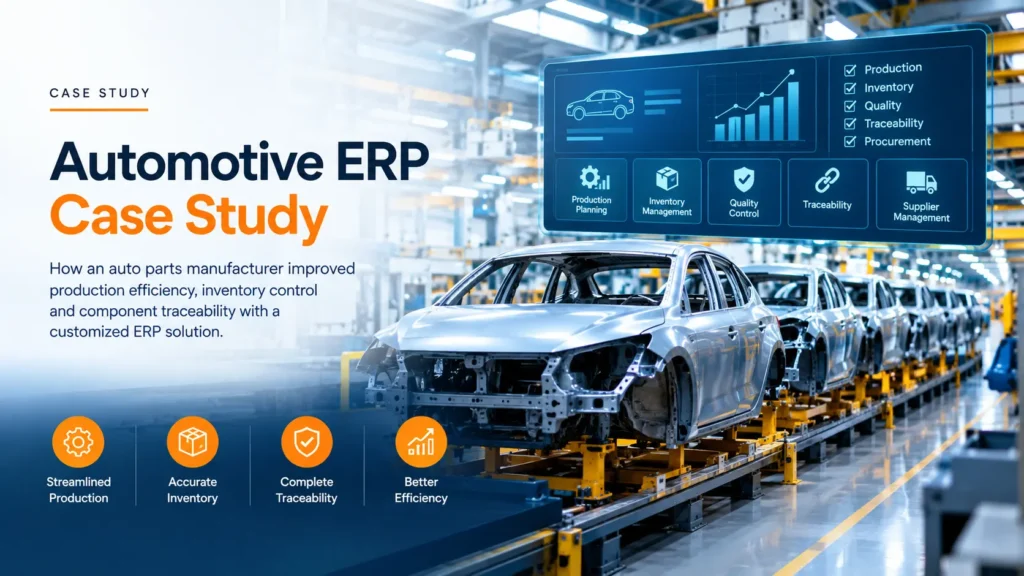
This illustrative case study explores how a customized automotive ERP solution can help an auto parts manufacturer streamline production workflows, improve component traceability, and gain better control over manufacturing operations.
Company Background
Industry: Automotive component manufacturing
Company type: Mid-sized auto parts manufacturer
Key operations: Component machining, assembly, quality inspection, inventory management, and dispatch
Business challenge: Disconnected systems and limited production visibility
The manufacturer supplied precision components to automotive OEMs and Tier 1 suppliers. As order volumes increased, the company faced growing pressure to maintain consistent quality, meet delivery schedules, and comply with customer-specific requirements.
However, its existing processes relied heavily on spreadsheets, manual reporting, and separate systems for inventory, procurement, and production.
The Challenge: Disconnected Manufacturing Operations
The company experienced several operational difficulties that affected productivity and coordination.
1. Limited Production Visibility
Production teams relied on manual updates to track work orders, machine schedules, and job progress. Managers often struggled to identify bottlenecks or determine whether orders would be completed on time.
2. Inventory Inaccuracies
Raw materials, work-in-progress components, and finished goods were tracked across different records. This made it difficult to maintain accurate stock levels and increased the risk of material shortages and excess inventory.
3. Inconsistent Component Traceability
Automotive supply chains require reliable records of materials, production batches, inspection results, and finished components. Maintaining these records manually made it harder to trace a component’s manufacturing history quickly.
4. Quality Management Difficulties
Inspection results and non-conformance records were maintained separately from production data. Quality teams had to spend additional time collecting information to investigate defects and identify recurring issues.
5. Delayed Reporting and Coordination
Procurement, production, inventory, and dispatch teams worked with different sets of information. Management lacked a consolidated view of order status, manufacturing costs, material consumption, and delivery performance.
These challenges highlighted the need for a centralized system capable of connecting the company’s manufacturing processes.
The Solution: A Customized Automotive ERP System
The manufacturer evaluated its operational requirements and adopted a customized automotive ERP approach to integrate its core business processes.
The proposed solution connected production planning, inventory, procurement, quality management, and order tracking through a centralized platform.
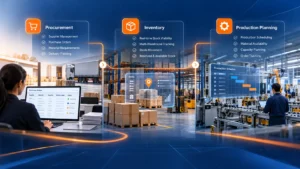
1. Production Planning and Scheduling
The system centralized production orders, work instructions, and scheduling information.
Key capabilities included:
- Work order creation and tracking
- Production scheduling based on material availability and capacity
- Work-in-progress monitoring
- Planned-versus-actual production reporting
- Identification of delayed orders and potential bottlenecks
This provided managers with a clearer understanding of production progress and resource utilization.
2. Inventory and Material Planning
Inventory management was integrated with procurement and production requirements.
Key capabilities included:
- Real-time stock movement records
- Raw material and finished goods tracking
- Bill of Materials (BOM) management
- Material requirement planning
- Reorder alerts and purchase planning
- Work-in-progress inventory visibility
By connecting material requirements with production orders, the manufacturer could plan purchases more effectively and reduce avoidable inventory discrepancies.
3. End-to-End Component Traceability
Traceability workflows connected incoming materials, production batches, inspection records, and finished goods.
Key capabilities included:
- Batch and lot identification
- Material-to-production order mapping
- Component history records
- Inspection and non-conformance documentation
- Finished goods and dispatch traceability
Where required, barcode or QR-code scanning could support faster identification and retrieval of component records.
4. Integrated Quality Management
Quality management processes were linked with manufacturing activities.
The system supported:
- Incoming material inspections
- In-process quality checks
- Final product inspections
- Defect and non-conformance tracking
- Corrective and preventive action records
- Quality reports by batch, product, or production order
This integration helped teams investigate quality issues using production and material history rather than relying on disconnected documents.
5. Supplier and Purchase Management
Procurement workflows were connected to inventory levels and production schedules.
The solution supported purchase requests, supplier records, order tracking, goods receipt documentation, and supplier performance monitoring.
This improved coordination between purchasing and production teams while helping the company identify potential material delays earlier.
6. Centralized Dashboards and Reporting
Management dashboards brought essential operational information into one place.
Reports could cover production progress, material consumption, inventory valuation, quality performance, pending purchase orders, and delivery status.
With more consistent information available, managers could make decisions based on current operational data instead of waiting for manually compiled reports.
Implementation Approach
A structured implementation process helped organize the transition from disconnected workflows to an integrated manufacturing system.
Phase 1: Process Assessment
The project team reviewed existing production, inventory, procurement, and quality workflows. Reporting requirements and operational bottlenecks were documented.
Phase 2: System Configuration and Customization
The ERP system was configured around the manufacturer’s processes, including BOM structures, production routing, stock transactions, quality checkpoints, and reporting requirements.
Phase 3: Data Migration and Validation
Relevant product records, material masters, supplier details, inventory balances, and open production orders were prepared, cleaned, and validated before migration.
Phase 4: Pilot Testing
Selected production workflows were tested to verify material consumption, stock movements, traceability records, quality documentation, and order reporting.
Phase 5: Training and Deployment
Production planners, warehouse teams, procurement personnel, quality inspectors, and managers received role-based training. Deployment was supported by process documentation and issue resolution.
Phase 6: Continuous Improvement
After deployment, the company could review operational reports, identify process gaps, and refine workflows based on user feedback and measured performance.
Illustrative Business Impact
The expected benefits of a well-implemented automotive ERP system can be measured using operational KPIs. The figures below are hypothetical examples for demonstrating how results could be presented; they are not verified results from an actual Jurysoft customer.
| Performance indicator | Illustrative target |
|---|---|
| Production reporting time | 40% reduction |
| Inventory record discrepancies | 30% reduction |
| Time required to retrieve traceability records | 50% reduction |
| Production schedule adherence | 15% improvement |
| Manual reporting effort | 35% reduction |
Actual results depend on the manufacturer’s starting performance, process maturity, data quality, employee adoption, and implementation scope.
The company should establish baseline measurements before deployment and compare them with post-implementation results to validate improvements.
Key Lessons for Automotive Manufacturers
This illustrative scenario highlights several important considerations for automotive businesses planning an ERP implementation.
Connect production and inventory. Production schedules become more reliable when material availability and consumption are visible in the same system.
Make traceability part of daily operations. Batch identification and inspection records should be captured during manufacturing rather than reconstructed later.
Integrate quality with production. Linking defects and inspection results to work orders helps teams investigate recurring problems more efficiently.
Measure outcomes using KPIs. Inventory accuracy, schedule adherence, reporting time, and defect rates provide a practical way to evaluate ERP performance.
Choose a solution that fits operational needs. Automotive manufacturers should assess their BOM complexity, production processes, customer requirements, integrations, and future growth before selecting or customizing an ERP platform.
How Jurysoft Global Can Help
Jurysoft Global provides customized enterprise technology solutions designed around business-specific operational requirements.
For automotive manufacturers and component suppliers, an appropriately scoped ERP solution can bring production planning, inventory management, procurement, quality workflows, and traceability into a connected operational environment.
Rather than forcing every manufacturer into the same workflow, a customized approach can align the system with existing processes, reporting requirements, and long-term business objectives.
Explore Jurysoft’s automotive ERP capabilities: https://jurysoft.com/erp/automotive-erp
Conclusion
Automotive manufacturing depends on coordination, consistency, and accurate operational information. Disconnected systems can make it harder to control inventory, maintain traceability, manage quality, and meet customer delivery commitments.
A customized automotive ERP system can provide a centralized foundation for managing these processes, improving visibility, and supporting data-driven decisions.
For manufacturers planning their next stage of growth, the most effective ERP strategy starts with clearly defined operational challenges, measurable objectives, and an implementation plan aligned with real production requirements.
Planning an automotive ERP implementation? Explore how Jurysoft Global can help you evaluate a solution aligned with your manufacturing operations.