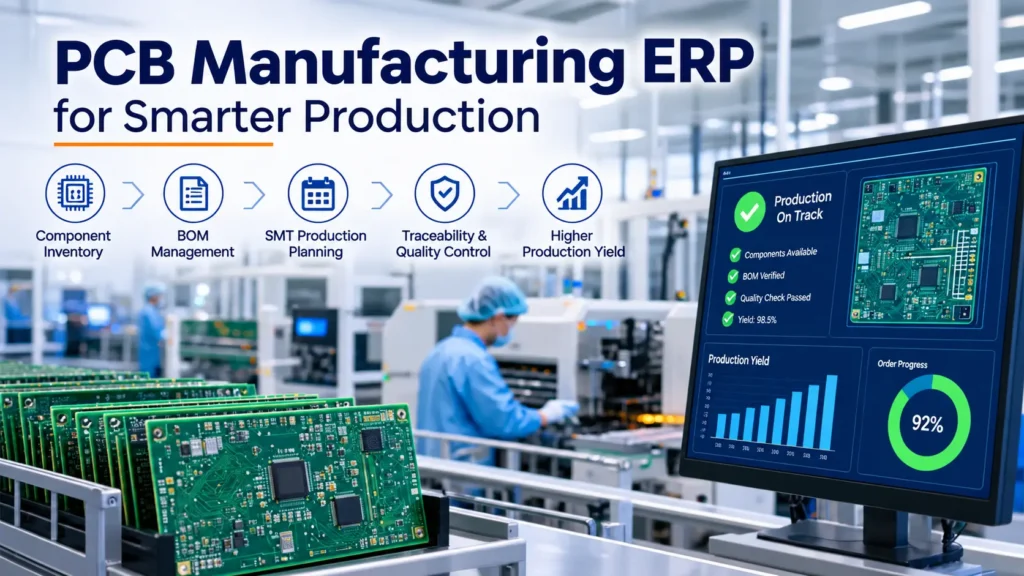
Printed Circuit Board (PCB) manufacturing requires precise coordination between electronic component procurement, inventory management, production scheduling, assembly, and quality testing. Even a small component shortage or production error can delay deliveries, increase manufacturing costs, and affect product reliability.
As electronics manufacturing becomes more complex, relying on spreadsheets, disconnected inventory systems, and manual production records can make it difficult to maintain accurate material planning and end-to-end traceability.
This is where a PCB Manufacturing ERP system can make a significant difference. By connecting inventory, production, procurement, quality management, and order tracking in one system, manufacturers can gain better visibility into their operations and make informed decisions.
However, successful implementation requires more than installing software. Manufacturers must align the system with their production workflows, component requirements, quality standards, and traceability needs.
In this guide, we explore how ERP implementation helps PCB manufacturers improve material planning, streamline production, and maintain consistent quality.
1. Why PCB Manufacturers Need a Specialized ERP System
PCB manufacturing involves multiple interconnected processes, from managing electronic components to assembling boards and testing finished products.
Manufacturers may need to coordinate:
- Electronic components such as resistors, capacitors, ICs, and connectors.
- Printed circuit boards, solder paste, and assembly materials.
- Bills of materials (BOMs) and engineering revisions.
- Surface Mount Technology (SMT) production lines.
- Through-hole assembly and inspection processes.
- Quality testing, defect tracking, and rework.
- Customer-specific orders and delivery schedules.
When these activities operate through separate systems, information gaps can develop between procurement, inventory, production, and quality teams.
An ERP for PCB manufacturers integrates these functions, allowing teams to work with consistent operational data. For example, when a new production order is created, the system can help determine component requirements, identify inventory shortages, support purchasing decisions, and track the order through manufacturing.
The result is improved coordination, fewer manual errors, and greater control over production activities.
2. Improving Electronic Component Inventory Management
Electronic component inventory is one of the most important areas of PCB manufacturing. Production depends on the availability of the correct components, in the required quantities, at the right time.
However, manufacturers often face challenges such as component shortages, excess inventory, supplier lead-time variations, and obsolete electronic parts.
How ERP improves inventory control
A PCB ERP system can help manufacturers:
- Maintain centralized records of electronic components and raw materials.
- Track stock availability across warehouses and production locations.
- Monitor component lot numbers, serial numbers, and supplier batches where required.
- Set minimum stock levels and reorder points.
- Track material receipts, issues, returns, and adjustments.
- Identify slow-moving, obsolete, or excess inventory.
- Monitor component shelf life and storage requirements where applicable.
For example, when an SMT production order requires 2,000 resistors and 500 integrated circuits, the system can compare the requirements against available stock and identify shortages before production begins.
This gives procurement teams time to arrange materials instead of discovering shortages after the production line has been scheduled.
Supporting accurate material planning
With reliable inventory data, manufacturers can reduce unnecessary purchasing, improve stock utilization, and minimize production delays caused by missing components.
The exact benefits depend on inventory accuracy, supplier reliability, and how consistently the ERP system is used across departments.
3. Managing Bills of Materials and Engineering Revisions
A Bill of Materials (BOM) defines the components and quantities required to manufacture a PCB assembly.
A typical PCB assembly BOM may contain:
- Component part numbers and descriptions.
- Required quantities for each assembly.
- Approved manufacturers and supplier references.
- Component specifications and substitutions.
- Assembly versions and engineering revisions.
- Reference designators and other production information.
Managing these details manually can become difficult when products undergo frequent design changes.
Why BOM accuracy matters
Consider a manufacturer producing several versions of the same electronic control board. A design revision may replace a component with a different specification or change the quantity required.
If the production team uses an outdated BOM, the result could be incorrect material procurement, assembly defects, or rework.
A properly configured PCB Manufacturing ERP can maintain BOM versions, support revision control, and connect approved production requirements with material planning.
Before releasing an order, teams can verify that the correct BOM revision is being used and that required components are available.
Where engineering changes are frequent, integration with Product Lifecycle Management (PLM), Electronic Design Automation (EDA), or other engineering systems may also be necessary.
4. Optimizing SMT Production Planning and Scheduling
Surface Mount Technology (SMT) is widely used to assemble electronic components onto printed circuit boards. SMT production planning requires coordination between component availability, machine capacity, setup requirements, production priorities, and delivery deadlines.
Without centralized planning, manufacturers may experience frequent schedule changes, excessive changeovers, idle equipment, or delays caused by missing materials.
How PCB Production Management Software helps
ERP-based production planning can connect customer orders with material availability, work orders, production capacity, and delivery schedules.
Depending on the system’s capabilities, manufacturers can use it to:
- Create production orders based on confirmed demand.
- Calculate material requirements using BOMs.
- Identify component shortages before releasing work orders.
- Coordinate SMT and subsequent assembly operations.
- Monitor work-in-progress inventory.
- Track production quantities and order completion.
- Adjust schedules when priorities or material availability change.
For example, if a customer brings forward the delivery date for a control board, planners can review material availability, production capacity, and the impact on existing orders before changing the schedule.
Important: Advanced SMT machine programming, feeder setup, real-time equipment monitoring, and line-level scheduling may require integration with Manufacturing Execution Systems (MES), machine software, or specialized planning tools. These capabilities should be confirmed during ERP selection.
5. Strengthening Component Traceability
Traceability is particularly important in electronics manufacturing, where a defective component batch can affect multiple production orders and finished products.
Manufacturers may need to determine which supplier provided a component, where it was used, which production batch consumed it, and which finished products could be affected by a quality issue.
Without reliable traceability records, investigations and product recalls can become time-consuming.
What should PCB traceability include?
A well-designed traceability process may capture:
- Supplier and incoming material batch information.
- Component lot and serial numbers, where applicable.
- Material issue and consumption records.
- PCB assembly and production batch identifiers.
- Work orders and manufacturing dates.
- Inspection and test results.
- Rework, repair, and non-conformance records.
- Finished-product shipment and customer information.
With the appropriate ERP configuration and shop-floor integrations, manufacturers can trace materials from receipt through production and shipment.
Example: Identifying a defective component batch
Suppose a supplier notifies a manufacturer that a particular batch of integrated circuits may have a defect.
With lot-level traceability, the quality team can identify the affected inventory, review production records to find assemblies that consumed the batch, and determine whether any affected products have already been shipped.
This supports faster investigations, targeted containment, and more informed corrective actions.
For high-reliability electronics, traceability requirements should be defined according to the product, customer contracts, and applicable industry standards.
6. Integrating Quality Testing and Defect Management
PCB quality control may involve several stages, including incoming material inspection, solder paste inspection, automated optical inspection (AOI), in-circuit testing (ICT), functional testing, and final inspection.
Each stage can generate valuable information about component quality, assembly accuracy, and production performance.
When testing records are disconnected from production data, identifying recurring defects and their causes becomes more difficult.
ERP-based quality management
An ERP system with suitable quality management capabilities can help manufacturers:
- Define inspection plans and acceptance criteria.
- Record incoming material inspection results.
- Track inspection status by batch or production order.
- Document defects and non-conformances.
- Manage corrective and preventive actions.
- Record rework and retesting outcomes.
- Link quality results with suppliers, materials, and production batches.
For example, if a specific component supplier is repeatedly associated with assembly failures, quality teams can analyze inspection and defect records to investigate the issue.
ERP integration with AOI, ICT, and functional testing systems may be required to capture detailed machine-generated results automatically.
7. Monitoring Production Yield and Manufacturing Performance
Production yield is a key indicator of manufacturing efficiency. It helps teams understand how many units meet the required quality criteria compared with the number produced or processed.
For PCB manufacturers, useful performance indicators may include:
| KPI | What it measures |
|---|---|
| First-pass yield | Percentage of units passing a process without rework |
| Defect rate | Frequency of defective units or detected defects |
| Scrap rate | Materials or products lost during manufacturing |
| Production cycle time | Time required to complete a production process |
| On-time delivery | Percentage of orders delivered as scheduled |
| Inventory accuracy | Agreement between recorded and actual stock |
| Material shortage frequency | How often missing materials disrupt production |
A PCB Manufacturing ERP system can bring production, inventory, and quality information together to support performance reporting.
For instance, if first-pass yield declines after a component substitution, managers can investigate whether the change is associated with a particular supplier, BOM revision, production line, or process.
The usefulness of these reports depends on accurate data capture and clear definitions for each KPI. Real-time machine-level analytics may require an MES or dedicated manufacturing analytics integration.
8. Key Steps for Successful PCB ERP Implementation
A successful PCB ERP implementation begins with understanding how the factory operates today and identifying the processes the new system must support.
Step 1: Assess existing manufacturing workflows
Document procurement, component storage, BOM management, SMT scheduling, assembly, inspection, and shipment processes. Identify manual tasks, duplicated data, and common production delays.
Step 2: Clean and migrate master data
Validate component codes, supplier records, units of measure, BOMs, inventory balances, and engineering revisions before migration. Establish consistent naming and identification rules.
Step 3: Configure production and inventory workflows
Set up material planning, purchasing, warehouse transactions, work orders, production reporting, quality checks, and traceability according to actual business requirements.
Step 4: Plan system integrations
Identify connections needed with accounting, CAD/EDA, PLM, MES, barcode scanners, SMT equipment, and testing systems. Confirm which integrations are available and which require customization.
Step 5: Test with real production scenarios
Test component shortages, BOM revisions, substitute parts, material returns, rejected components, rework, and lot traceability. Verify that the system produces accurate inventory and quality records.
Step 6: Train teams and monitor results
Train procurement, warehouse, production, and quality teams. Track baseline and post-implementation KPIs, resolve workflow issues, and refine configurations as requirements evolve.
A phased rollout can be useful for manufacturers with complex production environments. Starting with a controlled production area or product family allows teams to validate workflows before expanding the implementation.
9. Common PCB ERP Implementation Challenges
Even a capable system can underperform when implementation planning overlooks manufacturing-specific requirements.
| Challenge | Recommended approach |
|---|---|
| Inaccurate component master data | Standardize part numbers and validate supplier records before migration |
| Frequent BOM revisions | Define engineering change approvals and revision-control procedures |
| Obsolete or shortage-prone components | Use demand planning, supplier lead times, and lifecycle monitoring |
| Limited shop-floor visibility | Evaluate barcode-based transactions and MES integration |
| Incomplete traceability | Define lot-tracking rules and mandatory material consumption records |
| Disconnected testing systems | Plan interfaces for inspection and test-result data |
| Resistance to new workflows | Provide role-based training and practical production scenarios |
| Unclear implementation scope | Prioritize business-critical requirements and define measurable acceptance criteria |
Manufacturers should also evaluate system scalability, reporting capabilities, security, support arrangements, and the effort required to maintain integrations over time.
10. Choosing the Right ERP for PCB Manufacturers
Not every manufacturing system provides the same depth of electronics-specific functionality. Selecting the right solution requires evaluating how well it supports current processes and future manufacturing needs.
Before choosing a system, assess whether it supports:
- Electronic component inventory and supplier management.
- Multi-level BOMs and engineering revision control.
- Material requirements planning and purchasing.
- Production work orders and work-in-progress tracking.
- Lot, batch, and serial-number traceability.
- Quality inspections and non-conformance management.
- Yield, scrap, and production performance reporting.
- Integration with engineering, shop-floor, and testing systems.
- Custom workflows for different PCB products and assembly methods.
Also distinguish between standard functionality, configurable workflows, custom development, and third-party integrations. This helps establish a realistic implementation scope and budget.
For manufacturers with unique workflows, a configurable or custom-built solution may offer more flexibility than a rigid, one-size-fits-all platform.
How Jurysoft Supports Manufacturing ERP Requirements
Jurysoft Global provides custom ERP development for businesses that need software aligned with their operational workflows. For PCB and electronics manufacturers, the appropriate solution should be designed around material planning, production visibility, quality processes, inventory control, and traceability requirements.
Rather than assuming every factory needs the same configuration, the implementation process should begin with a review of the manufacturer’s production model, component data, existing systems, reporting needs, and integration requirements.
Explore Jurysoft’s manufacturing and custom ERP capabilities:
If your business is evaluating a new manufacturing system, start by identifying the production bottlenecks and traceability gaps that have the greatest impact on delivery performance and product quality.
Conclusion
PCB manufacturing requires accurate material planning, controlled production workflows, and reliable traceability from incoming components to finished assemblies. Disconnected systems and manual records can make these requirements harder to manage as product complexity and order volumes increase.
A well-planned PCB Manufacturing ERP implementation can help connect inventory, BOM management, production scheduling, quality control, and performance reporting within a coordinated operational system.
The key to success is selecting a solution that fits the factory’s actual processes, validating the required integrations, and establishing reliable production data from the beginning.
For PCB manufacturers looking to improve material availability, reduce avoidable production disruptions, and strengthen traceability, a manufacturing-focused ERP strategy provides a practical foundation for operational improvement.