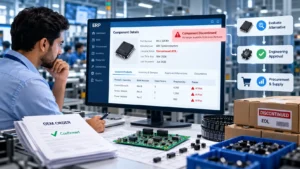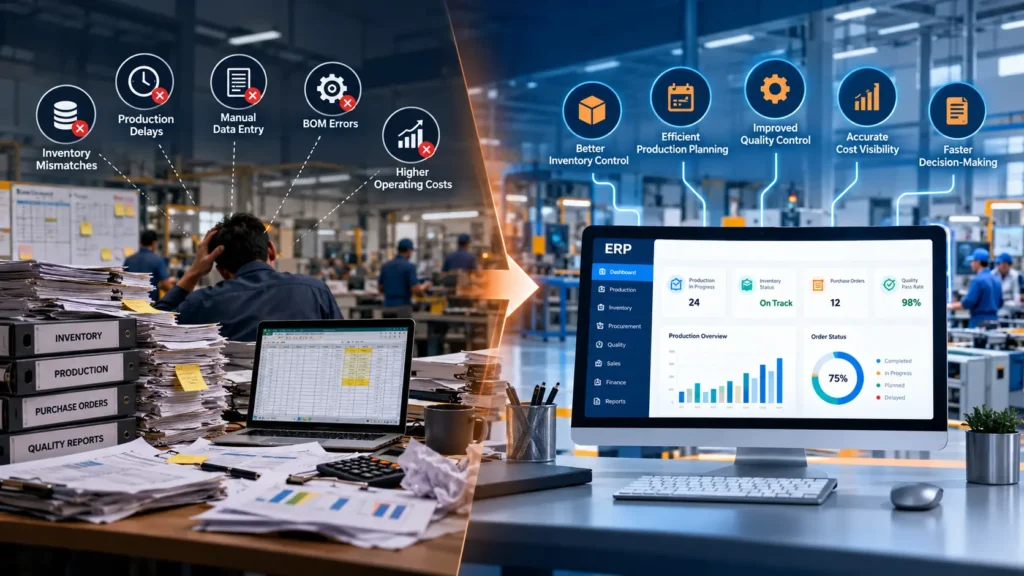
Manufacturing businesses often focus on visible expenses such as raw materials, labour, machinery, and transportation. However, many operational costs remain hidden within everyday processes. Manual data entry, disconnected spreadsheets, delayed inventory updates, production scheduling errors, and repetitive administrative tasks can gradually increase operating expenses and reduce overall productivity.
These challenges may not always appear as separate expenses in financial reports, but their impact can be significant. A small inventory discrepancy can lead to material shortages, while an outdated production schedule can cause delays, overtime costs, and missed delivery deadlines.
For manufacturers looking to improve operational efficiency, identifying these hidden costs is an important step towards sustainable growth. ERP software for manufacturers helps address these challenges by connecting production, inventory, procurement, quality control, and other essential business functions within a centralized system.
What Are Manual Manufacturing Processes?
Manual manufacturing processes involve managing operational activities through spreadsheets, paper records, standalone software, and repetitive human input instead of integrated digital workflows.
Although these methods may work for smaller operations, they often become difficult to manage as production volumes increase, product configurations become more complex, and businesses expand across multiple plants or warehouses.
Common examples include:
- Maintaining inventory records manually in spreadsheets.
- Preparing production schedules using disconnected files.
- Tracking raw materials and work-in-progress through paper documents.
- Updating bills of materials (BOMs) across multiple departments.
- Recording quality inspection results manually.
- Preparing purchase orders and production reports separately.
- Calculating production costs using information collected from different sources.
When these activities are not connected, employees spend more time managing information than improving operations. This creates inefficiencies that can affect productivity, profitability, and customer satisfaction.
7 Hidden Costs of Manual Manufacturing Processes
1. Excessive Labour Hours and Administrative Work
One of the most overlooked costs of manual manufacturing is the time employees spend on repetitive administrative tasks.
Production teams may manually update job sheets, inventory teams may reconcile stock records, and finance teams may repeatedly enter the same information into different systems. Managers must then collect these records to prepare reports and review operational performance.
These tasks consume valuable working hours that could otherwise be spent on production planning, quality improvement, and process optimization.
How ERP helps: ERP software automates routine data entry and connects information across departments. When a production order is updated, relevant inventory and operational records can be updated through integrated workflows, reducing duplicate work and improving data consistency.
2. Inventory Mismatches and Unexpected Material Shortages
Accurate inventory information is essential for maintaining uninterrupted production. However, manually maintained stock records can become outdated when materials are issued, received, transferred, or consumed without timely updates.
This can create two costly situations. Manufacturers may purchase materials they already have in stock, tying up working capital in excess inventory. Alternatively, they may discover shortages only when production is about to begin.
Both situations affect efficiency and increase operating costs.
How ERP helps: An integrated inventory management system provides better visibility into stock levels, material movements, warehouse locations, and consumption. Manufacturers can establish reorder levels, monitor material availability, and coordinate procurement with actual production requirements.
3. Production Delays and Poor Resource Utilization
Production schedules depend on several connected factors, including material availability, machine capacity, workforce availability, order priorities, and delivery deadlines.
When planners rely on separate spreadsheets or manual updates, changes in one area may not be reflected immediately in others. A delayed material delivery, for example, can disrupt multiple production orders.
The consequences may include idle machinery, overtime expenses, missed dispatch schedules, and underutilized employees.
How ERP helps: ERP systems connect production planning with inventory, procurement, and order management. This gives production managers a clearer view of available resources and potential constraints, helping them adjust schedules and allocate resources more effectively.
4. Errors Caused by Outdated Bills of Materials
A bill of materials specifies the components, quantities, and materials required to manufacture a product. When BOM revisions are managed manually, production teams may unintentionally use outdated specifications.
This is particularly risky for electronics, automotive, aerospace, and precision engineering manufacturers, where engineering changes can affect material requirements, production instructions, and quality standards.
An incorrect BOM can result in wasted materials, rework, rejected products, and delayed orders.
How ERP helps: ERP software can centralize BOM information, maintain revision histories, and connect approved changes with production planning and material requirements. With appropriate access controls and change approval workflows, manufacturers can reduce the risk of using outdated specifications.
5. Quality Issues, Rework, and Material Waste
Quality problems become more expensive when manufacturers identify them late in the production cycle.
If inspection records are maintained on paper or stored in disconnected files, it can be difficult to identify recurring defects, trace affected batches, or determine where a production issue originated.
This may lead to repeated inspections, additional labour, material waste, customer complaints, and product returns.
How ERP helps: ERP systems can integrate quality checks into production workflows, record inspection results, and link quality issues to relevant materials, suppliers, batches, and production orders. Where traceability and quality management features are configured, teams can investigate problems faster and take corrective action earlier.
6. Limited Visibility into Actual Production Costs
A product’s actual manufacturing cost involves more than raw materials. It may include labour, machine usage, overheads, scrap, rework, and other operational expenses.
When cost information is spread across spreadsheets and separate applications, calculating the true cost of a production order becomes time-consuming and potentially inaccurate.
As a result, management may struggle to identify unprofitable products, understand cost overruns, or make informed pricing decisions.
How ERP helps: ERP software connects relevant purchasing, inventory, production, and financial data to support more consistent production costing and variance analysis. Managers can compare planned costs with actual costs and investigate where expenses are increasing.
7. Delayed Decision-Making and Missed Delivery Commitments
Manufacturing decisions depend on accurate, timely information. If managers must wait for departments to submit spreadsheets and manually consolidate reports, important decisions may be delayed.
A sales team might promise a delivery date without reliable production capacity information. A procurement team might not know that a critical component is running low. Management might discover declining production efficiency only after reviewing month-end reports.
These delays can affect customer relationships, operational planning, and revenue opportunities.
How ERP helps: ERP provides a shared operational information base and reporting capabilities that help managers monitor production status, inventory availability, purchasing activity, and order progress. This supports faster decisions based on more consistent data.
How ERP Software for Manufacturers Reduces Hidden Operational Costs
The real value of ERP lies in connecting business processes that would otherwise operate independently.
Centralized Data Management
Maintains consistent information across departments, reducing duplicate records, manual reconciliation, and data discrepancies.
Automated Operational Workflows
Reduces repetitive administrative work through integrated processes for purchase orders, production orders, stock movements, and approvals.
Improved Inventory and Material Planning
Helps align purchasing, stock availability, and production requirements to reduce avoidable shortages and excess inventory.
Real-Time Operational Reporting
Gives management better visibility into production progress, resource utilization, quality performance, and cost variations.
Better Quality and Traceability
Connects inspection records, material batches, supplier details, and production history to support investigations and corrective actions.
The exact benefits depend on the ERP system, implementation quality, data accuracy, employee adoption, and the workflows configured for the business.
Manual Processes vs. ERP-Driven Manufacturing
| Operational area | Manual approach | ERP-driven approach |
|---|---|---|
| Inventory | Periodic spreadsheet updates | Integrated stock tracking |
| Production planning | Separate schedules and manual coordination | Connected planning and order information |
| Procurement | Purchases based on manually collected data | Better visibility into material requirements |
| BOM management | Risk of conflicting document versions | Controlled revisions and change workflows |
| Quality control | Paper-based or disconnected inspection records | Linked quality records and traceability |
| Cost tracking | Manual data consolidation | Integrated cost information and variance analysis |
| Reporting | Time-consuming report preparation | Centralized dashboards and reports |
ERP does not eliminate every operational problem automatically. However, a properly configured system can reduce the manual effort required to coordinate these activities and help manufacturers identify problems earlier.
How to Calculate the Hidden Cost of Manual Manufacturing
Before investing in an ERP system, manufacturers should estimate how much their current processes cost.
Start by evaluating these five areas:
- Administrative time: Calculate the hours employees spend entering data, reconciling spreadsheets, and preparing reports.
- Inventory losses: Review the financial impact of excess stock, obsolete materials, stock discrepancies, and emergency purchases.
- Production inefficiencies: Measure idle machine time, unplanned overtime, production delays, and missed schedules.
- Quality-related expenses: Track scrap, rework, rejected products, repeat inspections, and warranty-related costs.
- Delivery and coordination issues: Review expedited shipping expenses, order delays, and the time required to resolve cross-department problems.
For example, if a manufacturer spends 100 employee-hours every month on repetitive administrative work, the annual time commitment is 1,200 hours. This is a measurable operational burden, even before accounting for inventory losses or production delays.
The potential savings from ERP should be calculated using realistic assumptions rather than guaranteed percentage improvements.
A useful starting formula is:
Annual net benefit = Annual measurable cost savings − Annualized ERP ownership costs
ERP ownership costs should include implementation, software subscriptions or licences, training, integrations, data migration, and ongoing support. This provides a more practical basis for evaluating return on investment.
When Should a Manufacturer Consider ERP Implementation?
Manual systems may be sufficient when operations are simple and production volumes are low. However, certain warning signs indicate that existing processes may no longer support business growth.
Consider evaluating ERP software for manufacturers if your business:
- Operates multiple production lines, warehouses, or manufacturing facilities.
- Frequently experiences material shortages despite maintaining inventory records.
- Struggles to coordinate engineering changes and BOM revisions.
- Has difficulty tracking work-in-progress across production stages.
- Relies heavily on Excel sheets for production planning and cost calculations.
- Finds it difficult to trace materials, batches, or finished products.
- Cannot quickly compare planned production costs with actual expenses.
- Spends excessive time preparing operational reports for management.
These signs do not necessarily mean that every existing system must be replaced. A structured ERP gap assessment can help identify which processes need automation, better integration, or more effective controls.
Why Custom ERP Software Can Make a Difference
Every manufacturing business has different operational requirements. An automotive component supplier may prioritize serial-number traceability and supplier quality, while an electronics manufacturer may need tighter BOM revision control and component availability planning.
A standard ERP package may address many common requirements, but businesses with specialized production workflows may need additional configuration, integrations, or custom development.
Custom ERP software can be designed around specific manufacturing processes, approval requirements, reporting needs, and quality standards. The objective is not simply to digitize existing manual tasks but to create connected workflows that support the way the business operates.
Manufacturers should evaluate ERP solutions based on their current process gaps, future growth plans, integration requirements, reporting needs, and total cost of ownership.
Conclusion
The hidden costs of manual manufacturing processes often accumulate through small inefficiencies: repeated data entry, inaccurate inventory records, production delays, BOM errors, quality problems, and limited cost visibility.
Individually, these issues may appear manageable. Together, they can affect productivity, profitability, and the ability to meet customer commitments.
ERP software for manufacturers helps address these challenges by connecting critical business functions, automating routine workflows, improving traceability, and giving decision-makers more reliable operational information.
For manufacturers planning to scale, the first step is to identify where manual processes create the greatest financial and operational impact. Once these gaps are understood, the right ERP strategy can help build a more efficient, controlled, and scalable manufacturing operation.
Identify Your Manufacturing ERP Gaps with Jurysoft
Jurysoft helps manufacturing businesses evaluate operational challenges and explore ERP solutions aligned with their workflows. From production planning and inventory management to quality control and traceability, the goal is to improve process visibility and strengthen operational control.
If your team is still relying on disconnected spreadsheets, manual reports, or repetitive data entry, it may be time to assess where your current processes are creating unnecessary costs.
Book a Free ERP Gap Audit with Jurysoft to identify process gaps and explore opportunities to improve manufacturing efficiency.Book Your Free ERP Gap Audit