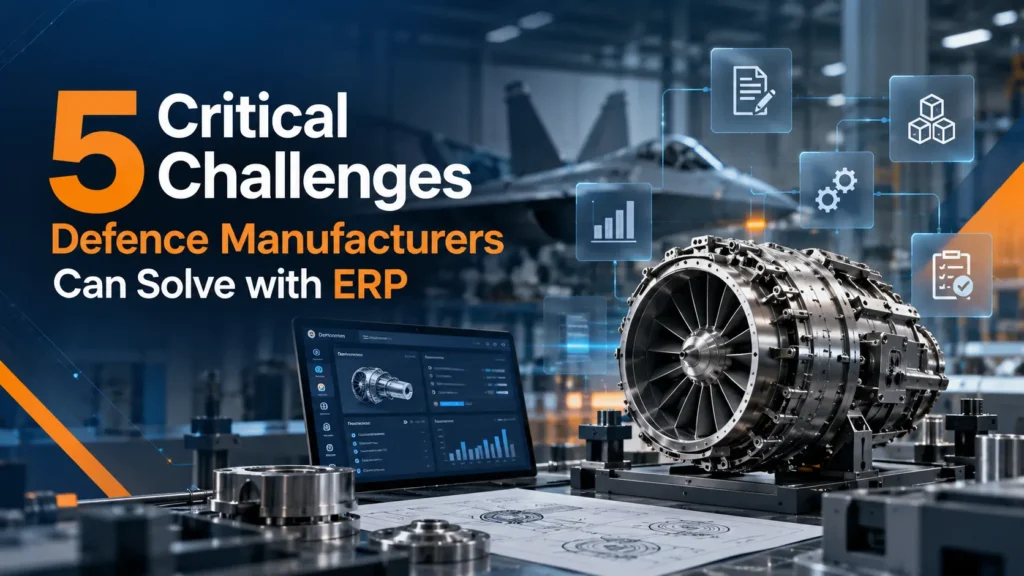
Defence component manufacturing requires precise production control, reliable quality management, accurate material tracking, and well-organized technical documentation. Every component may need to be linked to its raw material batch, supplier records, manufacturing history, inspection results, and approved engineering specifications.
However, when these processes are managed through disconnected software, spreadsheets, and manual records, maintaining visibility across the manufacturing lifecycle becomes difficult.
A defence manufacturing ERP system can help connect these operational processes, giving manufacturers better control over production, quality, materials, and traceability.
For defence component manufacturers and aerospace suppliers, the right ERP solution should do more than manage inventory and production orders. It should support the specific workflows, documentation requirements, and traceability needs of the business.
Here are five critical challenges that defence manufacturers should evaluate when reviewing their ERP systems.
1. Component Traceability Across the Manufacturing Lifecycle
Traceability is a fundamental requirement for manufacturers producing components for demanding industrial applications. When a quality issue occurs, teams may need to identify the material batch used, the supplier involved, the manufacturing operations performed, and the inspections completed.
Without connected records, retrieving this information can require searching through multiple systems and manually matching documents.
A manufacturing ERP with integrated traceability capabilities can connect:
- Raw material batches and supplier information
- Material test certificates and incoming inspection records
- Production orders and machining history
- Component serial numbers and batch references
- In-process inspection results and final quality records
For example, if an inspection identifies a dimensional deviation in a finished component, quality engineers should be able to trace the component back to its material batch and relevant production and inspection history.
How ERP helps: A well-configured system establishes relationships between materials, production activities, and quality records, making traceability investigations more structured and efficient.
2. Quality Management and Non-Conformance Tracking
Defence component manufacturing often involves multiple inspection stages, defined acceptance criteria, and detailed quality records. Managing these activities separately can make it difficult to identify recurring problems or determine whether corrective actions have been completed.
Common challenges include missing inspection records, delayed non-conformance reporting, inconsistent quality checkpoints, and limited visibility into recurring defects.
An ERP solution designed around manufacturing quality workflows can help organizations:
- Define inspection checkpoints for relevant production stages
- Record inspection measurements and acceptance results
- Link non-conformance reports to components and production orders
- Assign corrective actions and monitor their status
- Maintain records of quality reviews and approvals
Consider a component that fails an inspection during machining. The quality team needs to record the deviation, identify affected production, document the investigation, and track the required corrective action.
When these activities are connected within the ERP workflow, teams can follow the issue from identification through resolution.
How ERP helps: Integrated quality management supports more consistent inspection processes, clearer accountability, and improved visibility into product quality.
3. Engineering Revision and Change Control
Manufacturing teams rely on accurate drawings, bills of materials (BOMs), process instructions, and engineering specifications. When revisions are not communicated properly, production may continue using outdated information.
This can lead to rework, material waste, incorrect component configurations, and delays while engineering and production teams investigate discrepancies.
The problem becomes more complex when multiple orders are in progress or different departments maintain separate copies of technical documents.
A custom manufacturing ERP can support revision management by helping teams:
- Maintain controlled versions of relevant drawings and BOMs
- Record engineering change requests and approvals
- Link approved revisions to applicable production orders
- Restrict access to obsolete or superseded documents through appropriate controls
- Maintain revision histories for review and investigation
For example, when an engineering change modifies a component specification, the organization needs a clear process for reviewing the change, approving the revised documentation, and determining which production orders or materials are affected.
How ERP helps: Controlled revision workflows improve communication between engineering, procurement, production, and quality teams while reducing the risk of using incorrect documentation.
4. Material Availability and Supplier Documentation
Defence manufacturers may depend on specialized materials, qualified suppliers, and documentation that must be associated with incoming materials. A material shortage or missing supplier certificate can interrupt production even when the purchase order has been raised.
Common challenges include inaccurate stock information, unidentified material batches, incomplete supplier records, delayed incoming inspections, and poor visibility into material requirements.
An ERP system can connect procurement, inventory, supplier documentation, and production planning to help teams manage these dependencies.
Useful capabilities include:
- Supplier and purchase order management
- Material receipt and batch identification
- Incoming inspection workflows
- Material certificate and document association
- Inventory availability checks against production requirements
- Alerts for shortages and pending inspection activities
Suppose a production order requires a specific material grade, but the available stock has not completed incoming inspection. The system should help distinguish available stock from material that is awaiting approval, subject to the configured inventory and quality rules.
How ERP helps: Connecting procurement, inventory, and production requirements gives teams better visibility into material readiness and helps them identify potential supply interruptions earlier.
5. Audit Readiness and Controlled Documentation
Defence manufacturing operations can involve extensive documentation, including inspection reports, material certificates, engineering revisions, production records, approvals, and corrective action reports.
When records are distributed across spreadsheets, email attachments, shared folders, and paper files, preparing for an internal review or external audit can consume significant time.
Teams may struggle to establish which document applies to a particular component, whether the required approval was completed, or where supporting inspection evidence is stored.
A manufacturing ERP can help organize these records by connecting documentation to the relevant business transaction or manufacturing activity.
Depending on the system configuration, this may include:
- Controlled document storage and revision history
- Links between components, material batches, and production orders
- Inspection evidence and quality approval records
- Non-conformance and corrective action histories
- Access controls and approval workflows
- Searchable records for internal investigations and reviews
For instance, when a quality manager needs to investigate a completed production order, connected records can help retrieve the relevant material, process, inspection, and approval history.
How ERP helps: Structured documentation and linked records can make information retrieval more consistent and support audit preparation.
An important distinction is that ERP software alone does not guarantee certification or regulatory compliance. Compliance depends on applicable requirements, documented procedures, system configuration, implementation, and how the organization operates and maintains its processes.
How Defence Manufacturing ERP Connects the Entire Process
The greatest value of ERP comes from connecting these activities instead of treating them as isolated functions.
A well-designed workflow may follow this sequence:
Supplier Documentation → Material Batch Identification → Production Order → Manufacturing Process Records → Inspection and Quality Checks → Non-Conformance Management → Final Quality Review → Traceability Records
Each stage contributes information to the overall manufacturing history.
For example, material identification connects incoming stock to supplier documentation. The production order links the material to manufacturing operations. Inspection records document the results of quality checks, while non-conformance workflows capture issues and their resolution.
Together, these relationships help authorized teams understand the history of a component and retrieve relevant information when required.
The precise workflow should be designed around the manufacturer’s products, existing systems, customer requirements, and applicable quality procedures.
Why Custom ERP Matters for Defence Component Manufacturers
Standard ERP software may provide essential functions for finance, inventory, procurement, and production. However, some defence component manufacturers require additional workflows for serial-level traceability, batch genealogy, inspection checkpoints, engineering revisions, specialized approvals, and technical documentation.
A custom ERP approach can help align the software with these operational requirements instead of forcing every process into a generic workflow.
Before selecting or upgrading a system, manufacturers should evaluate:
- Can a finished component be traced to its raw material and supplier records?
- Are inspection results linked to the relevant production orders?
- Can production teams identify and use the correct approved revisions?
- Can material availability be checked against quality status and production needs?
- Can authorized users retrieve the complete manufacturing history of a component?
- Do the workflows support the organization’s documented quality and compliance processes?
These questions help identify gaps between the capabilities of the existing system and the actual needs of the factory.
How Jurysoft Helps Defence Manufacturers Improve Operational Visibility
Jurysoft provides custom ERP and manufacturing technology solutions designed around business-specific operational requirements.
For defence component manufacturers, a carefully designed ERP and traceability solution can help connect material records, production activities, quality workflows, engineering documentation, and inspection history.
Rather than treating traceability as a standalone reporting function, the objective is to connect relevant information throughout the manufacturing process.
The starting point is to evaluate the existing systems, identify gaps, and determine which workflows need better integration, automation, or control.
Conclusion
Defence manufacturing requires coordination across materials, production, engineering, quality, and documentation. Disconnected systems can make it harder to trace components, control revisions, investigate quality issues, monitor material readiness, and retrieve records.
A manufacturing ERP designed around these workflows can help establish connected records and improve operational visibility across the production lifecycle.
For manufacturers looking to strengthen traceability and process control, an ERP gap assessment is a practical first step toward identifying the improvements that matter most.
Ready to evaluate your current ERP system?
Book a Free ERP Gap Audit with Jurysoft to identify potential gaps in traceability, quality management, material control, revision management, and production visibility.