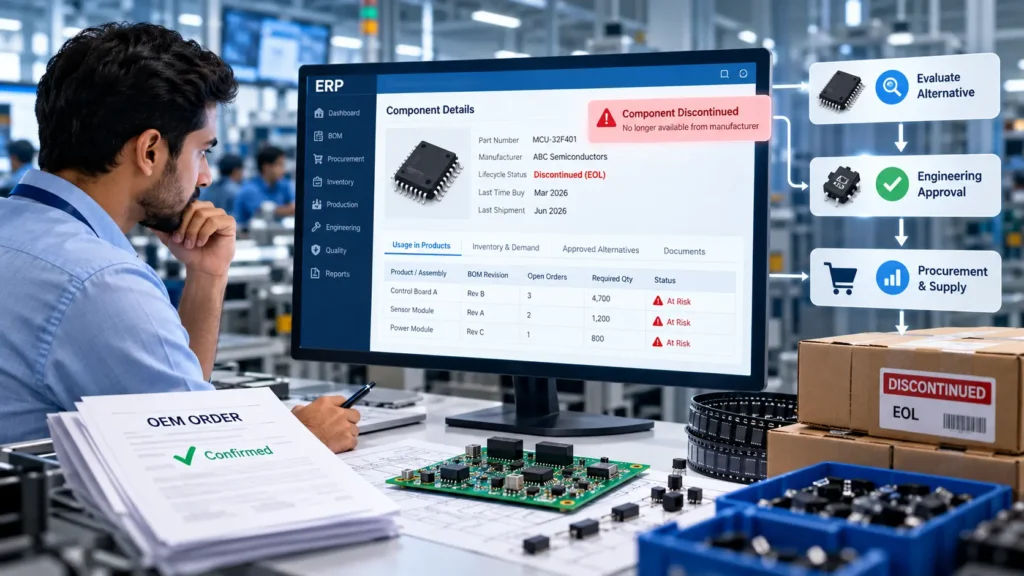
An OEM order is confirmed. The production schedule is prepared, the bill of materials (BOM) is approved, and procurement has already started purchasing electronic components. Everything appears to be on track until the purchasing team discovers that a critical component has been discontinued by the manufacturer.
The component may no longer be available from the original supplier, or the remaining stock may be insufficient to meet the order quantity. A replacement might exist, but it may require engineering approval, compatibility testing, or customer authorisation.
For electronics manufacturers, this is more than a procurement issue. A single obsolete resistor, microcontroller, connector, or power management IC can affect production schedules, product compliance, manufacturing costs, and customer delivery commitments.
This is where an electronics manufacturing ERP system can help manufacturers identify component lifecycle risks, evaluate alternatives, and coordinate decisions across procurement, engineering, inventory, and production.
Why Component Obsolescence Becomes a Manufacturing Problem
Electronic components have different lifecycle stages. A component may be active today but approaching its end-of-life (EOL) phase. Manufacturers may issue an end-of-life notice, stop accepting new orders, or gradually reduce supply before discontinuing the component entirely.
The problem becomes more serious when an OEM order has already been confirmed.
The production BOM may specify the exact component manufacturer and part number. Procurement may have already raised purchase orders, and production planners may have allocated inventory to several customer orders.
When that component becomes unavailable, the manufacturer must determine whether existing stock is sufficient, whether alternative components are acceptable, and how the change will affect delivery commitments.
Without connected systems, these decisions often depend on separate spreadsheets, email conversations, supplier updates, and manual inventory checks. This makes it difficult to understand the full impact before production is disrupted.
What Happens When an Approved Component Is Discontinued?
Production schedules may need to change
If the obsolete component is essential to a particular assembly, production cannot always proceed as planned. Other materials may already be available, but the assembly could remain incomplete until the missing component is sourced or approved for replacement.
Production planners may need to reschedule work orders, prioritise orders with available materials, or adjust machine utilisation.
The impact can extend beyond one order when multiple products depend on the same component.
Existing inventory may not cover confirmed demand
A component may still be available in the warehouse even after its manufacturer announces discontinuation. However, available stock must be compared with the actual demand across all open orders.
For example, a manufacturer has 4,000 units of a microcontroller in stock, while three confirmed OEM orders require 2,000, 1,500, and 1,200 units.
Total demand is 4,700 units, leaving a shortage of 700 units.
If the inventory team checks only the stock balance without considering allocated quantities and future production requirements, planners may discover the shortage too late.
An ERP system can connect inventory balances with BOM quantities, work orders, reservations, and open customer demand to help identify the shortfall earlier.
Replacement components require technical validation
A replacement component is not automatically interchangeable with the discontinued part.
Even when two components appear similar, differences in operating temperature, voltage tolerance, package dimensions, pin configuration, firmware compatibility, or electrical characteristics can affect the final product.
Engineering teams may need to evaluate the proposed alternative, conduct testing, update the BOM, and obtain customer approval where required.
Manufacturers also need to preserve revision history so that production teams know which component is approved for each product version and customer order.
An electronics manufacturing ERP system can support controlled BOM revisions and approval workflows, helping prevent unapproved substitutions from reaching the production line.
Procurement costs and delivery commitments may change
When a component becomes obsolete, manufacturers may need to purchase remaining stock from authorised distributors, use an approved alternative, or evaluate a redesign.
Each option can affect cost and lead time.
Buying last-time-buy inventory may protect future production, but excessive purchasing can tie up working capital and create the risk of unused stock. Purchasing from an unfamiliar source may introduce authenticity and quality concerns.
The purchasing team must evaluate price, availability, supplier reliability, minimum order quantities, and delivery timelines against the OEM’s requirements.
Connected procurement and production information helps teams make decisions based on actual demand instead of purchasing components without understanding their wider impact.
How Electronics Manufacturing ERP Helps Manage Component Obsolescence
Monitor component lifecycle information
Manufacturers need visibility into which components are approaching end-of-life, which suppliers have issued discontinuation notices, and which products depend on those parts.
An ERP system can maintain component master records, supplier information, approved part details, and procurement history. Where lifecycle information is available through supplier feeds or external integrations, it can help teams identify potential risks earlier.
This gives procurement and engineering teams more time to evaluate alternatives before the shortage affects production.
Identify affected products and OEM orders
A discontinued component may be used across multiple products, assemblies, and customer orders.
ERP-linked BOM records help manufacturers identify where the component is used, which work orders require it, and which confirmed deliveries could be affected.
This visibility allows planners to assess the impact before changing schedules or reallocating stock.
Coordinate approved substitutions
Component replacement requires collaboration between procurement, engineering, quality, and production.
A controlled workflow can document the proposed alternative, technical evaluation, test results, approval status, and effective BOM revision.
Once approved, the updated information can be communicated to the relevant production and purchasing teams. This reduces the risk of one department working with outdated component specifications.
Recalculate material requirements
After confirming the available inventory and the approved replacement options, planners need to understand how much material is still required and when it must arrive.
ERP-based material planning can compare component availability against demand from open OEM orders and planned production. It can also help teams evaluate revised purchasing requirements and production schedules.
This supports more informed decisions about order prioritisation, stock allocation, and delivery commitments.
Maintain traceability and revision control
When a component is replaced, manufacturers must know which version was used in each production batch or finished product.
This becomes particularly important for electronics supplied to automotive, aerospace, defence, medical, and other regulated or quality-sensitive industries.
Depending on the ERP configuration and connected manufacturing systems, records can link BOM revisions, component batches, supplier information, inspection results, and production orders.
These records support investigations, quality reviews, and customer enquiries when component changes occur.
Practical Example: An OEM Order at Risk
Consider an electronics manufacturer producing 2,000 control boards for an OEM customer. After the order is confirmed, the supplier announces that a microcontroller used in the approved BOM is being discontinued.
The manufacturer has enough stock to build only 1,200 boards.
Without integrated planning, procurement may begin searching for replacements while production continues consuming the remaining stock. Engineering may evaluate an alternative without knowing which orders depend on the original component. The customer may receive a delivery update only after the schedule has already slipped.
With a suitably configured electronics manufacturing ERP system, the team can identify the shortage against the confirmed order, review other demand for the same component, and evaluate approved alternatives.
Engineering can validate the proposed replacement, quality can review the relevant requirements, and procurement can assess supplier availability and lead time. Production planners can then revise the material plan and schedule based on the approved decision.
ERP does not eliminate component obsolescence, but it can improve visibility, coordination, and response time when a critical part becomes unavailable.
Best Practices for Preventing Component Obsolescence Disruptions
Electronics manufacturers should treat component lifecycle management as an ongoing operational activity rather than a task that begins after a supplier announces discontinuation.
Maintain accurate manufacturer part numbers and approved alternates in component master records. Review lifecycle notices for components used in high-volume or long-term OEM products. Identify components shared across multiple BOMs, and assess the effect of a potential shortage on all open orders.
Define a controlled approval process for component substitutions, including testing and customer authorisation where necessary. Evaluate last-time-buy decisions using realistic demand forecasts, product lifecycle expectations, and inventory carrying costs.
Finally, connect engineering, procurement, inventory, quality, and production information so that changes in component availability can be evaluated against actual manufacturing commitments.
Conclusion
When a component becomes obsolete after an OEM order is confirmed, the consequences can extend far beyond a single purchase order. Manufacturers may face material shortages, production rescheduling, additional procurement costs, engineering changes, and missed delivery commitments.
An electronics manufacturing ERP system helps bring component data, BOM revisions, inventory, procurement, and production planning into a more connected workflow. This enables teams to identify affected orders, evaluate approved alternatives, and make informed decisions before a component shortage becomes a larger manufacturing problem.
For electronics OEMs, the goal is not simply to find another component. It is to protect product quality, maintain traceability, control costs, and fulfil customer commitments despite changing component availability.
Is your electronics manufacturing operation prepared for component lifecycle changes? Evaluate how your current systems handle BOM revisions, component shortages, approved substitutions, and production planning to identify where better coordination could reduce risk.