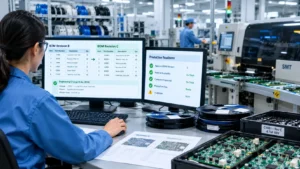
When a manufacturer grows from one plant to several, inventory rarely grows in a coordinated way. Each location builds its own routines, its own spreadsheets and sometimes its own software. The result is a business that holds plenty of stock overall but cannot see where that stock actually is.
The symptoms are familiar. One plant sits on excess raw material while another halts a line for want of the same component. Purchasing teams order items that already exist in a sister warehouse. Warehouse teams chase transfers by phone and email, and production managers learn about shortages only when a work order reaches the shop floor.
Spreadsheets, manual reporting and separate systems make it hard to keep stock information consistent across locations. By the time data is consolidated, it is already out of date.
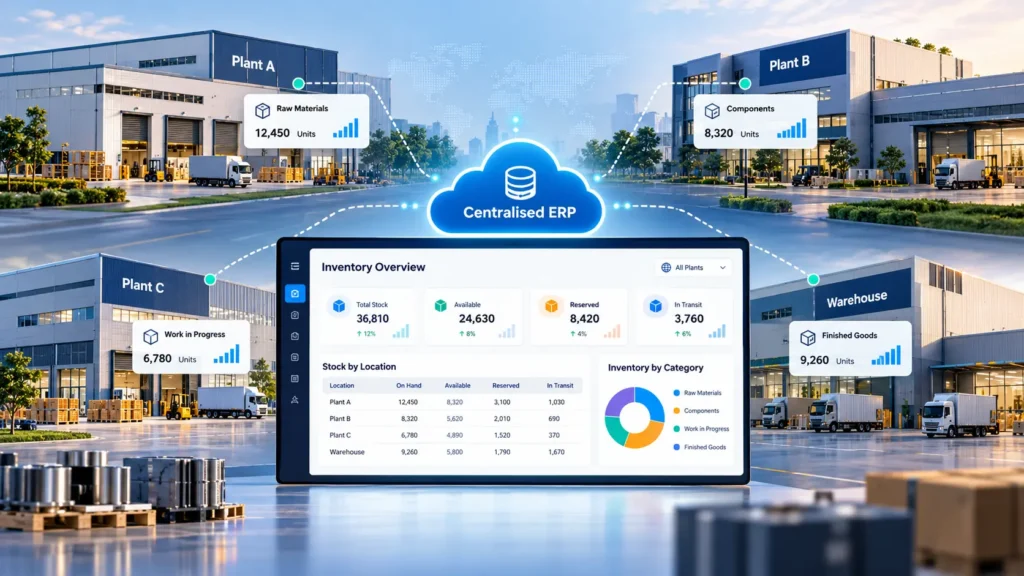
A centralised manufacturing ERP addresses this by connecting warehouse inventory, procurement, stock transfers and production planning in one system. The lesson of this case study is simple: inventory visibility across multiple plants requires more than accurate stock records. It requires connected information that supports timely operational decisions.
Company Background: A Manufacturer Operating Across Multiple Locations
The manufacturer in this scenario produces [product category, e.g. engineered components] for [industries served]. It operates [number] manufacturing plants and [number] warehouses, managing roughly [number] active items across raw materials, purchased components, semi-finished goods and finished products.
Inventory activity involves several departments: stores and warehouse teams handle receipts and issues, procurement manages suppliers and replenishment, production planning schedules work orders, and finance reviews inventory valuation. Dispatch and sales teams depend on finished goods availability.
As the business expanded, each location developed its own practices. One plant tracked stock in spreadsheets, another used a standalone inventory package, and a third relied heavily on paper registers reconciled weekly. Item codes and descriptions differed between sites, so the same bearing or fastener could appear under three names.
These separate records worked adequately when each plant operated independently. As plants began sharing materials and supplying one another, the limitations became costly. Nobody could answer a basic question quickly: how much of this component do we hold across the whole company, and how much of it is actually free to use?
The Challenge: Why Stock Visibility Broke Down Between Plants
Fragmented Inventory Records
Each plant kept its own stock records. Managers could not easily total the quantity of a component across all locations, and any consolidated view required collecting files from each site.
Duplicate Purchasing
Procurement sometimes ordered materials already available at another warehouse. This raised purchasing cost and added to inventory holding requirements while usable stock sat idle elsewhere.
Inaccurate Stock Balances
Delayed transaction updates, manual data entry and inconsistent item codes created gaps between recorded and physical stock. Teams learned not to trust the numbers and began keeping private buffers.
Slow Inter-Plant Stock Transfers
When one plant needed material held at another, employees relied on calls, emails and informal approvals. The requesting team often could not tell whether material had been approved, dispatched or was simply forgotten.
Production Delays Caused by Material Shortages
Planners lacked reliable information on available and reserved materials. Shortages surfaced late, sometimes after production orders were released.
Together these problems affected inventory carrying cost, production schedules, purchasing decisions and delivery commitments. Customers experienced the impact as missed or rescheduled dates, even though the company held the necessary materials somewhere in its network.
The Turning Point: Why the Manufacturer Needed Centralised ERP
The company first tried to fix the problem with better spreadsheets and additional reports. These efforts improved individual sites but could not solve the underlying issue: data was entered separately, coded differently and reconciled after the fact. More reports on top of disconnected records simply produced more disconnected numbers.
Leadership concluded it needed a single system that gave a consistent view of stock across plants, warehouses and storage locations. The key requirements were:
- A unified inventory dashboard across all locations
- Standardised item codes and inventory records
- Real-time or transaction-based stock updates
- Visibility into available, reserved, blocked and in-transit quantities
- Structured inter-plant stock transfer workflows
- Integration between inventory, procurement and production planning
- Role-based access and transaction history
- Reliable inventory reporting for management decisions
The company evaluated centralised manufacturing ERP solutions against these criteria. The objective was not to replace manual records with digital copies of the same records. It was to improve coordination between plants and give decision-makers information they could act on.
The ERP Solution: Creating a Unified Inventory System Across Plants
A. Centralised Inventory Dashboard
Authorised employees could view stock across all plants and warehouses from one interface. The dashboard separated physical stock from usable stock, reserved quantities, blocked inventory and materials in transit. This distinction matters: a warehouse may physically hold 500 units, but if 400 are reserved for confirmed production orders, the usable surplus is far smaller.
B. Standardised Item Master Data
A common item master introduced consistent item codes, descriptions, units of measurement and warehouse identifiers. Facilities that once used different internal names could now identify the same material reliably, which removed a major source of duplication and confusion.
C. Inter-Plant Stock Transfer Management
Transfers followed a structured flow: request creation, approval, dispatch, shipment tracking and receiving confirmation. Each step left a transaction record, improving accountability. The requesting plant could see whether material was available, dispatched or received without calling the supplying site.
D. Procurement Integration
Buyers could review inventory availability across locations before raising purchase requisitions. Reorder levels, safety stock, supplier lead times and demand requirements informed the decision. Transfers and purchases also accounted for reserved stock and the operational needs of the supplying plant, so one site’s shortage was not simply moved to another.
E. Production Planning Integration
Inventory data connected with bills of materials, production orders and material requirements planning. Planners could identify potential shortages earlier and arrange replenishment or inter-plant transfers before production was affected.
F. Inventory Audit Trail and Reporting
Goods receipts, material issues, transfers, adjustments and warehouse movements were all recorded. Transaction history and standardised reports helped management investigate discrepancies and monitor inventory performance without rebuilding the story from scattered files.
ERP Implementation: From Disconnected Records to Shared Inventory Data
The rollout followed practical stages.
Phase 1: Inventory audit and data cleansing. The team reviewed existing stock records, identified duplicate item codes, reconciled balances and standardised units of measurement.
Phase 2: Warehouse and plant configuration. Each facility was set up in the ERP system, including warehouses, storage locations, access permissions and stock transfer rules.
Phase 3: Data migration. Approved item records and opening balances were migrated and checked against physical inventory.
Phase 4: Workflow configuration and integration. Inventory transactions were connected with purchasing, production planning and warehouse operations.
Phase 5: Pilot testing and rollout. A pilot validated stock movements, transfer approvals, reporting and inventory updates before the system expanded to other facilities.
Phase 6: Training and monitoring. Warehouse staff, buyers and planners were trained on standardised processes, and early usage was monitored closely.
Several risks needed active management: inaccurate opening balances, inconsistent master data, resistance to new processes and continued reliance on old spreadsheets. Setting a firm cut-over date for retiring parallel records, and assigning data owners at each plant, helped address them.
The Results: Operational Improvements in Inventory Visibility
The clearest change after implementation was in how teams worked day to day. Before-and-after figures were not recorded for this scenario, so the improvements below are described qualitatively and no percentages are claimed.
Inventory accuracy. Standardised transactions replaced manual updates, so recorded stock followed physical movements more closely. When a count did not match, teams could trace the difference to a specific receipt, issue or transfer instead of searching through separate spreadsheets.
Less duplicate purchasing. Buyers could see usable stock at other facilities before raising a requisition. Surplus at one plant became a first option to consider, not an unknown.
Clearer, more orderly stock transfers. Requests, approvals, dispatches and receipts followed one workflow with a visible status. Requesting plants no longer had to call the supplying site to find out where material stood.
Earlier warning of shortages. With available, reserved and in-transit quantities visible, planners could spot a shortfall before a production order was released and arrange a transfer or replenishment in time.
Better warehouse coordination. Shared inventory information cut down on manual follow-ups, emails and phone calls between plant teams.
Simpler inventory reporting. Managers could view consolidated stock without waiting for each facility to send its own file.
If you are planning a similar rollout, record baseline measures before go-live, such as count variances, emergency purchases, transfer lead times and report preparation effort. Those baselines make it possible to report verified improvements later, and to separate the effect of the ERP from unrelated business changes.
An Example Workflow: Coordinating a Stock Transfer Between Two Plants
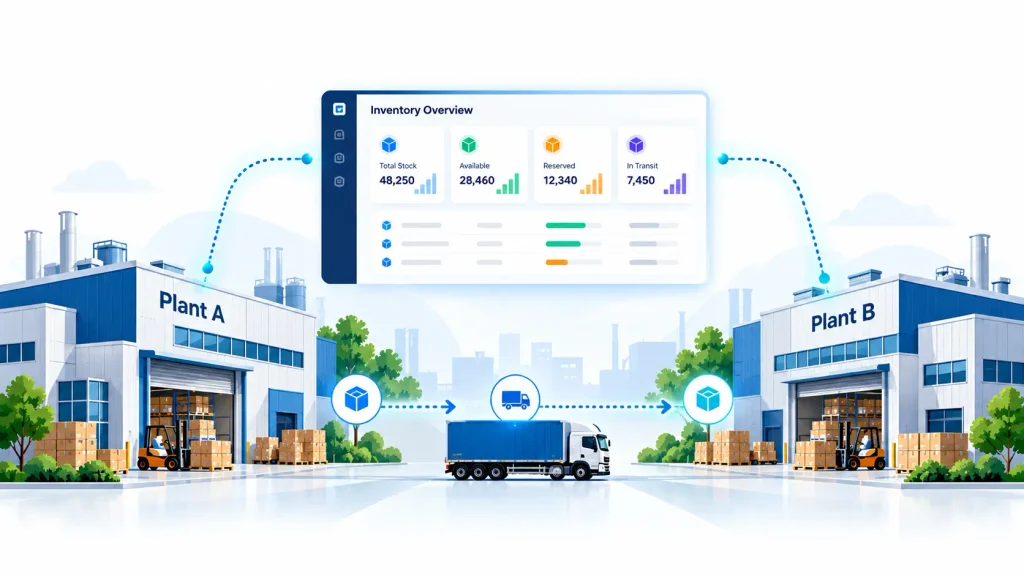
Plant A holds a quantity of a component that Plant B needs for an upcoming production order. Before centralised ERP, Plant B might have raised a new purchase request simply because its team could not see stock held elsewhere.
With centralised ERP, Plant B checks the component’s availability across all locations, including quantities already reserved for other requirements. Seeing that Plant A has usable surplus, the team raises a transfer request.
After approval, Plant A records the dispatch and the inventory status shows the material as in transit. When the component arrives, Plant B confirms receipt. The full transaction history lets both teams track the movement and keep records consistent.
The benefit is practical: less unnecessary purchasing, fewer phone calls and a clearer picture of material flow between plants.
Key Lessons for Manufacturers Managing Multiple Plants
- Standardise inventory data before implementing a centralised ERP system.
- Distinguish physical stock from available, reserved, blocked and in-transit quantities.
- Establish clear responsibilities for stock transfers and inventory adjustments.
- Connect inventory records with procurement and production planning.
- Maintain reliable transaction records across all locations.
- Train employees to follow standardised inventory workflows.
- Monitor inventory accuracy and system adoption after implementation.
- Review stock allocation rules so materials needed for confirmed production orders are not transferred away.
Centralised ERP delivers the most value when accurate data, clear processes and consistent employee adoption work together. Software alone does not fix inconsistent habits.
Conclusion: Improving Inventory Visibility Across Manufacturing Locations
For manufacturers running multiple plants and warehouses, connected inventory information is a operational necessity. A centralised manufacturing ERP can improve stock visibility, coordinate transfers, surface material shortages earlier, support better purchasing decisions and tie warehouse activity to production requirements.
Its effectiveness, however, depends on reliable data, well-designed workflows and consistent use across every location.
Managing multiple plants with disconnected inventory records? Explore Jurysoft’s manufacturing ERP solutions to identify opportunities to improve inventory visibility, stock transfer management and production coordination. Request a free ERP gap audit to assess your current processes and find areas for improvement