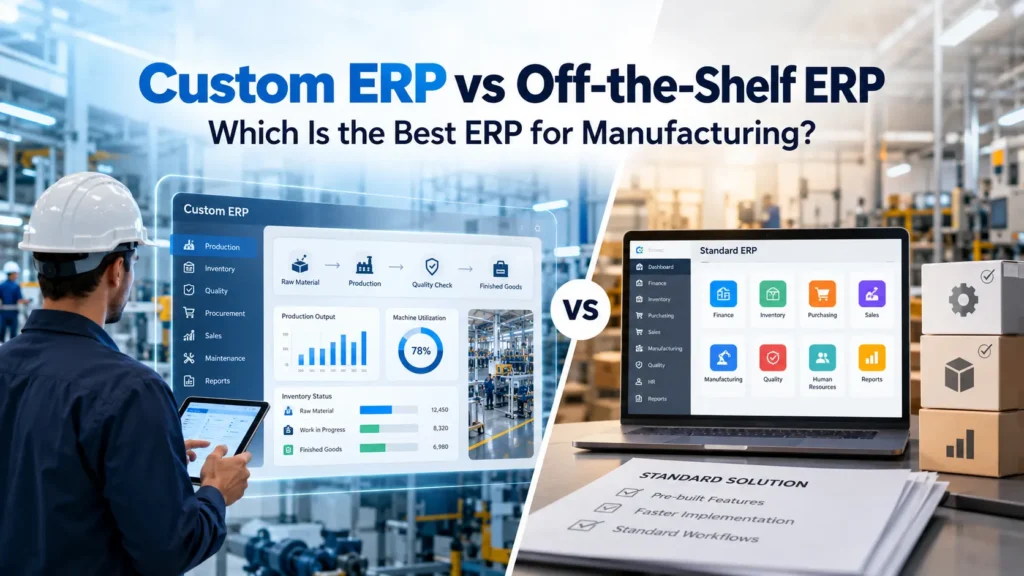
Choosing the best ERP for manufacturing is not simply about selecting the software with the most features. Manufacturing businesses have different production processes, inventory structures, quality requirements, reporting needs, and growth plans. An ERP that works well for one manufacturer may create unnecessary complexity for another.
Two common options are custom ERP and off-the-shelf ERP. Off-the-shelf systems provide pre-built functionality that can be implemented relatively quickly, while custom ERP solutions are designed around the specific processes and requirements of a business.
For manufacturing owners, CFOs, factory managers, and operations managers, the right choice depends on factors such as production complexity, operational workflows, scalability, integration requirements, implementation time, and total cost of ownership.
So, which one is the best ERP for manufacturing? The answer depends on how closely the ERP can support the way your manufacturing business actually operates.
What Is a Custom ERP?
A custom ERP is an enterprise resource planning system developed or configured specifically for a company’s business processes.
Instead of changing existing workflows to fit a software package, manufacturers can design the ERP around their operational requirements.
A custom manufacturing ERP can connect areas such as:
- Production planning
- Inventory and warehouse management
- Procurement
- Quality management
- Sales and order management
- BOM and material management
- Machine and production tracking
- Batch and lot traceability
- Supplier management
- Financial management
- Business intelligence and reporting
For example, a manufacturer with a complex production process may require specific approval workflows, quality checkpoints, production stages, or traceability requirements that are not available in a standard ERP without significant customization.
Custom ERP gives the business greater control over how these processes are managed.
What Is an Off-the-Shelf ERP?
An off-the-shelf ERP is a pre-built software solution designed to serve a broad range of businesses.
These platforms generally come with standard modules for common business functions, including:
- Finance and accounting
- Inventory
- Purchasing
- Sales
- Human resources
- Production
- Customer management
- Reporting
The major advantage is that many of the core capabilities are already developed and tested.
For manufacturers with relatively standard processes, an off-the-shelf ERP can provide a practical way to centralize operations without developing a system from scratch.
However, businesses may need to adapt some of their workflows to match the ERP’s existing structure.
Custom ERP vs Off-the-Shelf ERP for Manufacturing
The right choice becomes clearer when comparing the two approaches across important manufacturing requirements.
| Factor | Custom ERP | Off-the-Shelf ERP |
|---|---|---|
| Manufacturing workflows | Built around specific processes | Based on standard workflows |
| Production planning | Highly configurable | Usually pre-defined |
| Inventory management | Tailored to business requirements | Standard inventory functions |
| Quality management | Custom quality workflows possible | Standard QMS capabilities |
| Traceability | Can be designed for specific needs | Depends on available functionality |
| Integrations | Can be built for required systems | Depends on supported integrations |
| Scalability | Designed around future requirements | Depends on platform and plans |
| Implementation | Usually requires more planning | Generally faster |
| Initial investment | Potentially higher | Usually more predictable |
| Flexibility | Very high | Limited by platform capabilities |
1. Manufacturing Workflows
Manufacturing businesses rarely operate in exactly the same way.
One factory may manufacture products against customer orders, while another may operate through make-to-stock production. Some manufacturers may have multiple production stages, subcontracting processes, rework procedures, or complex approval requirements.
A custom ERP can be designed around these workflows.
Off-the-shelf ERP systems generally provide standard manufacturing workflows. They may offer configuration options, but there can be limits when a company’s processes are highly specialized.
Best approach: Custom ERP for highly specialized manufacturing workflows; off-the-shelf ERP for standardized operations.
2. Production Planning
Production planning directly affects capacity utilization, delivery schedules, material availability, and operational efficiency.
Manufacturers may need to consider:
- Machine capacity
- Workforce availability
- Raw material availability
- Production priorities
- Work orders
- Lead times
- Production stages
- Customer delivery schedules
An off-the-shelf ERP may already include production planning and scheduling capabilities. This can be sufficient for manufacturers with relatively straightforward requirements.
A custom ERP can go further by incorporating company-specific planning rules and workflows.
3. Inventory Management
Inventory is one of the most important areas of manufacturing ERP.
Businesses need visibility into raw materials, work-in-progress inventory, finished goods, rejected materials, safety stock, and warehouse movements.
Both custom and off-the-shelf ERP systems can support inventory management.
However, manufacturers with unique inventory structures, complex material movements, multiple warehouses, or specialized tracking requirements may benefit from a custom approach.
The key question is not simply whether an ERP has inventory management. It is whether it manages your inventory processes effectively.
4. Quality Management
Quality management is critical for manufacturers operating in industries where compliance, inspection, and documentation are essential.
An ERP may need to support:
- Incoming material inspection
- In-process quality checks
- Final inspection
- Non-conformance management
- Corrective actions
- Quality documentation
- Approval workflows
- Inspection records
Off-the-shelf ERP systems may provide standard quality modules.
A custom ERP can be designed around the company’s specific quality procedures and approval processes.
For manufacturers with complex quality requirements, this flexibility can become an important consideration.
5. Traceability
Traceability is particularly important in industries such as aerospace, automotive, electronics, medical devices, food manufacturing, and other regulated or quality-sensitive sectors.
Manufacturers may need to track:
Raw material → Batch/Lot → Production Order → Workstation → Quality Check → Finished Product → Customer
A custom ERP can be developed around the exact traceability structure required by the manufacturer.
Off-the-shelf ERP may also provide strong traceability features, but manufacturers should carefully evaluate whether those features match their specific requirements before investing.
6. Integrations
Modern manufacturing rarely operates through a single system.
An ERP may need to integrate with:
- Accounting software
- CRM platforms
- E-commerce systems
- Production machines
- IoT devices
- Barcode scanners
- Warehouse systems
- Supplier platforms
- Business intelligence tools
- Customer portals
Off-the-shelf ERP platforms often support popular integrations.
However, if a manufacturer uses proprietary systems or requires a specialized integration, custom ERP development can provide greater flexibility.
7. Scalability
Manufacturing businesses change as they grow.
A company may add:
- New production lines
- New warehouses
- New factories
- New products
- New suppliers
- New customers
- New geographical markets
The ERP should be able to support that growth.
Off-the-shelf ERP can be a good option when its roadmap and capabilities align with the company’s future plans.
Custom ERP can be designed with the company’s expected growth in mind, allowing additional modules, workflows, integrations, and automation to be introduced over time.
8. Implementation Time
Implementation speed is another major difference.
An off-the-shelf ERP usually has pre-built modules, processes, and configurations. This can make implementation faster, although implementation complexity still depends on the size and requirements of the organization.
Custom ERP typically requires more time because the system needs to be designed, developed, tested, and deployed according to the business requirements.
For a company that needs an ERP immediately and has relatively standard processes, an off-the-shelf solution may be more practical.
For a manufacturer planning a long-term digital transformation, additional development time may be justified if the resulting system provides a much better operational fit.
9. Total Cost of Ownership
ERP cost should not be evaluated only by looking at the initial software price.
Manufacturers should consider:
- Licensing
- Implementation
- Customization
- Integration
- Training
- Maintenance
- Upgrades
- Support
- Additional modules
- Infrastructure
- Future development
An off-the-shelf ERP may have a lower initial development requirement, but extensive customization can increase its long-term cost.
A custom ERP may require a higher initial investment, but it can provide a system specifically designed around the organization’s processes.
The right question is therefore:
Which ERP provides the best long-term value for the business?
Which Is the Best ERP for Manufacturing?
There is no single ERP that can be called the best ERP for manufacturing for every company.
The right choice depends on several factors.
Choose an off-the-shelf ERP when:
- Your manufacturing processes are relatively standard.
- You need faster implementation.
- Your budget is limited.
- Existing ERP features meet most of your requirements.
- You do not require extensive custom workflows.
- Your integration requirements are straightforward.
Consider a custom ERP when:
- Your manufacturing processes are highly specialized.
- Existing ERP systems require extensive customization.
- You need unique production workflows.
- Traceability is a major requirement.
- Your quality processes are complex.
- You require specialized integrations.
- You want greater control over future development.
- Your business has unique operational requirements.
The best ERP is ultimately the system that provides the right balance between functionality, flexibility, cost, scalability, and operational fit.
When Should Manufacturers Choose a Custom ERP?
A manufacturer should consider custom ERP development when standard software repeatedly forces the business to change how it works.
Some warning signs include:
- Employees depend heavily on spreadsheets.
- Multiple disconnected systems are being used.
- Production information is difficult to access.
- Managers lack real-time operational visibility.
- Quality data is managed manually.
- Traceability requires significant manual work.
- Existing ERP software requires expensive customization.
- Different departments maintain duplicate data.
- Management reporting takes too much time.
- Existing software cannot support future requirements.
In these situations, a custom ERP can become more than an internal software system. It can become the digital foundation for manufacturing operations.
How to Evaluate an ERP Before Investing
Before choosing an ERP, manufacturers should evaluate the software against their actual business requirements.
1. Map your current processes
Document how production, procurement, inventory, quality, sales, and finance currently operate.
2. Identify operational gaps
Find areas where employees rely on spreadsheets, manual approvals, duplicate data entry, or disconnected systems.
3. Define critical ERP requirements
Separate requirements into:
- Must-have
- Important
- Nice-to-have
4. Evaluate manufacturing capabilities
Check production planning, BOM management, inventory, quality, traceability, procurement, reporting, and workflow management.
5. Review integration requirements
Identify every system that needs to exchange information with the ERP.
6. Calculate total cost
Consider implementation, customization, training, maintenance, upgrades, integrations, and future development.
7. Consider future growth
The ERP should support the company’s expected products, production capacity, locations, customers, and operational complexity.
8. Request a practical demonstration
Instead of watching only a generic product demo, ask the ERP provider to demonstrate how the system would handle your actual manufacturing workflow.
Build an ERP Around Your Manufacturing Operations
For manufacturers with specialized processes, choosing between custom and off-the-shelf ERP is ultimately a strategic decision.
An off-the-shelf ERP can be an excellent choice when standard functionality meets the company’s requirements. A custom ERP can make more sense when manufacturing workflows, quality processes, traceability, integrations, or operational requirements demand greater flexibility.
The goal should not be to find the ERP with the longest feature list.
The goal is to find an ERP that fits the way your manufacturing business operates today and can support where it is going tomorrow.
Jurysoft ERP helps manufacturers build ERP solutions tailored to their production, inventory, quality, traceability, integration, and operational requirements. If your existing ERP is limiting your operations or you are planning a new manufacturing ERP, a customized approach can help create a system aligned with your actual business processes.
Ready to explore the right ERP approach for your manufacturing business? Connect with Jurysoft to discuss your requirements and identify the right ERP strategy for your business.