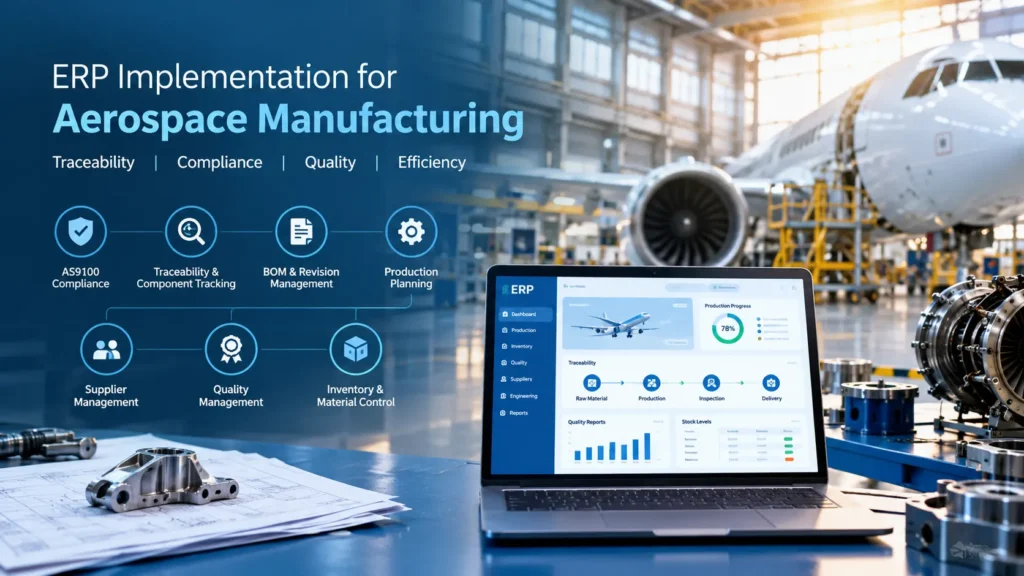
Aerospace manufacturing operates under strict requirements for quality, traceability, compliance, production control, and supplier management. From raw material procurement to final component delivery, every stage must be accurately documented and traceable.
An Aerospace ERP system helps manufacturers connect engineering, production, procurement, inventory, quality, finance, and supply chain operations through a centralized platform. With the right implementation strategy, an ERP for Aerospace Manufacturing can improve visibility, reduce production risks, strengthen compliance, and support scalable growth.
What Is Aerospace ERP?
An Aerospace ERP is an enterprise resource planning system designed to address the specialized requirements of aerospace manufacturers, component suppliers, MRO organizations, and defence-related manufacturers.
Unlike a generic ERP, an Aerospace Manufacturing ERP needs to support requirements such as:
- End-to-end component traceability
- Lot and serial number tracking
- BOM and revision management
- Quality inspection and non-conformance management
- AS9100-aligned quality processes
- Production planning and scheduling
- Supplier qualification and performance monitoring
- Material and inventory control
- Compliance documentation
- Cost and resource management
- Aerospace component tracking
The objective is to create a single source of operational data while maintaining the documentation and control expected in aerospace manufacturing.
Why Aerospace Manufacturers Need ERP Implementation
Aerospace production involves complex products, multiple manufacturing stages, strict quality standards, and long product lifecycles. A single aircraft component may pass through several suppliers, processes, inspections, and production operations before reaching the customer.
Managing these processes through spreadsheets, disconnected applications, and manual records can create several challenges:
- Difficulty tracking component history
- Duplicate or inconsistent data
- Delayed production information
- Manual quality documentation
- Inventory inaccuracies
- Difficulty managing engineering revisions
- Limited supplier visibility
- Delays in identifying quality issues
- Complicated compliance audits
An integrated ERP for Aerospace Manufacturing provides manufacturers with centralized control over these processes.
Key Features of an Aerospace ERP
1. End-to-End Traceability
Traceability is one of the most important requirements in aerospace manufacturing.
An ERP system should allow manufacturers to track materials and components throughout their lifecycle.
For example:
Raw Material → Supplier → Batch/Lot → Production Order → Machine/Operation → Inspection → Finished Component → Customer
The system can maintain information such as:
- Material batch numbers
- Heat numbers
- Lot numbers
- Serial numbers
- Supplier details
- Production orders
- Work orders
- Inspection results
- Operators
- Machines
- Process history
- Final customer information
This creates a digital history of each component and helps manufacturers quickly investigate quality issues or customer queries.
2. AS9100 Compliance Support
Aerospace organizations often operate under rigorous quality management requirements. AS9100 is a widely recognized quality management standard for the aerospace, aviation, and defence industries.
An ERP system does not automatically make an organization AS9100 certified. However, a properly configured ERP can support many of the processes required for an effective quality management system.
ERP functionality can support:
- Document control
- Revision management
- Inspection records
- Non-conformance management
- Corrective and preventive actions
- Supplier evaluation
- Quality records
- Audit documentation
- Training records
- Process monitoring
By keeping relevant information in a centralized system, organizations can improve consistency and audit readiness.
3. Bill of Materials and Engineering Revision Management
Aerospace products can contain hundreds or thousands of components, materials, and manufacturing operations.
Managing the Bill of Materials (BOM) accurately is therefore critical.
An Aerospace ERP can help manage:
- Multi-level BOMs
- Engineering revisions
- Component specifications
- Approved materials
- Manufacturing instructions
- Alternate components
- Effective dates
- Change history
- Engineering change orders
When an engineering revision is approved, the ERP can help ensure that production teams work with the correct version.
This reduces the risk of manufacturing components using outdated specifications.
4. Production Planning and Scheduling
Aerospace manufacturing frequently involves make-to-order, engineer-to-order, and complex production environments.
Production planning needs to consider:
- Machine availability
- Labour capacity
- Material availability
- Production lead times
- Work-center capacity
- Customer delivery schedules
- Quality requirements
- Manufacturing sequences
An Aerospace ERP can provide production planners with a centralized view of orders, materials, resources, and production capacity.
This allows manufacturers to identify potential bottlenecks earlier and make better scheduling decisions.
5. Quality Management
Quality management is central to aerospace manufacturing.
ERP systems can integrate quality activities directly into production workflows.
For example:
Purchase → Incoming Inspection → Production → In-Process Inspection → Final Inspection → Dispatch
Quality checkpoints can be configured at different stages.
The system can capture:
- Inspection plans
- Inspection measurements
- Acceptance criteria
- Test results
- Non-conformance reports
- Rework requirements
- Scrap information
- Corrective actions
- Final inspection approvals
This reduces dependence on disconnected quality records and improves visibility across production.
6. Aerospace Component Tracking
Aerospace components often require detailed lifecycle tracking.
An ERP system can maintain a digital record for each serialized component, including:
- Component identification
- Manufacturing date
- Material information
- Production order
- Supplier
- Inspection history
- Process history
- Revision information
- Quality status
- Shipment information
This information becomes particularly valuable when customers request documentation or when manufacturers need to investigate a quality problem.
7. Supplier Management
Aerospace manufacturers often depend on a network of specialized suppliers for materials, components, machining, coatings, testing, and other processes.
An ERP can help organizations manage:
- Approved supplier lists
- Purchase orders
- Supplier certifications
- Material certificates
- Supplier quality records
- Delivery performance
- Supplier non-conformances
- Inspection requirements
- Supplier performance
Manufacturers can use this information to identify suppliers that consistently meet quality, cost, and delivery expectations.
ERP Implementation Process for Aerospace Manufacturing
Implementing an Aerospace ERP should be treated as a business transformation project rather than simply a software installation.
Step 1: Analyze Existing Processes
Start by documenting current workflows across:
- Engineering
- Procurement
- Inventory
- Production
- Quality
- Maintenance
- Finance
- Sales
- Dispatch
Identify manual processes, duplicate data entry, disconnected systems, and major operational bottlenecks.
Step 2: Define Aerospace-Specific Requirements
The ERP should be evaluated against actual manufacturing requirements.
Important requirements may include:
- Lot tracking
- Serial number tracking
- Material traceability
- Revision control
- BOM management
- Quality inspections
- Non-conformance management
- Supplier quality
- Production scheduling
- Document management
- Compliance reporting
Avoid selecting an ERP solely because it offers a large number of generic features. The system must support the organization’s actual aerospace workflows.
Step 3: Configure the ERP
Once requirements are defined, the ERP can be configured around the organization’s processes.
This may include configuring:
- Item masters
- BOMs
- Work centers
- Routings
- Quality checkpoints
- Inspection plans
- Supplier workflows
- Approval processes
- Inventory locations
- Production workflows
- Reporting dashboards
For organizations with highly specialized requirements, custom ERP development or extensions may be necessary.
Step 4: Integrate Engineering and Production
One of the most important aspects of an Aerospace ERP Implementation is connecting engineering information with manufacturing execution.
Engineering changes should flow into production without creating confusion around revisions.
A connected workflow can look like:
Engineering Change → BOM Revision → Approval → Production Update → Quality Update → Manufacturing
This helps reduce errors caused by outdated information.
Step 5: Migrate Existing Data
Before going live, organizations need to determine which existing data should be migrated.
Typical data includes:
- Customer records
- Supplier records
- Material masters
- Product information
- BOMs
- Inventory
- Open purchase orders
- Open production orders
- Quality records
- Serial numbers
- Historical traceability data
Data should be cleaned and validated before migration.
Step 6: Test the System
Testing should use real aerospace manufacturing scenarios rather than only generic software tests.
For example:
Scenario 1: Receive a raw material batch and record its certificate.
Scenario 2: Use that batch in a production order.
Scenario 3: Record in-process inspection results.
Scenario 4: Assign a serial number to the finished component.
Scenario 5: Track the finished component back to the original material batch.
These scenarios help confirm that the ERP can provide the required end-to-end traceability.
Step 7: Train Employees
ERP implementation affects multiple departments.
Training should be role-specific.
For example:
Production teams: Work orders, operations, material consumption
Quality teams: Inspections, non-conformance, corrective actions
Procurement: Purchase orders, suppliers, material certificates
Warehouse: Receiving, stock movements, lot and serial tracking
Management: Dashboards, KPIs, production and financial reports
Effective training helps improve adoption and reduces resistance to the new system.
Common Aerospace ERP Implementation Challenges
Poor Data Quality
Incorrect item codes, duplicate materials, incomplete BOMs, and outdated supplier information can create problems during implementation.
Excessive Customization
Customizing every ERP process can make the system expensive and difficult to maintain.
Organizations should first determine whether existing ERP functionality can meet the requirement through configuration.
Lack of User Involvement
ERP projects can fail when the system is designed without sufficient input from production, quality, engineering, and procurement teams.
Inadequate Traceability Design
Traceability should be designed from the beginning rather than added after implementation.
The organization should define exactly what needs to be tracked and at which stages.
Poor Change Management
ERP implementation changes how employees work. Without proper communication and training, users may continue using spreadsheets or manual processes alongside the ERP.
Benefits of Aerospace Manufacturing ERP
A successful Aerospace ERP Implementation can provide several operational benefits.
Better Traceability
Manufacturers can track materials and components throughout the production lifecycle.
Improved Quality Control
Quality information becomes connected with production, procurement, and inventory.
Greater Production Visibility
Managers can monitor orders, production progress, capacity, and bottlenecks.
Improved Inventory Management
Lot and serial tracking provides better control over aerospace materials and components.
Faster Audits
Centralized records make it easier to retrieve relevant documentation and quality information.
Better Supplier Management
Supplier performance, certifications, purchase orders, and quality information can be managed centrally.
Reduced Manual Work
Automating repetitive processes can reduce spreadsheet dependency and duplicate data entry.
How to Choose the Right Aerospace ERP
Before selecting an ERP, aerospace manufacturers should evaluate the system against several factors:
- Traceability capabilities
- Quality management
- BOM and revision control
- Production planning
- Supplier management
- Lot and serial number tracking
- Compliance support
- Reporting and analytics
- Integration capabilities
- Scalability and customization
The right system should support today’s operations while providing enough flexibility for future growth.
The Future of Aerospace ERP
The next generation of aerospace ERP systems is moving beyond basic transaction management.
Technologies such as AI, automation, advanced analytics, IoT, and cloud computing can make ERP systems more intelligent.
AI-powered ERP solutions can potentially help manufacturers with:
- Production forecasting
- Demand prediction
- Inventory optimization
- Supplier risk analysis
- Predictive quality analysis
- Production scheduling
- Anomaly detection
- Automated reporting
IoT integration can also connect machines and production equipment with ERP systems, creating a more real-time view of manufacturing operations.
The result is a shift from simply recording manufacturing information to using operational data to support faster and more informed decisions.
Conclusion
Aerospace manufacturing requires much more than conventional enterprise resource planning. Manufacturers need accurate traceability, strong quality processes, controlled engineering data, reliable production planning, and detailed component tracking.
A properly implemented Aerospace ERP can connect these functions into a unified digital environment. By integrating engineering, procurement, inventory, production, quality, suppliers, and finance, manufacturers can improve operational visibility while building stronger processes for compliance and growth.
For organizations evaluating an ERP for Aerospace Manufacturing, the most important consideration is not simply the number of ERP features available. The system should be designed around the organization’s manufacturing processes, traceability requirements, quality objectives, and long-term business strategy.
With the right implementation approach, an Aerospace Manufacturing ERP can become a foundation for greater efficiency, improved quality, stronger traceability, and scalable aerospace production.