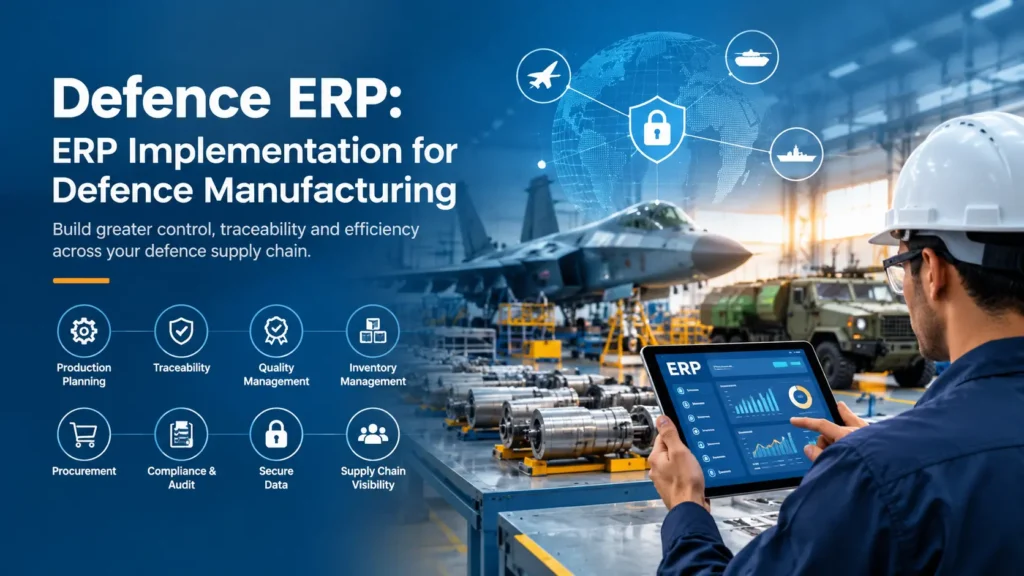
Defence manufacturing operates in an environment where precision, compliance, security, traceability, and operational efficiency are critical. Manufacturers involved in defence components, aerospace parts, electronics, weapons systems, vehicles, assemblies, and other defence equipment must manage complex production processes while meeting strict quality and regulatory requirements.
A well-designed Defence ERP system can bring production, procurement, inventory, quality, finance, supply chain, and compliance activities into a connected digital environment. Instead of managing critical information across spreadsheets, disconnected applications, and manual processes, manufacturers can use an integrated ERP for Defence Manufacturing to improve visibility and control across the entire organization.
What Is Defence ERP?
A Defence ERP is an enterprise resource planning system designed to address the specific operational and compliance requirements of defence manufacturers.
Traditional ERP platforms provide modules for finance, inventory, purchasing, production, and human resources. However, defence manufacturing often requires additional capabilities such as detailed product traceability, batch and serial number tracking, quality documentation, controlled access, compliance management, engineering change control, and secure information handling.
A specialized Defence Manufacturing ERP connects these processes so organizations can track materials and products from procurement through production, inspection, delivery, and after-sales support.
Why Defence Manufacturers Need Specialized ERP
Defence manufacturing involves complex supply chains and highly controlled production environments. A single product may contain hundreds or thousands of components sourced from multiple suppliers.
Without an integrated system, manufacturers may face challenges such as:
- Limited visibility into production status
- Difficulties tracking components and raw materials
- Manual quality documentation
- Inventory discrepancies
- Delays in procurement
- Poor coordination between departments
- Difficulty maintaining audit trails
- Engineering change management issues
- Compliance risks
- Data security concerns
A Defence ERP addresses these challenges by creating a centralized system where authorized users can access accurate operational information.
Key Requirements of ERP for Defence Manufacturing
1. Production Planning and Scheduling
Defence manufacturing often involves make-to-order production, complex assemblies, long production cycles, and strict delivery schedules.
An ERP system can help production teams plan:
- Production orders
- Work orders
- Bill of materials
- Routing
- Machine capacity
- Workforce requirements
- Material availability
- Production timelines
- Job status
Manufacturers can monitor production progress in real time and identify potential bottlenecks before they affect delivery schedules.
For organizations handling multiple defence projects simultaneously, centralized production planning helps allocate materials, machines, and resources more effectively.
2. End-to-End Traceability
Traceability is one of the most important requirements of defence manufacturing.
Manufacturers may need to identify where a particular component came from, which batch was used, who processed it, what inspection was performed, and where the finished product was delivered.
A Defence Manufacturing ERP can provide traceability across:
Supplier → Purchase Order → Raw Material → Batch/Serial Number → Production Order → Inspection → Finished Product → Customer
This creates a digital history for each product or component.
Serial number and batch tracking can also make it easier to investigate quality issues, conduct recalls, identify affected products, and support audits.
3. Quality Management
Quality requirements in defence manufacturing are significantly higher than in many conventional manufacturing environments.
ERP can integrate quality management into procurement, production, and delivery processes.
Important capabilities include:
- Incoming material inspection
- In-process inspection
- Final inspection
- Non-conformance management
- Corrective and preventive actions
- Quality certificates
- Inspection records
- Supplier quality management
- Test results
- Quality approvals
- Audit documentation
Instead of maintaining quality records separately, organizations can connect inspection information directly with materials, batches, production orders, and finished products.
4. Inventory Management
Defence manufacturers may manage thousands of components, raw materials, tools, spare parts, and specialized inventory items.
An ERP system can provide visibility into:
- Raw materials
- Work-in-progress inventory
- Finished goods
- Safety stock
- Reserved inventory
- Batch numbers
- Serial numbers
- Shelf-life information
- Warehouse locations
- Material consumption
- Stock movements
Real-time inventory visibility helps organizations reduce shortages, excess inventory, and unnecessary procurement.
5. Procurement and Supplier Management
Defence supply chains often involve multiple tiers of suppliers.
An ERP system can connect procurement activities from requirement generation to supplier selection, purchase order creation, material receipt, inspection, and payment.
Procurement teams can manage:
- Purchase requisitions
- RFQs
- Vendor quotations
- Purchase orders
- Supplier approvals
- Delivery schedules
- Material receipts
- Supplier performance
- Purchase history
- Quality records
Supplier performance data can help organizations identify reliable suppliers and address recurring delivery or quality issues.
6. Compliance and Audit Management
Defence manufacturers must often comply with industry standards, government regulations, contractual requirements, and customer-specific procedures.
ERP can support compliance by maintaining structured records and creating audit trails.
A system can track:
- Approvals
- User activities
- Document revisions
- Quality records
- Material history
- Production history
- Supplier information
- Engineering changes
- Inspection results
This makes it easier to demonstrate how processes were performed and who authorized specific activities.
ERP does not automatically make an organization compliant with every defence regulation. Instead, it provides the systems, controls, records, and workflows needed to support the organization’s compliance framework.
7. Secure Data and Role-Based Access
Security is particularly important when ERP systems handle sensitive manufacturing, engineering, supplier, or customer information.
A Defence ERP should provide role-based access so employees only access information required for their responsibilities.
For example:
Production Manager → Production planning and work orders
Quality Manager → Inspection and non-conformance records
Procurement Manager → Supplier and purchasing information
Finance Team → Financial transactions and costing
Management → Business dashboards and reports
Additional security capabilities may include authentication controls, access logs, approval workflows, encryption, backups, and audit trails.
The exact security architecture should be designed according to the organization’s classification requirements, contractual obligations, infrastructure, and applicable regulations.
Engineering Change Management
Defence products can undergo frequent engineering modifications.
A change to a component, material, specification, drawing, or manufacturing process can affect purchasing, production, inventory, quality, and documentation.
An ERP system integrated with engineering workflows can help organizations control:
- Engineering change requests
- Revision numbers
- BOM changes
- Drawing versions
- Approval workflows
- Effective dates
- Production impact
- Material impact
This reduces the risk of manufacturing products using outdated specifications.
Bill of Materials and Product Configuration
Defence products can contain highly complex multi-level assemblies.
For example:
Defence System → Major Assembly → Sub-Assembly → Component → Raw Material
ERP can maintain multi-level Bills of Materials and connect them with production orders and inventory.
This helps manufacturers understand exactly which materials and components are required for a particular production order.
Configuration management becomes particularly valuable when different customers or projects require customized product configurations.
Costing and Financial Control
Defence manufacturing projects can have long production cycles and complex cost structures.
ERP can help organizations track:
- Material costs
- Labour costs
- Machine costs
- Overhead costs
- Project costs
- Production variances
- Purchase costs
- Inventory valuation
- Work-in-progress
Management can compare planned costs against actual costs and identify areas where production expenses are increasing.
ERP Implementation Challenges in Defence Manufacturing
Implementing ERP in a defence manufacturing organization is not simply a software installation project.
Common challenges include:
Legacy Systems
Many manufacturers already use multiple systems for finance, production, inventory, quality, and engineering.
Integrating or replacing these systems requires careful planning.
Data Migration
Historical inventory, supplier, product, BOM, customer, and financial data must be reviewed and cleaned before migration.
Poor-quality master data can create problems after implementation.
Complex Workflows
Defence manufacturing workflows can involve multiple approvals and quality checkpoints.
The ERP must reflect real business processes rather than forcing teams into generic workflows.
Employee Adoption
Employees may be accustomed to spreadsheets or legacy systems.
Training, documentation, role-based onboarding, and change management are essential for successful adoption.
Security Requirements
ERP infrastructure and access controls must be designed according to the organization’s security requirements and applicable regulations.
A Practical ERP Implementation Roadmap for Defence Manufacturers
Step 1: Assess Current Processes
Document existing workflows across:
- Production
- Procurement
- Inventory
- Quality
- Finance
- Engineering
- Supply chain
Identify manual processes, bottlenecks, duplicate data, and reporting gaps.
Step 2: Define ERP Requirements
Create a detailed requirements document covering functional, technical, security, compliance, reporting, and integration requirements.
Prioritize critical requirements rather than attempting to implement every feature simultaneously.
Step 3: Design the ERP Architecture
Define how the ERP will interact with existing systems such as CAD/PLM, accounting software, warehouse systems, manufacturing equipment, customer portals, and other enterprise applications.
Step 4: Prepare Master Data
Clean and standardize:
- Item master
- Vendor master
- Customer master
- BOMs
- Routings
- Warehouses
- Units of measurement
- Product revisions
Good master data is fundamental to ERP success.
Step 5: Configure and Customize
Configure standard ERP capabilities first.
Custom development should be used where defence-specific processes genuinely require it. Excessive customization can increase implementation cost and make future upgrades more difficult.
Step 6: Integrate Quality and Traceability
Traceability and quality should not be treated as separate afterthoughts.
Connect material receipts, batch/serial numbers, production orders, inspections, non-conformances, and finished products into one traceability chain.
Step 7: Test the System
Conduct functional, integration, security, performance, and user acceptance testing.
Test real-world scenarios such as:
- New material procurement
- Material inspection
- Production order creation
- Component consumption
- Quality rejection
- Rework
- Engineering revision
- Finished product inspection
- Product dispatch
Step 8: Train Users
Provide role-specific training for production, quality, procurement, warehouse, finance, engineering, and management teams.
Step 9: Go Live in Phases
A phased implementation can reduce operational risk.
Organizations can begin with critical modules such as inventory, procurement, production, and quality before expanding into additional areas.
Step 10: Monitor and Improve
After implementation, monitor adoption, data quality, system performance, reporting accuracy, and business outcomes.
ERP implementation should be treated as an ongoing improvement program rather than a one-time technology project.
Benefits of Defence Manufacturing ERP
A properly implemented ERP can provide several measurable benefits:
Better Traceability: Track materials, components, batches, serial numbers, and finished products.
Improved Production Visibility: Monitor production status and identify bottlenecks.
Stronger Quality Control: Connect inspections and quality records directly to production.
Better Inventory Accuracy: Improve visibility into stock levels and material movements.
Faster Procurement: Automate purchasing workflows and improve supplier visibility.
Improved Compliance Readiness: Maintain structured records and audit trails.
Better Decision-Making: Give management access to real-time operational and financial information.
Improved Collaboration: Connect departments through a centralized platform.
How to Choose the Right Defence ERP
Before selecting an ERP platform, defence manufacturers should evaluate:
- Defence manufacturing experience
- Traceability capabilities
- Quality management
- Production planning
- Serial and batch tracking
- Supplier management
- Security architecture
- Role-based access
- Audit trails
- Engineering change management
- Integration capabilities
- Reporting and analytics
- Scalability
- Customization requirements
- Implementation support
The right solution should fit the organization’s manufacturing processes rather than simply offering a long list of software features.
Conclusion
Modern defence manufacturing requires more than basic inventory and accounting software. Manufacturers need connected systems that can manage production, procurement, quality, traceability, inventory, engineering changes, compliance records, and secure information.
A well-planned ERP for Defence Manufacturing provides a centralized operational foundation that can improve visibility, control, traceability, and decision-making across the organization.
However, successful ERP implementation for defence manufacturing depends on more than selecting software. Organizations need clear requirements, clean master data, secure architecture, well-designed workflows, employee training, effective testing, and continuous improvement.
For defence manufacturers looking to modernize their operations, a Defence Manufacturing ERP can become a strategic platform for improving operational efficiency while supporting the high standards of quality, traceability, and control expected across the defence industry.