The automotive manufacturing industry operates under constant pressure to deliver high-quality components, meet strict production schedules, control costs, and maintain accurate records. From vehicle manufacturers and automotive OEMs to Tier 1 and Tier 2 suppliers, every stage of production requires coordination between materials, machines, employees, suppliers, and quality teams.
However, when production planning, inventory management, purchasing, and quality control operate through disconnected systems or spreadsheets, manufacturers can struggle with delayed orders, inaccurate inventory records, inconsistent quality documentation, and limited visibility into factory operations.
Automotive ERP (Enterprise Resource Planning) helps manufacturers connect these activities through a unified software system. With the right solution, businesses can improve production visibility, strengthen component traceability, reduce operational inefficiencies, and make more informed decisions.
1. What Is Automotive ERP?
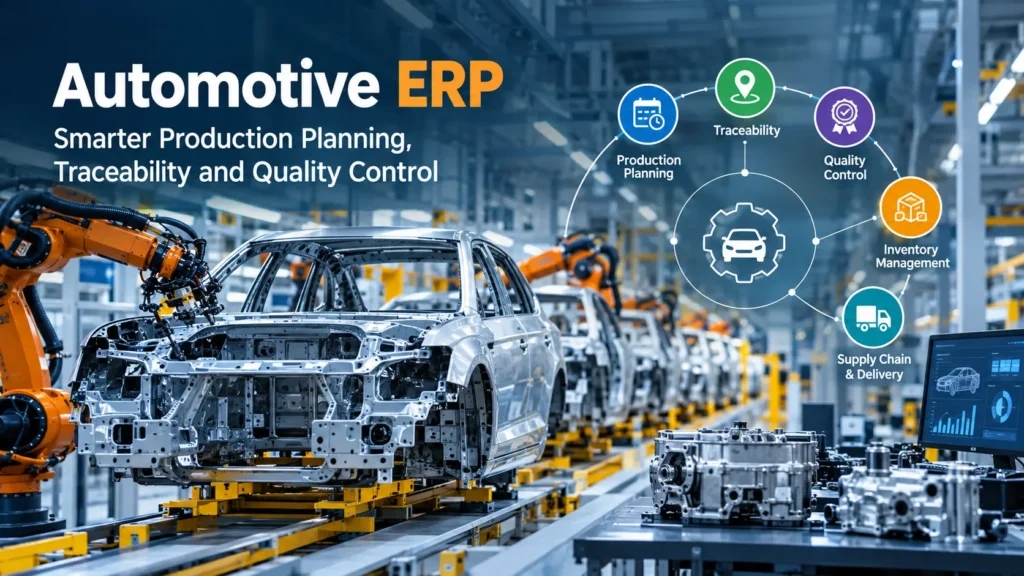
Automotive ERP is an integrated software solution designed to manage and coordinate essential automotive manufacturing operations. It connects production planning, procurement, inventory, quality management, order processing, costing, and reporting in one system.
Unlike disconnected applications that maintain separate records, an integrated platform allows departments to work with consistent operational data.
For example, when a manufacturer receives a new order for engine components, the system can help teams check material availability, assess production capacity, plan manufacturing activities, schedule inspections, and track order progress.
The exact capabilities depend on the software configuration and the manufacturer’s operational requirements.
2. Why Automotive Manufacturers Need an Integrated System
Automotive manufacturing involves complex production processes, multiple suppliers, detailed specifications, and demanding delivery schedules. Common operational challenges include:
Disconnected production data: Production teams may rely on spreadsheets while purchasing and inventory teams use separate applications. This makes it difficult to establish a reliable view of current operations.
Production scheduling difficulties: Last-minute order changes, machine breakdowns, and material shortages can disrupt production plans and affect delivery commitments.
Limited component traceability: Without consistent records, identifying the source, batch, or production history of a component can become time-consuming.
Quality management challenges: Inspection results, non-conformance reports, corrective actions, and quality documents may be scattered across multiple systems.
Inventory inaccuracies: Manufacturers may hold excess stock of slow-moving materials while facing shortages of critical components.
Unclear production costs: Material consumption, labour, machine usage, scrap, and rework can be difficult to consolidate when cost data is recorded separately.
An integrated automotive ERP system helps bring these activities together, providing better control over day-to-day manufacturing operations.
3. How Automotive ERP Improves Production Planning
Production planning is one of the most important activities in automotive manufacturing. A delay in one component can affect assembly schedules, customer deliveries, and the utilisation of production resources.
An automotive ERP solution can support production planning by connecting customer orders, bills of materials (BOMs), inventory availability, routing information, and machine capacity.
Better material planning
Manufacturers can compare production requirements with available raw materials and components. This helps purchasing teams identify shortages earlier and plan replenishment based on demand.
Improved production scheduling
Production planners can coordinate manufacturing orders, work centres, planned machine availability, and delivery deadlines. Depending on the system, finite-capacity scheduling and rescheduling tools can help evaluate the impact of changing priorities.
Faster response to order changes
When a customer changes a delivery date or order quantity, planners can assess the affected production orders, material requirements, and capacity constraints instead of manually checking several disconnected records.
Greater visibility into production progress
Shop-floor updates can help supervisors understand which jobs are completed, which are in progress, and which require attention.
The result is a more coordinated planning process that helps manufacturers respond to disruptions and make better use of available resources.
4. End-to-End Component Traceability
Traceability is essential for automotive manufacturers, particularly those supplying safety-critical or specification-sensitive components.
Manufacturers may need to identify where a component originated, which materials were used, which production processes it passed through, and whether it met the required inspection criteria.
An appropriately configured automotive ERP system can maintain traceability through:
- Raw material batch and lot numbers.
- Component serial numbers and production identifiers.
- Supplier and purchase receipt records.
- Manufacturing orders and process routing.
- Inspection results and non-conformance records.
- Rework, scrap, and corrective-action history.
- Dispatch records and customer order references.
For example, if a quality issue is identified in a batch of machined components, authorised personnel can use linked production and material records to identify the affected batch, review its manufacturing history, and determine which other orders or deliveries may require investigation.
This supports faster root-cause analysis and more targeted containment activities.
The traceability process must be designed around the manufacturer’s product, process, customer, and regulatory requirements. An ERP system supports the process, but accurate data capture and appropriate operating procedures remain essential.
5. Strengthening Quality Control in Automotive Manufacturing
Quality issues can lead to rework, scrap, customer complaints, production interruptions, and additional costs. Managing quality only through separate inspection sheets can make it difficult to connect a defect with its production history.
An integrated system can connect quality activities with purchasing, inventory, production, and dispatch.
Key capabilities may include:
Incoming material inspection: Record inspection results for raw materials and purchased components before they enter production.
In-process quality checks: Associate inspection requirements and measurements with relevant manufacturing operations.
Final inspection: Maintain evidence that products have passed the required checks before dispatch.
Non-conformance management: Record defects, classify issues, assign responsibility, and document corrective and preventive actions.
Quality reporting: Analyse recurring defects, scrap, rework, and supplier quality trends.
Automotive manufacturers may also require processes aligned with IATF 16949, customer-specific requirements, and applicable industry standards. Software should be configured to support these processes; implementing an ERP system alone does not guarantee compliance or certification.
6. Inventory and Supply Chain Management
Automotive production depends on the timely availability of raw materials, purchased parts, tooling, and consumables. Shortages can interrupt production, while excessive inventory ties up working capital and storage space.
An automotive ERP solution can connect inventory records with purchasing, production demand, supplier deliveries, and customer orders.
Important functions include:
- Real-time or near-real-time stock visibility, depending on data capture and integration.
- Lot-level inventory tracking and material movement history.
- Reorder planning and material requirement calculations.
- Purchase order and supplier delivery tracking.
- Warehouse transfers and stock reconciliation.
- Material allocation to production orders.
- Inventory valuation and consumption reporting.
When demand changes, purchasing teams can use updated requirements to review open purchase orders and replenishment plans. Production teams can also identify material shortages before they become immediate bottlenecks.
For suppliers operating under customer-specific delivery schedules or just-in-time arrangements, these capabilities can support better coordination across procurement, inventory, and production.
7. Connecting Production, Finance, and Operations
Automotive manufacturers need more than production visibility. They also need to understand how operational decisions affect profitability.
When production, inventory, purchasing, and finance share consistent records, managers can build a clearer picture of manufacturing costs and business performance.
An integrated system can help track:
- Planned versus actual material consumption.
- Labour and machine-related production costs.
- Scrap and rework expenses.
- Purchase costs and inventory valuation.
- Production order costs and variances.
- Customer orders, invoicing, and outstanding payments.
For example, repeated cost overruns on a particular component may indicate material price changes, excess scrap, inefficient routing, or higher-than-expected machine time. Connected operational data helps managers investigate these issues with greater context.
Dashboards and reports can also help leadership monitor order status, production performance, inventory exposure, and cost trends without waiting for separate departmental reports.
8. Custom Automotive ERP vs. Standard Software
Not every automotive manufacturer operates in the same way. A precision machining supplier, an electronics component producer, and a vehicle assembly facility can have very different requirements.
Standard ERP software may provide a suitable foundation for common business processes. However, manufacturers with specialised workflows may need additional configuration, integrations, or custom development.
A custom automotive ERP solution can be designed around requirements such as:
- Industry-specific manufacturing workflows.
- Specialised traceability and genealogy requirements.
- Customer-specific inspection and documentation processes.
- Complex production routing and scheduling.
- Integration with CNC machines, shop-floor systems, or quality equipment where technically supported.
- Existing accounting, warehouse, or business applications.
- Custom dashboards and operational reporting.
The decision should be based on process fit, implementation cost, scalability, integration requirements, ongoing support, and the total cost of ownership.
Customisation is not automatically the best choice for every business. The objective is to select a system that meets essential operational needs without introducing unnecessary complexity.
9. How to Implement Automotive ERP Successfully
A successful implementation starts with a clear understanding of current operations and the problems the manufacturer wants to solve.
Step 1: Map existing processes. Document how orders, materials, production, inspections, and dispatch currently work. Identify manual tasks, duplicated records, and operational bottlenecks.
Step 2: Define business requirements. Prioritise requirements such as production planning, batch traceability, quality management, inventory accuracy, and management reporting.
Step 3: Clean and validate data. Review item masters, BOMs, supplier details, inventory records, routing data, and customer information before migration.
Step 4: Plan integrations. Identify the systems, machines, or applications that must exchange data with the new platform.
Step 5: Pilot critical workflows. Test representative manufacturing orders, material movements, traceability scenarios, and quality processes before wider deployment.
Step 6: Train employees. Ensure that production planners, operators, quality inspectors, warehouse teams, and finance personnel understand their responsibilities within the new workflows.
Step 7: Monitor performance. Measure outcomes against a documented baseline and refine processes after deployment.
A phased implementation can help control risk, particularly when the factory cannot afford significant production disruption.
10. Measuring the Impact of Automotive ERP
Manufacturers should evaluate results using measurable operational indicators rather than relying only on software features.
Useful KPIs include:
| KPI | What it helps measure |
|---|---|
| On-time delivery | Ability to fulfil customer commitments |
| Schedule adherence | Actual production versus planned schedules |
| Inventory accuracy | Agreement between recorded and physical stock |
| Scrap and rework rate | Material losses and quality-related inefficiencies |
| Production cycle time | Time required to complete manufacturing |
| Traceability response time | Time needed to retrieve relevant component records |
| Supplier delivery performance | Reliability of incoming materials |
| Manufacturing cost variance | Difference between planned and actual costs |
Establish a baseline before implementation and compare results after sufficient operational data has accumulated. Targets should reflect the manufacturer’s starting point, product mix, and business priorities.
No specific improvement percentage should be assumed without measured evidence from the individual factory.
Conclusion: Build a More Connected Automotive Manufacturing Operation
Automotive manufacturers need reliable coordination between production planning, inventory, purchasing, quality, traceability, and finance. When these functions operate in disconnected systems, teams may spend valuable time reconciling data instead of addressing production problems.
An appropriately designed automotive ERP solution brings critical information and workflows together, helping manufacturers improve operational visibility, manage materials, maintain production records, and make better-informed decisions.
The right solution depends on the complexity of manufacturing processes, traceability requirements, existing technology, and long-term business goals.
Looking to improve production planning, quality management, or component traceability in your automotive manufacturing business?
Jurysoft helps businesses explore tailored ERP and software solutions aligned with their operational requirements.
Discuss your manufacturing requirements with Jurysoft: https://jurysoft.com/erp/
Contact the Jurysoft team to discuss your current challenges and explore an appropriate solution for your manufacturing operations.