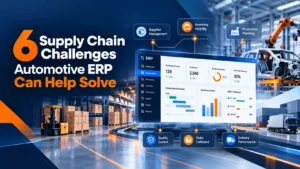
Automotive manufacturers operate in a demanding environment where production delays, material shortages, quality issues, and inaccurate inventory records can affect the entire supply chain. With multiple components moving through machining, assembly, inspection, and dispatch, managing operations through disconnected spreadsheets and standalone systems can become increasingly difficult.
This case study explores how a growing automotive components manufacturer could overcome these challenges by implementing a customized Enterprise Resource Planning (ERP) solution designed to connect production, inventory, quality management, and order tracking.
The Challenge: Disconnected Manufacturing Operations
Consider a mid-sized automotive parts manufacturer supplying precision-engineered components to multiple OEMs and Tier 1 suppliers. As customer orders increased, its existing processes struggled to keep pace with growing production requirements.
The production team relied on spreadsheets to schedule machine operations, while inventory records were maintained separately. Quality inspection results were documented independently, making it difficult to connect a finished component with its raw material batch and inspection history.
The company faced several operational challenges:
- Production scheduling delays: Frequent changes in customer orders disrupted machine schedules and delivery commitments.
- Inventory inaccuracies: Limited visibility into raw materials, work-in-progress, and finished goods led to unexpected shortages.
- Traceability gaps: Finding the production batch, material source, and inspection records for a specific component required manual effort.
- Quality management difficulties: Inspection failures and rework were not consistently connected to production records.
- Limited operational visibility: Management lacked a consolidated view of production progress, material consumption, and pending orders.
These challenges made it harder to maintain consistent quality, control operating costs, and meet customer delivery expectations.
The Solution: A Connected Manufacturing Management System
The manufacturer could address these issues through a customized ERP implementation that connects core manufacturing processes within a centralized platform.
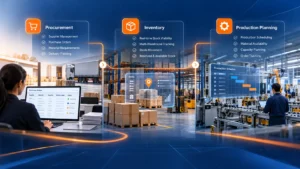
1. Production Planning and Scheduling
The system consolidates customer orders, available materials, machine capacity, and production priorities to support more practical production schedules.
When a customer changes an order quantity or delivery date, planners can review the impact on existing jobs and adjust schedules accordingly.
Expected operational benefit: Better visibility into production capacity, fewer scheduling conflicts, and more informed delivery commitments.
2. Real-Time Inventory Management
Inventory management connects raw materials, work-in-progress, and finished goods with production requirements.
Material movements are recorded as components move through different manufacturing stages. Reorder alerts help purchasing teams identify shortages before they interrupt production.
Expected operational benefit: Improved inventory accuracy, reduced material-related delays, and better control over excess stock.
3. End-to-End Component Traceability
Automotive suppliers often need to identify the origin and manufacturing history of individual components or batches.
The system can link material lot numbers, supplier details, work orders, machine operations, inspection results, and dispatch records. Barcode or QR-code scanning can make retrieving these records faster.
Expected operational benefit: Faster batch identification, more reliable audit preparation, and improved support for customer quality investigations.
4. Integrated Quality Management
Quality checkpoints can be incorporated into incoming material inspection, in-process inspection, and final product testing.
When a component fails inspection, the system can record the non-conformance, flag affected batches, assign corrective actions, and maintain a record of reinspection results.
Expected operational benefit: Better control over quality issues, improved documentation, and clearer visibility into rework and rejection trends.
5. Centralized Production Reporting
Dashboards bring key operational information together, including order status, machine utilization, production output, inventory levels, rejection rates, and delivery performance.
Managers can identify bottlenecks and take corrective action using current operational information instead of waiting for manually consolidated reports.
Expected operational benefit: Faster decision-making and improved coordination between production, procurement, quality, and dispatch teams.
Illustrative Results: What Could Change After Implementation?
The following figures demonstrate how performance improvements could be presented in a real automotive ERP case study. They are sample targets, not measured customer results.
| Performance indicator | Illustrative baseline | Illustrative target |
|---|---|---|
| On-time delivery | 78% | 93% |
| Inventory accuracy | 85% | 97% |
| Production planning time | 10 hours/week | 4 hours/week |
| Batch traceability retrieval | 3 hours | 15 minutes |
| Rework and rejection rate | 6% | 3.5% |
Actual outcomes depend on the manufacturer’s starting performance, implementation scope, data quality, employee adoption, and production processes.
Implementation Approach
A phased implementation can help minimize disruption to ongoing manufacturing operations.
Phase 1: Process assessment
Review current production workflows, inventory practices, quality checkpoints, customer requirements, and reporting gaps.
Phase 2: Solution configuration
Configure production planning, inventory management, quality controls, traceability, and dashboards around the manufacturer’s actual workflows.
Phase 3: Data migration and integration
Validate existing product, supplier, inventory, and production records. Integrate relevant accounting, machine-data, barcode, or other business systems where required.
Phase 4: Pilot and employee training
Test the solution with a selected product line or production unit. Train employees, resolve workflow issues, and verify that reports reflect operational reality.
Phase 5: Performance monitoring
Track agreed KPIs before and after deployment, gather user feedback, and improve workflows as the system expands across operations.
Key Takeaways for Automotive Manufacturers
An automotive ERP system is not simply a tool for storing business information. When properly designed and implemented, it can connect production planning, material availability, quality records, and customer orders into a more coordinated manufacturing process.
For manufacturers dealing with changing order schedules, complex component traceability requirements, inventory discrepancies, and quality documentation, a customized solution can help establish better operational control.
The most important step is to identify measurable business problems first and then configure the system around the processes that need improvement.
Looking to Improve Your Automotive Manufacturing Operations?
Jurysoft Global helps businesses explore customized enterprise software and manufacturing solutions aligned with their operational requirements.
Whether your priority is production scheduling, inventory visibility, component traceability, quality management, or integrated reporting, the right implementation should be built around your manufacturing workflows and business goals.
Ready to explore a solution for your factory?
Discuss your manufacturing requirements with the Jurysoft team. Explore Manufacturing ERP Solutions