The automotive industry is becoming increasingly complex, with manufacturers and suppliers managing thousands of components, multiple vendors, strict quality standards, changing customer demands, and tight delivery schedules. Managing these operations using spreadsheets and disconnected software can lead to production delays, inventory inaccuracies, quality issues, and rising operational costs.
Choosing the right software for automotive parts manufacturers helps businesses connect production, inventory, procurement, quality control, and order management in one system. For growing automotive businesses, an integrated solution can improve visibility across operations, support better decision-making, and help meet customer expectations.
In this guide, we explore the essential features of automotive manufacturing software, the benefits of integrated business management systems, and how to choose the right solution for your company.
Why Do Automotive Parts Manufacturers Need Specialized Software?
Automotive parts manufacturing involves multiple interconnected processes. A single component may require raw material procurement, machining, assembly, inspection, packaging, and delivery before reaching an original equipment manufacturer (OEM) or distributor.
Without a centralized system, teams may struggle to access accurate production data, track component batches, coordinate suppliers, and respond quickly to order changes.
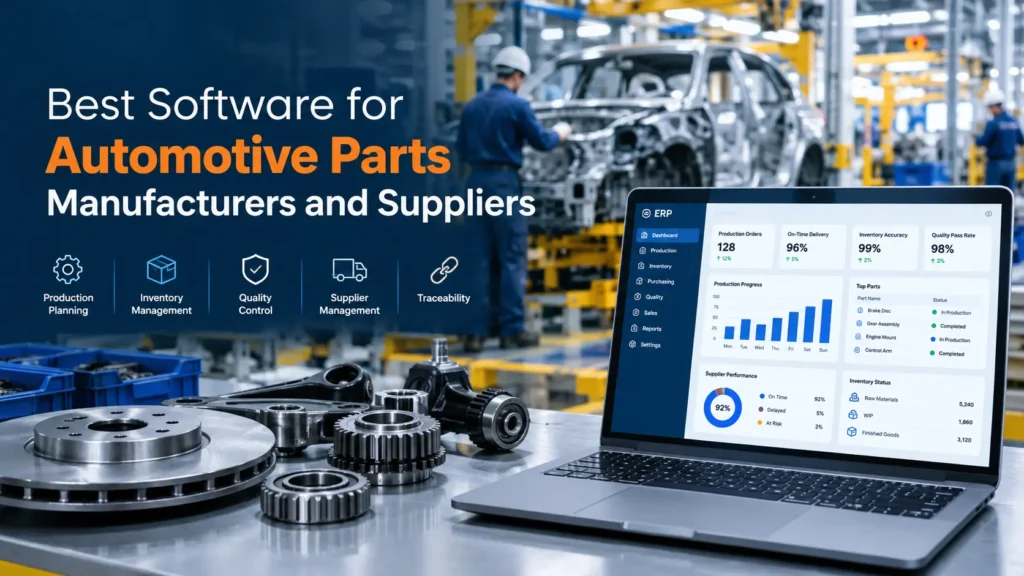
Specialized manufacturing software helps businesses address these challenges by providing:
- Production visibility: Monitor work orders, production schedules, machine utilization, and manufacturing progress.
- Inventory accuracy: Track raw materials, work-in-progress components, and finished goods.
- Quality management: Record inspection results, identify defects, and maintain quality documentation.
- Supplier coordination: Manage purchase orders, delivery schedules, and supplier performance.
- Cost control: Monitor material consumption, labor costs, production expenses, and order profitability.
- Traceability: Track components and materials across manufacturing and distribution processes.
The right solution connects these activities, reducing manual work and helping teams respond to operational changes more efficiently.
What Is the Best Software for Automotive Parts Manufacturers?
The best solution depends on your company’s size, production methods, supply chain complexity, and reporting requirements. Many automotive businesses evaluate enterprise resource planning (ERP) software because it integrates multiple business functions within a centralized platform.
An integrated system can connect production planning, procurement, inventory, finance, sales, and quality management rather than requiring teams to maintain separate records.
When comparing ERP for automotive operations, manufacturers should look beyond basic inventory and accounting features. The system should support the specific requirements of automotive component production and supplier management.
Essential Features to Look For
1. Production Planning and Scheduling
Automotive manufacturers must coordinate machines, labor, materials, and delivery deadlines. Production planning capabilities help managers schedule work orders, allocate resources, monitor progress, and adjust schedules when customer requirements change.
For example, when an OEM increases an order quantity, the system should help planners evaluate material availability, production capacity, and delivery commitments before confirming the revised schedule.
2. Inventory and Material Management
Automotive parts businesses frequently handle numerous components, raw materials, fasteners, packaging materials, and finished products.
Inventory management should provide real-time stock visibility, reorder alerts, warehouse tracking, and material movement records. Lot and batch tracking are particularly important when businesses need to identify affected components during a quality investigation.
3. Quality Management and Compliance
Quality is a critical requirement throughout the automotive supply chain. Manufacturers need processes for incoming material inspections, in-process checks, final inspections, nonconformance reporting, and corrective actions.
Depending on customer and certification requirements, software may also need to support documentation and processes aligned with standards such as IATF 16949 and applicable customer-specific requirements.
4. Bill of Materials and Routing Management
A bill of materials (BOM) identifies the materials and components required to manufacture a product. Routing defines the operations a component must pass through during production.
Managing BOMs and routings digitally helps manufacturers maintain consistent production instructions, calculate material requirements, and understand the operational steps associated with each part.
5. Procurement and Supplier Management
Automotive suppliers depend on reliable material availability and coordinated supplier deliveries. Procurement capabilities should support purchase requisitions, purchase orders, supplier records, delivery monitoring, and purchasing reports.
A connected system helps purchasing teams identify potential shortages earlier and coordinate with production planners before delays affect customer commitments.
6. Costing and Financial Reporting
Manufacturers need to understand the true cost of producing each component or product family. Software should help track material costs, labor, overheads, scrap, and other relevant manufacturing expenses.
These insights help management evaluate margins, identify cost variations, and make more informed pricing and production decisions.
7. Traceability and Recall Support
When a component fails inspection or a customer reports a defect, manufacturers need to identify the affected production batches and material lots quickly.
Traceability features help connect supplier materials, production records, inspection results, and finished goods. The level of traceability required will depend on the component, customer specifications, and applicable regulations.
How ERP for Automotive Suppliers Improves Supply Chain Operations
Automotive suppliers must coordinate their activities with OEMs, Tier 1 suppliers, Tier 2 suppliers, distributors, and other manufacturing partners. They may also need to manage frequent order updates, scheduled deliveries, customer-specific packaging, and strict quality documentation.
ERP for automotive suppliers helps connect these activities by bringing purchasing, production, inventory, sales orders, and delivery information into a common operational workflow.
Consider a supplier manufacturing precision-machined automotive components. The customer revises its delivery schedule while a critical raw material shipment is delayed.
With disconnected systems, the sales team may promise a delivery date without knowing the actual production capacity or available materials. With an integrated platform, teams can review stock levels, purchase order status, work orders, and production schedules before deciding how to respond.
Key benefits include:
- Better coordination between customer orders and production plans.
- Improved visibility into supplier deliveries and material shortages.
- More accurate delivery commitments.
- Reduced manual data entry and duplicated records.
- Faster access to production and quality information.
- Better coordination between manufacturing, purchasing, sales, and finance.
For automotive businesses working with multiple customers and suppliers, this connected approach can make daily operations easier to manage.
Choosing ERP for Parts Manufacturers
Not every manufacturing business has the same operational requirements. A company producing standardized fasteners may need a different configuration from a manufacturer producing complex assemblies, precision-machined components, or safety-critical automotive parts.
When evaluating ERP for parts manufacturers, consider the following factors.
1. Support for Your Manufacturing Process
Determine whether your business uses discrete manufacturing, repetitive production, machining, assembly, subcontracting, or a combination of processes.
The system should reflect your actual workflows rather than forcing employees to adapt to an unsuitable operating model.
2. Scalability and Customization
Your software should support increasing order volumes, additional product lines, new production facilities, and changing customer requirements.
Customization may be necessary when your business follows specialized approval workflows, traceability rules, costing methods, or customer-specific processes.
3. Integration Capabilities
Check whether the software can integrate with your existing accounting applications, CAD tools, warehouse systems, machine data platforms, and customer or supplier systems where required.
Integration reduces information silos and helps teams work with consistent data.
4. Reporting and Real-Time Visibility
Manufacturing leaders need actionable information about production output, machine downtime, inventory shortages, rejection rates, order status, and profitability.
Evaluate whether dashboards and reports can be configured around the metrics that matter most to your operations.
5. Implementation and Ongoing Support
Software selection is only one part of the process. Successful implementation also requires process mapping, data migration, employee training, testing, and ongoing support.
Evaluate the provider’s understanding of automotive manufacturing, implementation methodology, support arrangements, and ability to accommodate future requirements.
ERP vs. Disconnected Software: What Is the Difference?
Many automotive parts businesses start with spreadsheets, standalone accounting tools, and separate inventory applications. These tools may work initially, but managing growing production volumes becomes more challenging when information is spread across multiple systems.
| Business requirement | Disconnected tools | Integrated ERP system |
|---|---|---|
| Production planning | Manual coordination between teams | Connected planning and work orders |
| Inventory management | Separate records and frequent reconciliation | Centralized inventory visibility |
| Quality tracking | Records maintained across different files | Quality information linked to operations |
| Supplier management | Manual purchase order follow-ups | Connected purchasing and supplier records |
| Cost analysis | Data compiled from multiple sources | Integrated operational and financial reporting |
| Traceability | Time-consuming record collection | Linked material and production records, depending on configuration |
The actual benefits depend on the software’s capabilities, implementation quality, data accuracy, and how consistently employees use the system.
When Should You Consider Custom Automotive Manufacturing Software?
Standard software may cover most manufacturing requirements, but some businesses need additional functionality to support specialized production processes or customer expectations.
Custom software or a configurable ERP platform may be appropriate when your business requires:
- Industry-specific production workflows.
- Advanced component and batch traceability.
- Specialized quality inspection and approval processes.
- Complex BOM structures and production routing.
- Integration with existing manufacturing equipment.
- Customer-specific reporting and documentation.
- Multi-location inventory and production coordination.
The objective is not to customize every process unnecessarily. It is to identify genuine operational gaps and implement the functionality needed to address them.
How to Evaluate Software Before Implementation
Before selecting a solution, document your existing processes and prioritize the problems you want to solve.
Use the following checklist during software demonstrations:
- Can the system manage our products, BOMs, routings, and work orders?
- Can planners identify material shortages before production begins?
- Can we trace components and materials through the required production stages?
- Does it support our inspection, nonconformance, and corrective-action workflows?
- Can we monitor purchase orders, supplier deliveries, and customer commitments?
- Can management review production costs, scrap, and profitability?
- Does it integrate with our existing systems?
- Are implementation costs, timelines, training, and support clearly defined?
Ask potential providers to demonstrate real scenarios from your business rather than relying exclusively on standard product presentations.
Conclusion
Selecting the best software for automotive parts manufacturers requires a clear understanding of production workflows, supply chain challenges, quality requirements, and future growth plans.
An integrated ERP solution can help manufacturers coordinate production, manage inventory, improve supplier visibility, strengthen traceability, and make better-informed operational decisions. For automotive suppliers, it can also provide a clearer view of customer commitments, material availability, and delivery schedules.
The right system should fit your manufacturing processes, support your compliance and reporting needs, integrate with existing tools, and scale with your business.
Looking for a manufacturing management solution tailored to your automotive business? Explore Jurysoft’s automotive ERP solutions to learn how a customized approach can support production planning, inventory management, quality control, and supply chain operations.
Contact the Jurysoft team to discuss your requirements and identify the capabilities that best fit your manufacturing operations.