Digital transformation is no longer limited to adopting new technologies. For modern businesses, it means rethinking how operations are managed, how data is used, how teams collaborate, and how decisions are made.
As organizations grow, disconnected software, manual processes, spreadsheets, and isolated databases can make it difficult to maintain efficiency and visibility. This is where Enterprise Resource Planning (ERP) plays an important role.
An ERP system brings core business functions together on a unified platform, helping organizations streamline processes, centralize information, automate repetitive tasks, and make data-driven decisions. For businesses planning or undergoing digital transformation, ERP can serve as the foundation for building a more connected and scalable organization.
What Is Digital Transformation?
Digital transformation is the process of using digital technologies to improve business operations, customer experiences, decision-making, and overall business performance.
It can involve technologies such as:
- Cloud computing
- Artificial intelligence
- Business automation
- Data analytics
- Internet of Things (IoT)
- Mobile applications
- Customer relationship management
- Enterprise resource planning
However, implementing technology alone does not create digital transformation. Businesses also need to integrate their systems, improve processes, eliminate unnecessary manual work, and ensure that employees can access the information they need.
This is why ERP has become an important component of digital transformation strategies.
What Is ERP?
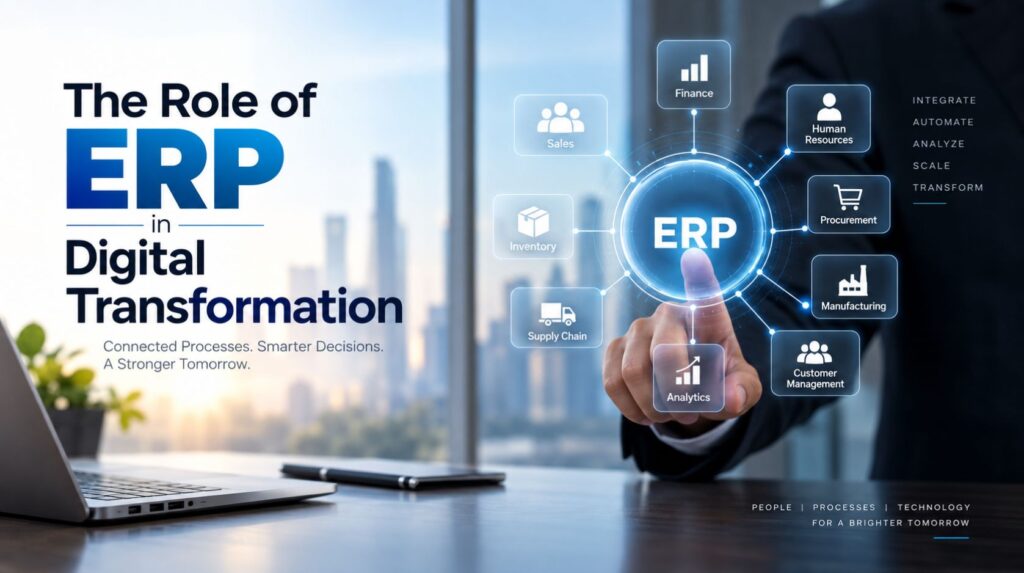
Enterprise Resource Planning is a business management system that connects different departments and processes through a centralized platform.
Depending on the organization’s requirements, an ERP system can manage areas such as:
- Finance and accounting
- Inventory management
- Procurement
- Sales
- Human resources
- Manufacturing
- Supply chain management
- Customer management
- Project management
- Reporting and analytics
Instead of relying on separate systems for each department, ERP allows businesses to create a connected digital environment where information can flow between different functions.
Why ERP Is Important for Digital Transformation
Digital transformation requires businesses to have reliable data, connected processes, and the ability to respond quickly to changing market conditions.
ERP supports these requirements by creating a centralized operational framework.
1. Connects Business Departments
One of the biggest challenges businesses face is fragmented information.
For example, the sales team may maintain customer information in one application, the finance team may use another system for invoices, and the warehouse may track inventory through spreadsheets.
This can result in duplicated data, communication gaps, and delays.
ERP connects these departments through a common system. When information is updated in one part of the organization, authorized users across other departments can access the relevant data.
This creates greater visibility across the organization and reduces information silos.
2. Automates Repetitive Processes
Manual processes can consume significant amounts of employee time and increase the possibility of errors.
ERP systems can automate many routine activities, including:
- Invoice generation
- Purchase order processing
- Inventory updates
- Payroll processes
- Approval workflows
- Financial reporting
- Order processing
Automation allows employees to spend less time on repetitive administrative tasks and more time on activities that require analysis, creativity, and decision-making.
3. Creates a Single Source of Truth
Data is one of the most valuable assets for a modern organization. However, data becomes difficult to use when it is stored across disconnected systems.
An ERP system can centralize important business information within a unified platform.
For example, management can potentially view sales, inventory, purchasing, expenses, and financial information from connected ERP modules rather than collecting reports manually from different departments.
This helps create a more consistent view of business performance.
4. Enables Data-Driven Decision Making
Digital transformation is closely connected with the ability to make faster and better decisions.
ERP systems can provide dashboards, reports, analytics, and real-time or near-real-time operational information, depending on the system architecture and configuration.
Business leaders can use this information to understand areas such as:
- Revenue performance
- Inventory levels
- Operating costs
- Purchase trends
- Sales performance
- Production efficiency
- Cash flow
- Employee productivity
Instead of relying entirely on assumptions or outdated spreadsheets, decision-makers can use centralized business data to support strategic planning.
5. Improves Operational Efficiency
ERP helps businesses standardize and optimize their workflows.
For example, a manufacturing company can connect procurement, inventory, production, sales, and finance processes. When these functions work together, organizations can reduce unnecessary duplication and improve coordination.
The result can be more efficient workflows and better utilization of business resources.
6. Supports Business Scalability
As businesses expand, their operational complexity increases.
A company may add new employees, products, warehouses, branches, customers, suppliers, or business processes. Systems that worked for a smaller organization may eventually become difficult to maintain.
A properly designed ERP solution can provide a scalable foundation for managing this growth.
Organizations can add modules, users, integrations, workflows, or locations based on their evolving requirements.
7. Strengthens Financial Management
Finance is one of the most important areas of digital transformation.
ERP can connect financial operations with other business activities, including sales, purchasing, inventory, and payroll.
This can help businesses improve financial visibility and streamline processes such as:
- Accounts payable
- Accounts receivable
- Expense management
- Budgeting
- Invoicing
- Financial reporting
When financial data is connected with operational data, management can gain a broader understanding of the organization’s financial position.
8. Improves Inventory and Supply Chain Visibility
Inventory management becomes increasingly complex as businesses grow.
Without integrated systems, companies may struggle with issues such as overstocking, stock shortages, delayed procurement, and inaccurate inventory records.
ERP can connect inventory, procurement, sales, and supply chain processes.
Businesses can use centralized information to monitor stock levels, track purchases, manage suppliers, and improve inventory planning.
9. Supports Integration With Modern Technologies
ERP does not have to operate as an isolated system.
Modern ERP environments can integrate with technologies and platforms such as:
- CRM systems
- E-commerce platforms
- Payment gateways
- Business intelligence tools
- Cloud services
- Mobile applications
- AI-powered solutions
- IoT devices
- Third-party APIs
These integrations allow businesses to create a broader digital ecosystem instead of operating individual applications independently.
ERP and Artificial Intelligence
Artificial intelligence is increasingly becoming part of digital transformation strategies.
When AI is combined with ERP data, organizations can explore new possibilities in areas such as predictive analytics, intelligent automation, forecasting, anomaly detection, and decision support.
For example, historical sales and inventory data can potentially be analyzed to improve demand forecasting. AI-powered automation can also assist with repetitive processes and help employees identify relevant information more quickly.
However, the quality of AI-driven insights depends heavily on the quality, availability, and structure of business data. A well-integrated ERP system can provide an important data foundation for these initiatives.
Cloud ERP and Digital Transformation
Cloud ERP has also changed how organizations approach enterprise software.
Traditional ERP deployments may require significant investment in infrastructure, maintenance, and internal IT resources. Cloud ERP can provide businesses with access to enterprise applications through cloud infrastructure.
Depending on the solution, cloud ERP can offer advantages such as:
- Remote accessibility
- Easier scalability
- Centralized updates
- Reduced infrastructure management
- Integration capabilities
- Flexible deployment options
For growing businesses, cloud-based ERP can be particularly useful when employees and operations are distributed across multiple locations.
ERP for Different Industries
ERP is not limited to a particular industry. Its modules and workflows can be customized according to business requirements.
For example:
Manufacturing: Production planning, inventory, procurement, quality management, and supply chain operations.
Retail: Inventory, sales, purchasing, customer management, and financial operations.
Healthcare: Administrative processes, finance, inventory, procurement, and operational management.
Construction: Project management, procurement, budgeting, resource management, and financial tracking.
Logistics: Fleet management, inventory, order processing, procurement, and supply chain operations.
Professional Services: Project management, billing, finance, resource allocation, and customer management.
The right ERP strategy depends on the organization’s processes, industry requirements, business size, and growth plans.
ERP Implementation: What Businesses Should Consider
Implementing ERP is a major business initiative and should not be treated simply as a software installation.
Before implementing an ERP system, organizations should evaluate:
Business Requirements
Businesses should first identify the processes they want to improve and the problems they want the ERP system to solve.
Process Standardization
Existing processes should be reviewed to identify inefficiencies, duplication, and unnecessary manual steps.
Data Migration
Existing customer, supplier, product, financial, and operational data may need to be cleaned, structured, and migrated into the new ERP environment.
Employee Training
ERP adoption depends heavily on employees understanding how to use the system effectively. Proper training and change management are therefore essential.
Integration
Businesses should identify the other applications and platforms that need to communicate with the ERP system.
Security
ERP systems contain critical business information. Access controls, authentication, data protection, backups, and security policies should be considered during implementation.
Scalability
The selected ERP solution should support the organization’s future growth rather than only solving its current requirements.
Common Challenges in ERP Implementation
Although ERP can provide significant benefits, implementation can also present challenges.
Common issues include:
- Poorly defined requirements
- Inadequate employee training
- Resistance to change
- Poor data quality
- Lack of management involvement
- Insufficient testing
- Integration difficulties
- Unrealistic implementation timelines
Businesses can reduce these risks through proper planning, stakeholder involvement, process analysis, testing, training, and ongoing support.
The Future of ERP in Digital Transformation
ERP is evolving from a traditional back-office management system into a broader digital business platform.
Future ERP environments are expected to become increasingly connected with AI, automation, analytics, cloud computing, mobile technologies, and other digital solutions.
The focus is also shifting from simply recording transactions to helping organizations understand their operations and act on business information more efficiently.
For businesses looking to build a connected and data-driven organization, ERP can therefore become an important foundation for long-term digital transformation.
How Jurysoft Can Help With ERP Solutions
Digital transformation requires more than selecting an ERP product. Businesses need a solution that aligns with their processes, industry requirements, operational goals, and future growth.
Jurysoft provides ERP solutions designed to help businesses streamline operations, integrate business functions, automate processes, and improve access to critical business information.
From ERP planning and implementation to customization, integration, and ongoing support, Jurysoft can help organizations build an ERP environment aligned with their digital transformation objectives.
Whether a business is replacing legacy systems, moving away from spreadsheets, integrating disconnected applications, or building a scalable enterprise platform, a well-planned ERP strategy can provide the foundation for sustainable digital growth.
Conclusion
ERP plays a central role in digital transformation by connecting business functions, centralizing data, automating processes, improving visibility, and supporting data-driven decision-making.
Rather than viewing ERP as simply accounting or business management software, organizations should consider it as part of their broader digital infrastructure.
With the right implementation strategy, ERP can help businesses become more connected, efficient, scalable, and prepared for future technologies.
Looking to transform your business operations with ERP? Jurysoft can help you plan and implement an ERP solution tailored to your business requirements.