Why Production Capacity Is More Complex Than It Looks
In manufacturing, production rarely moves at the same speed across every machine. One machine may complete an operation in five minutes, while another may require fifteen minutes to process the same batch. Some machines can operate continuously, whereas others require frequent adjustments, maintenance, or operator intervention.
These differences create a significant challenge for production managers. Even when every machine is functioning properly, differences in processing speeds and available capacity can prevent manufacturers from achieving their planned output.
For example, a manufacturing facility may have sufficient raw materials, skilled operators, and available machines, but production can still fall behind schedule because one critical machine cannot process materials as quickly as the other production stages.
This is where production bottlenecks become a serious operational concern.
Without proper production capacity planning, manufacturers may experience unnecessary waiting time, work-in-progress accumulation, underutilised resources, and delayed customer orders.
Implementing manufacturing production planning software can help businesses understand machine availability, coordinate production activities, and make more informed scheduling decisions. Instead of treating every machine as having equal capacity, manufacturers can plan operations according to actual resource limitations.
Understanding Machine Capacity Differences in Manufacturing
Machine capacity refers to the amount of work a machine can complete within a specific period. However, determining actual capacity involves more than simply looking at the machine’s maximum production rate.
Different machines have different operating characteristics, which influence the overall production process.
Production Rate and Cycle Time
Production rate indicates how many units a machine can produce within a given period. Cycle time represents the time required to complete one production cycle.
For instance:
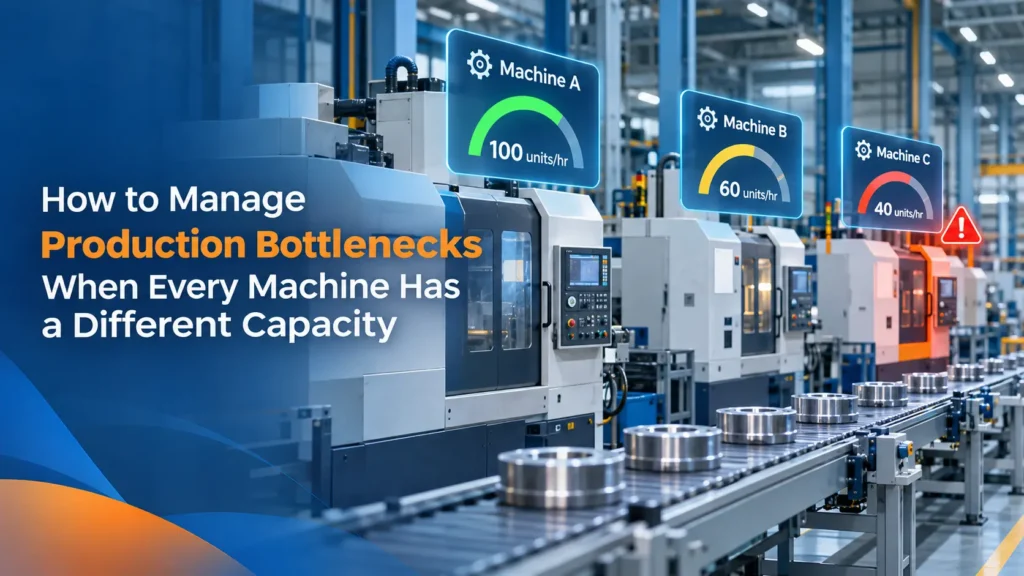
- Machine A produces 100 components per hour.
- Machine B produces 60 components per hour.
- Machine C produces 40 components per hour.
If these machines are involved in consecutive production stages, Machine C may become the limiting factor.
Even if Machine A and Machine B can process more components, the final output cannot exceed the capacity of the slowest required operation over the same planning period.
Operating Hours and Machine Availability
Not every machine operates for the same number of hours.
Some machines may operate across multiple shifts, while others are available only during specific working hours. Scheduled maintenance, operator availability, and production priorities can further reduce available operating time.
Production managers must consider these factors when calculating realistic machine capacity.
Setup Time and Changeovers
Changing production specifications, adjusting machine settings, and switching between product types can consume valuable production time.
For manufacturers handling multiple products, frequent changeovers can significantly reduce available capacity.
For example, a machine capable of producing 500 units per shift may deliver considerably less output if it requires several lengthy setup operations.
Theoretical Capacity vs Actual Capacity
Theoretical capacity represents the maximum possible output under ideal operating conditions. Actual capacity considers real-world limitations such as breakdowns, material shortages, setup delays, and operator availability.
Understanding this difference is essential for accurate production planning.
Manufacturers should schedule production using realistic capacity estimates rather than assuming every machine will operate at its maximum theoretical output.
How One Machine Can Slow Down an Entire Production Line
A production line consists of multiple interconnected operations. When one operation cannot keep pace with the others, it can affect the entire manufacturing workflow.
This is commonly known as a production bottleneck.
Consider a manufacturing facility producing metal components through three consecutive operations:
- Cutting: 120 units per hour.
- Drilling: 80 units per hour.
- Finishing: 50 units per hour.
Although the cutting and drilling machines have higher processing capacities, the finishing machine can handle only 50 units per hour.
As a result, components begin accumulating before the finishing stage.
<escape>###</escape> How Does This Affect Production?
Work-in-progress accumulation: Components waiting for the slower machine occupy valuable floor space and increase inventory holding requirements.
Idle machine time: Faster machines may eventually stop operating because there is insufficient downstream capacity to process additional output.
Longer production lead times: Products spend more time waiting between operations, increasing the total time required to complete an order.
Missed delivery commitments: If the bottleneck continues without intervention, manufacturers may struggle to meet planned dispatch dates.
Higher operating costs: Excessive waiting, overtime, inefficient resource allocation, and additional handling can increase manufacturing expenses.
The important point is that increasing the speed of every machine is not always necessary. Manufacturers first need to understand which operation is restricting overall output.
Improving the capacity or availability of that specific operation can have a greater impact than making changes across the entire production line.
Common Challenges in Managing Production Bottlenecks
Identifying production bottlenecks is only the first step. Manufacturers also need to address the operational problems that contribute to them.
Some of the most common challenges include:
1. Inconsistent Machine Utilisation
Machines with different processing capacities are often assigned production workloads without considering their actual limitations.
This can result in some machines being overloaded while others remain underutilised.
2. Poor Production Sequence and Scheduling
When production jobs are scheduled without considering machine availability, processing time, and delivery priorities, unnecessary delays can occur.
A machine may be assigned multiple urgent jobs even when its available capacity is insufficient to complete them on time.
3. Unplanned Machine Breakdowns
Unexpected equipment failures can interrupt production schedules.
When a critical machine stops operating, all dependent production activities may be affected. Without alternative scheduling arrangements, the disruption can continue even after the machine becomes operational again.
4. Excessive Waiting Time Between Production Stages
Materials may spend more time waiting for the next operation than being actively processed.
This often happens when production managers lack visibility into the workload and availability of individual machines.
5. Limited Visibility Into Machine Performance
Without accurate production data, managers may find it difficult to determine:
- Which machine is operating below capacity?
- Which production stage is creating delays?
- How much time is lost during changeovers?
- How frequently do machine breakdowns occur?
- Which orders are likely to miss their deadlines?
6. Difficulty Balancing Workloads
Different machines may have different capabilities, even when they perform similar operations.
Assigning work without considering technical compatibility, machine capacity, and operator skills can create additional scheduling problems.
These challenges highlight why manufacturers need a structured approach to production planning and resource management.

Strategies to Balance Production Capacity Across Machines
Managing production bottlenecks requires manufacturers to coordinate machine capacity, production priorities, and available resources.
The following strategies can help improve production flow.
Identify the Actual Bottleneck
Start by analysing each production stage to identify where work accumulates and why production slows down.
Compare processing times, machine availability, waiting periods, and actual output.
Do not assume that the slowest machine is always the bottleneck. A machine with a higher processing rate may still become a constraint because of frequent breakdowns, long changeovers, or limited operating hours.
Identifying the actual constraint helps managers focus improvement efforts where they can deliver the greatest benefit.
Schedule Production According to Available Capacity
Production schedules should reflect the actual capacity of each machine rather than assigning equal workloads across all resources.
For example, if one machine can process 300 units per shift and another can process only 180, the production schedule should account for this difference.
Capacity-based scheduling helps reduce unnecessary queues and prevents production managers from creating unrealistic completion targets.
Prioritise Jobs Based on Delivery Requirements
Not every production order has the same priority.
Manufacturers should consider customer delivery dates, order quantities, production complexity, and material availability when sequencing jobs.
Urgent orders may require priority scheduling, but managers must also consider their impact on other scheduled production activities.
A structured priority system helps balance customer commitments with available manufacturing capacity.
Optimise Batch Sizes and Changeovers
Producing larger batches can reduce the frequency of machine changeovers. However, excessively large batches may increase work-in-progress inventory and delay other orders.
Manufacturers should identify an appropriate batch size based on machine setup requirements, demand, storage capacity, and production priorities.
Grouping similar jobs can also help reduce unnecessary machine adjustments.
Plan Preventive Maintenance Around Production Demand
Preventive maintenance helps reduce unexpected equipment failures.
Rather than waiting for a breakdown, manufacturers should schedule maintenance based on machine condition, usage, and production requirements.
Whenever possible, maintenance activities should be coordinated with production schedules to minimise operational disruption.
Allocate Alternative Machines Where Feasible
Some manufacturing operations can be performed using multiple machines.
If the primary machine becomes overloaded, managers may be able to transfer compatible jobs to alternative equipment.
However, this requires checking machine specifications, tooling requirements, quality standards, and operator availability before reallocating work.
Why Traditional Production Scheduling Is Not Enough
Many manufacturers continue to manage production activities using spreadsheets, manual records, and disconnected applications.
Although these methods may work for smaller operations, they become increasingly difficult to manage as production complexity increases.
Limited Capacity Visibility
Spreadsheets often contain planned production quantities without reflecting the latest machine availability or operational changes.
When a machine breaks down or an urgent order arrives, managers may need to update multiple records manually.
This increases the possibility of outdated information and scheduling conflicts.
Manual Tracking Creates Delays
Production managers may depend on employees to report job completion, machine downtime, and material consumption.
When information is recorded late, managers cannot make timely decisions based on actual shop floor conditions.
Disconnected Inventory and Production Data
A production schedule is only useful when the required materials are available.
If procurement, inventory, and production departments operate independently, managers may schedule jobs without knowing whether the necessary components are in stock.
This can result in machines waiting for materials despite having available capacity.
Difficulty Managing Multiple Production Orders
As order volumes increase, manually coordinating machine workloads, production sequences, and delivery commitments becomes more challenging.
Manufacturers need a centralised system that provides better visibility into production resources and operational activities.
This is where manufacturing production planning software becomes valuable.
How Manufacturing Production Planning Software Helps Manage Bottlenecks
Manufacturing production planning software helps businesses organise production activities by connecting production orders, available resources, and operational requirements.
Instead of relying entirely on manual calculations, managers can use centralised information to improve planning and coordination.
Here are some important capabilities to consider.
Centralised Production Planning and Scheduling
Production planning software allows manufacturers to organise production orders and coordinate activities across different production stages.
Managers can review planned workloads, production priorities, and scheduling requirements from a centralised system.
This helps reduce confusion caused by maintaining separate schedules for different departments.
Machine Capacity and Resource Availability Tracking
Understanding available machine capacity is essential when working with equipment that has different processing speeds.
A suitable system can help manufacturers maintain information about machine availability, assigned workloads, and resource requirements.
This supports more realistic production planning and helps managers identify potential capacity conflicts.
Work Order Management and Production Sequencing
Work orders define what needs to be manufactured, in what quantity, and according to which production requirements.
Production planning software can help organise work orders and coordinate their movement through different manufacturing stages.
This improves production coordination and makes it easier to track pending and completed activities.
Material Availability Checks Before Scheduling
Machine availability alone does not guarantee that production can begin.
Manufacturers also need the required raw materials, components, and consumables.
When production planning is connected with inventory management, managers can check material availability before scheduling jobs.
This helps reduce production interruptions caused by missing components.
Production Progress Monitoring
Production managers need visibility into what is happening on the shop floor.
A connected system can help track production order status, completed quantities, pending jobs, and operational progress.
When actual production differs from the planned schedule, managers can review the situation and take corrective action.
Identifying Capacity Constraints and Scheduling Conflicts
By bringing production and resource information together, software can help managers recognise situations where planned workloads exceed available capacity.
For example, if several production orders require the same machine during overlapping time periods, managers can review the conflict and adjust the schedule.
The availability of advanced features such as automatic finite-capacity scheduling depends on the specific software and its configuration.
Production Performance Reporting
Historical production data can help manufacturers understand recurring operational problems.
Managers can analyse production quantities, delays, machine utilisation, and operational performance to identify areas requiring improvement.
Over time, these insights support more informed production decisions.
The Role of ERP in Connecting Machine Capacity With Overall Production Planning
Production bottlenecks are not always caused by machine limitations alone.
Sometimes, a machine remains idle because raw materials have not arrived. In other situations, production is delayed because procurement information is unavailable or work orders are not properly coordinated.
This is why manufacturers should look beyond standalone scheduling tools and consider an integrated ERP system.
Enterprise Resource Planning (ERP) connects important business functions, helping departments work with more consistent operational information.
Connecting Production With Inventory Management
ERP systems connect production requirements with available inventory.
Before starting a production order, managers can review whether the required raw materials and components are available.
This helps reduce situations where machines remain idle because materials have not been issued or replenished.
Coordinating Procurement With Production Requirements
When inventory levels are insufficient, procurement teams need visibility into upcoming production requirements.
An integrated ERP system can connect material requirements with purchasing activities.
This helps businesses coordinate purchasing decisions with production schedules and reduce avoidable material shortages.
Managing Production Orders and Work Centres
ERP-based production planning can help manufacturers organise production orders, operations, work centres, and resource requirements.
Managers can use this information to coordinate workloads and understand how different production stages contribute to order completion.
Improving Decision-Making Through Connected Information
When production, inventory, procurement, and other business functions operate through an integrated system, managers have a more complete view of operational requirements.
This makes it easier to identify the reasons behind production delays and coordinate corrective actions across departments.
Ultimately, ERP production planning supports better coordination between manufacturing activities and the wider business.
Key Factors to Consider When Selecting Production Planning Software
Choosing the right production planning software requires understanding the actual requirements of your manufacturing facility.
Not every manufacturer needs the same features. The right solution should support existing production processes while allowing the business to expand its operations.
Consider the following factors:
1. Machine and Work-Centre Capacity Planning
The software should help businesses organise production resources according to machine availability, processing requirements, and operational capacity.
This is particularly important for manufacturers working with machines that have significantly different production rates.
2. Flexible Production Scheduling
Look for scheduling capabilities that allow managers to adjust production plans when priorities change, machines become unavailable, or new orders arrive.
Flexibility is essential for managing unexpected operational disruptions.
3. Integration With Inventory and Procurement
Production planning should not operate independently from material management.
Choose an ERP solution that connects inventory information, purchasing activities, and production requirements.
4. Production Tracking and Visibility
Managers should be able to monitor production order progress and understand which jobs are pending, in progress, or completed.
Where available, real-time shop floor integration can provide additional operational visibility.
5. Reporting and Analytics
Production reports help businesses evaluate performance and identify recurring bottlenecks.
Look for reporting capabilities that provide useful information about production output, resource utilisation, delays, and operational efficiency.
6. Scalability
Manufacturing requirements change as businesses introduce new products, purchase additional machines, and expand production facilities.
The selected system should be capable of supporting additional resources, production processes, and operational complexity.
Conclusion: Turn Production Constraints Into Better Planning Decisions
Managing production when every machine has a different capacity requires more than simply assigning work orders and monitoring output.
Manufacturers must understand actual machine capabilities, identify production constraints, and coordinate workloads according to available resources.
A machine with limited capacity can influence the performance of an entire production line. Without proper planning, this can lead to excessive work-in-progress, longer production lead times, resource underutilisation, and delayed customer deliveries.
Implementing manufacturing production planning software helps businesses organise production activities, monitor resource availability, and improve scheduling decisions.
An integrated ERP system takes this approach further by connecting production with inventory, procurement, and other essential business functions.
For manufacturers looking to improve operational visibility and coordinate production activities more effectively, Jurysoft ERP is a solution worth exploring.
Is Your Production Line Operating at Its Full Potential?
Managing machines with different capacities requires more than just assigning production orders. Manufacturers need better visibility into machine availability, production schedules, material requirements, and operational constraints.
With Jurysoft ERP, businesses can explore a more connected approach to production planning, resource coordination, and manufacturing operations.
Take control of your production planning. Connect with Jurysoft to discover how an integrated ERP solution can help your manufacturing business improve production visibility and manage operational challenges more effectively.