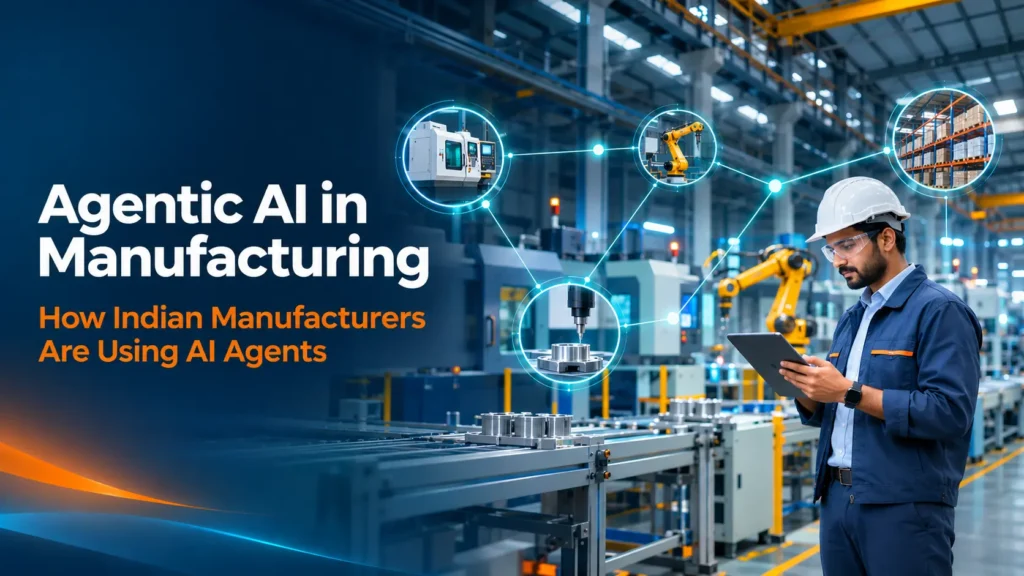
India’s factory floors are changing. Sensors, ERP and MES platforms, robotics, and data dashboards are now common across automotive, engineering, textiles, FMCG, and electronics. Yet in many plants, people still stitch these systems together by hand: checking a dashboard, calling a supervisor, raising a maintenance request, and updating a spreadsheet.
Agentic AI in manufacturing is the next step. Instead of only analyzing data and producing reports, AI agents can understand an objective, plan the steps, and take actions within permissions you define, with people approving what matters. For Indian manufacturers dealing with tight margins, volatile supply chains, and growing demand for quality, this is becoming a practical area to explore.
What Is Agentic AI in Manufacturing?
Agentic AI refers to AI systems built from AI agents: software that works toward a goal rather than answering a single prompt. In simple terms, an AI agent can:
- Understand a goal, such as “reduce unplanned downtime on Line 3.”
- Gather and analyze information from machines, ERP, MES, and other connected systems.
- Plan and execute tasks, such as creating a work order or flagging a schedule conflict.
- Learn from feedback, improving as humans approve, correct, or reject its suggestions.
- Collaborate with other agents, for example a maintenance agent coordinating with a production-planning agent.
A simple example: A vibration sensor on a CNC machine shows an unusual pattern. A maintenance agent checks the machine’s service history, confirms a spare part is in stock, finds a low-demand window in the production schedule, and drafts a maintenance request for the supervisor’s approval. Each step used to be a separate manual task.
Agentic AI vs Traditional AI and Automation
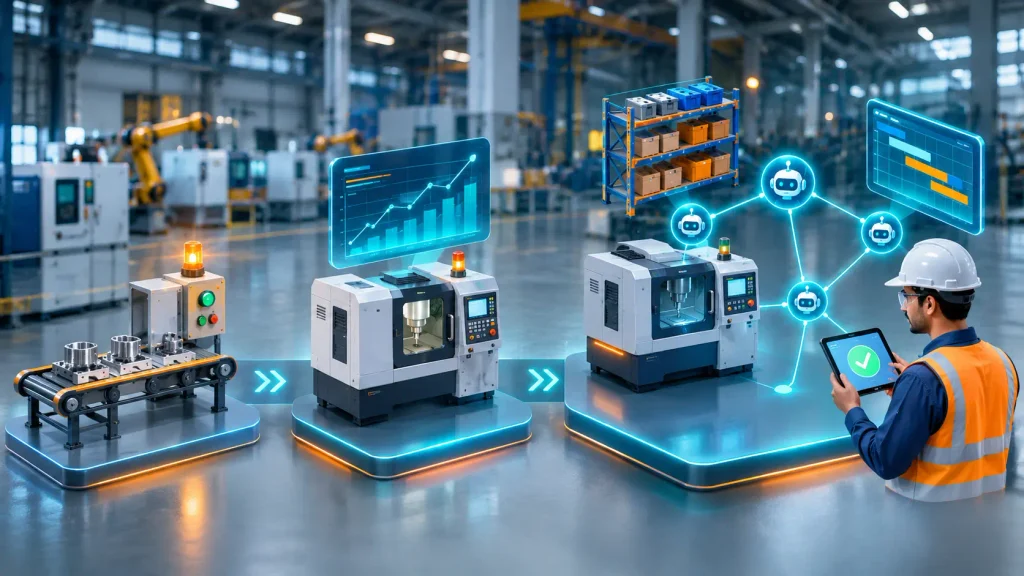
These terms are often mixed up, but they solve different problems.
| Aspect | Rule-Based Automation | Traditional AI | Agentic AI |
|---|---|---|---|
| How it works | Follows fixed, predefined rules | Analyzes data and predicts or recommends | Pursues goals through multi-step workflows |
| Flexibility | Low; breaks when conditions change | Moderate; limited to its trained task | Higher; adapts plans as conditions change |
| Typical output | Triggered action | Prediction or insight | Coordinated, authorized actions |
| Human role | Sets the rules | Acts on the insight | Sets goals, approves high-impact actions |
| Example | Alert when temperature crosses a threshold | Predicts a likely bearing failure | Predicts failure, checks parts and schedule, raises a maintenance request |
Agentic AI does not replace automation or predictive models. It builds on them by connecting insight to action.
How Are Indian Manufacturers Using Agentic AI?
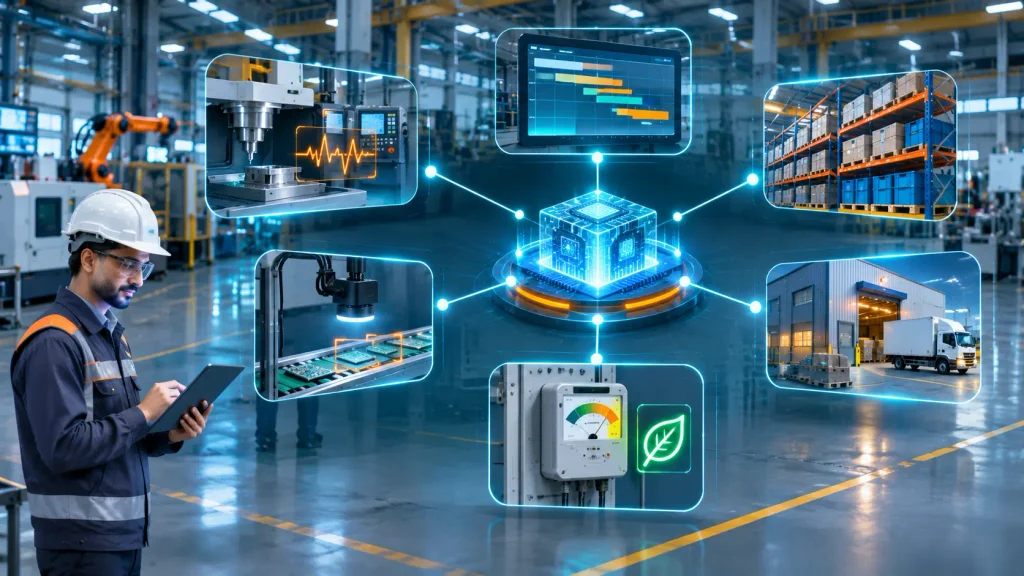
Adoption is still early and varies by company, and many of the applications below are emerging rather than universal. These are the areas where Indian manufacturers are exploring or can realistically apply AI agents.
1. Predictive Maintenance
The challenge: Unplanned breakdowns halt production, delay dispatches, and strain maintenance teams.
How agents help: AI-driven predictive maintenance monitors machine performance, spots unusual patterns, and estimates the risk of failure. An agent can go further by checking spare-part availability and initiating a maintenance workflow for approval.
Benefit: Less unplanned downtime and better-planned maintenance windows.
2. Production Planning and Optimization
The challenge: Schedules change constantly with rush orders, machine availability, and material delays.
How agents help: Agents can analyze order priorities, machine capacity, and material requirements, then recommend or coordinate updated production plans when something changes.
Benefit: Faster re-planning and smoother use of capacity.
3. Supply Chain and Inventory Management
The challenge: Material shortages and overstocking tie up cash and disrupt production.
How agents help: Agents can monitor inventory levels, flag supplier delays, track upcoming material requirements, and prepare procurement recommendations for review.
Benefit: Better inventory control and earlier warning of disruptions.
4. Quality Control and Defect Detection
The challenge: Defects found late mean rework, scrap, and customer complaints.
How agents help: AI-powered systems can analyze inspection data, detect recurring defect patterns, and help trigger corrective workflows, such as alerting the quality team or holding a batch for review.
Benefit: Earlier issue detection and more consistent quality management.
5. Warehouse and Logistics Automation
The challenge: Coordinating stock movement, dispatch, and delivery schedules across multiple teams is slow and error-prone.
How agents help: Intelligent agents can coordinate warehouse tasks, plan dispatches, and adjust delivery schedules as orders or transport availability change.
Benefit: Smoother material flow and less manual coordination.
6. Energy and Resource Optimization
The challenge: Energy is a major operating cost, especially in energy-intensive industries.
How agents help: Agents can analyze consumption patterns, highlight inefficient machines or shifts, and recommend actions to reduce waste.
Benefit: Lower operating costs and more efficient resource use.
Real-World Benefits of Agentic AI for Indian Manufacturers
When applied to well-chosen use cases, manufacturers can aim for:
- Reduced operational downtime
- Improved production efficiency
- Better inventory management
- Faster decision-making
- Reduced manual and repetitive workload
- Improved quality management
- More efficient use of materials, energy, and labor
- Greater visibility across operations
Results depend on data quality, process maturity, and how well the solution is implemented, so outcomes are never guaranteed.
Challenges of Implementing Agentic AI in Manufacturing
Agentic AI works best when its challenges are acknowledged early:
- Integration: Agents need to work with existing ERP, MES, SCADA, and legacy systems.
- Data quality and availability: Incomplete or inconsistent machine and process data limits accuracy.
- Implementation cost: Initial investment in infrastructure, integration, and development can be significant.
- Cybersecurity and data privacy: Connected systems must be protected, with strict access controls.
- Workforce adoption: Teams need training and clarity on how agents support their work.
- Human oversight and governance: High-impact decisions, such as stopping a line or placing a large purchase order, should always require human approval.
This is why a phased approach matters. Starting small lets you test reliability, build trust, and refine governance before expanding.
How Can Indian Manufacturers Get Started with Agentic AI?
- Identify repetitive, time-consuming processes such as manual reporting, maintenance requests, or stock reconciliation.
- Evaluate your digital infrastructure and data readiness, including what your machines and systems already record.
- Shortlist suitable use cases where the value and feasibility are clear.
- Start with a focused pilot on one line, plant, or process.
- Integrate agents with existing systems like ERP and MES rather than replacing them.
- Set up human approval and monitoring, defining which actions agents can take alone and which need sign-off.
- Measure performance and scale gradually based on results from the pilot.
How Jurysoft Helps Businesses Implement AI Solutions
Adopting AI is as much about choosing the right problem as choosing the right technology. Jurysoft works with organizations exploring practical AI adoption, helping them:
- Identify suitable AI opportunities
- Develop customized AI-powered applications
- Integrate AI capabilities into existing workflows
- Automate business processes
- Build intelligent solutions aligned with business objectives
Manufacturers looking to integrate intelligent automation into their operations can explore Jurysoft’s AI development services to identify and implement AI solutions aligned with their business requirements.
Frequently Asked Questions (FAQs)
1. What is Agentic AI in manufacturing?
Agentic AI in manufacturing uses AI agents that work toward defined goals, such as reducing downtime or optimizing schedules. They analyze data, plan multi-step tasks, and take authorized actions across connected systems, with humans approving high-impact decisions.
2. How is Agentic AI different from traditional AI?
Traditional AI typically analyzes data and delivers predictions or recommendations, leaving people to act on them. Agentic AI goes further by coordinating multi-step workflows and carrying out permitted actions toward an objective, while operating under human oversight and clear rules.
3. Can small and medium-sized Indian manufacturers use Agentic AI?
Yes. SMEs don’t need to transform everything at once. They can begin with one focused use case, such as predictive maintenance or inventory monitoring, using existing data and systems, and expand gradually as they see results and build confidence.
4. How can Agentic AI improve manufacturing productivity?
It can reduce manual coordination, flag problems earlier, and speed up routine decisions. Applied to maintenance, planning, quality, and inventory, it helps teams spend less time on repetitive tasks and more on higher-value work, though results vary by implementation.
5. Is Agentic AI suitable for factories using existing ERP systems?
Generally, yes. Agentic AI is designed to work alongside existing ERP and MES platforms by connecting through integrations. Success depends on data quality and integration planning, which is why starting with a pilot is recommended.
Conclusion
Agentic AI in manufacturing moves AI from insight to action, helping Indian manufacturers coordinate maintenance, planning, quality, inventory, and logistics more intelligently. It doesn’t remove the need for human judgment. It frees teams from repetitive coordination and keeps people in control of important decisions.
The good news is that you don’t need to overhaul your entire operation. Begin with a targeted use case, prove its value, and scale from there. To explore what this could look like for your plant, discover Jurysoft’s AI development and implementation capabilities and start the conversation.