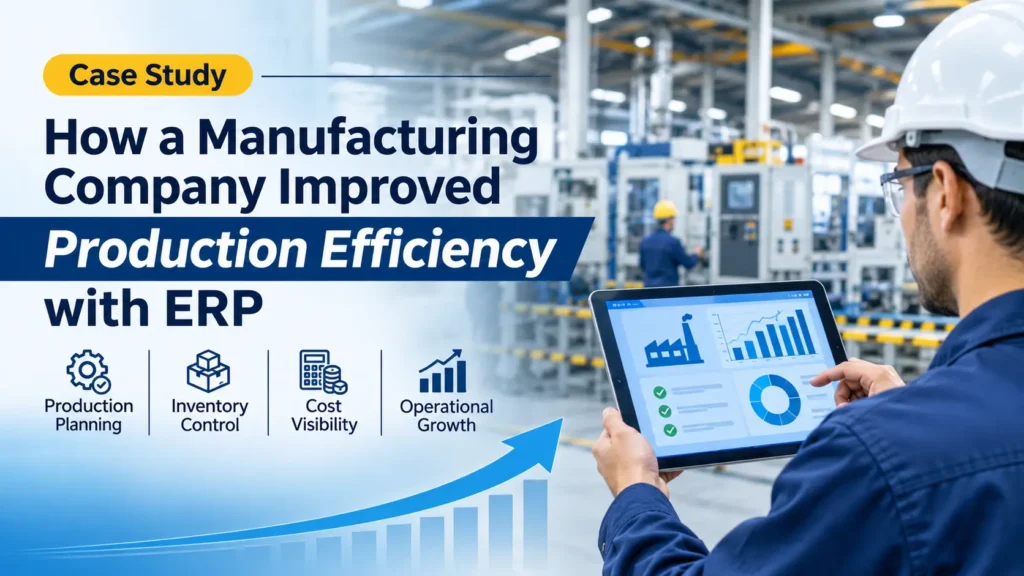
Manufacturing businesses often face increasing operational challenges as production volumes grow. Managing production schedules, inventory, procurement, material requirements, and manufacturing costs becomes more complicated when different departments rely on disconnected systems and manual processes.
Without accurate and centralised information, even well-established manufacturing companies can experience production delays, inventory mismatches, inefficient resource utilisation, and difficulties tracking actual production costs.
This case study explores how a growing manufacturing company addressed these common operational challenges by adopting an integrated manufacturing ERP approach with Jurysoft ERP.
Editorial note: This is an illustrative, anonymised case study based on common manufacturing challenges. It does not represent a verified customer implementation or independently measured customer results.
1. Company Background
A growing manufacturing company was experiencing increasing difficulties in managing its production activities, inventory, procurement, and operational costs.
As the business expanded, its existing systems and manual processes struggled to support the growing complexity of daily operations.
The production team maintained separate records for manufacturing activities, the inventory department tracked stock using spreadsheets, and the procurement team managed purchase requirements independently.
This created information gaps between departments and made it difficult for management to understand what was happening across the organisation.
Some of the major operational concerns included:
- Difficulty coordinating production schedules with material availability.
- Limited visibility into actual inventory levels.
- Delays in identifying material requirements.
- Challenges calculating accurate manufacturing costs.
- Lack of centralised operational reports.
- Increased dependency on manual data entry.
The company recognised the need for a more connected approach to managing its manufacturing operations.
It required a system that could bring production, inventory, procurement, costing, and reporting together.
2. The Key Challenges Before ERP Implementation
Before moving towards an integrated manufacturing ERP system, the company faced several operational challenges that affected efficiency and decision-making.
2.1 Production Planning Difficulties
Production planning was becoming increasingly complicated as manufacturing requirements increased.
The production team found it difficult to coordinate production schedules with available materials, machine capacity, and delivery commitments.
Without connected production and inventory information, identifying potential material shortages before production started was challenging.
This resulted in scheduling difficulties, delays, and inefficient utilisation of available resources.
2.2 Inventory Inaccuracies and Material Shortages
Inventory information was maintained across different spreadsheets and departmental records.
As a result, the actual availability of raw materials, components, and finished goods was not always clear.
The company faced challenges such as:
- Difficulty identifying available stock.
- Delays in updating inventory records.
- Limited visibility into material movements.
- Challenges tracking material consumption.
- Risk of excess inventory and unexpected shortages.
These issues affected production planning and made inventory control more difficult.
2.3 Disconnected Departments and Information Gaps
Production, inventory, procurement, sales, and finance teams operated with separate information.
For example, production teams needed material availability updates from inventory, while procurement teams required accurate material requirements to plan purchases.
However, the lack of connected information created communication gaps and delayed coordination.
Management also had to collect information from different departments before understanding overall business performance.
2.4 Inaccurate Product Costing
Understanding the actual cost of manufacturing each product was another major challenge.
Product costing required information about several factors, including:
- Raw material consumption.
- Component costs.
- Labour and operational expenses.
- Production-related overheads.
- Actual manufacturing activities.
Since these details were maintained separately, calculating accurate product costs was difficult.
This limited management’s ability to evaluate production expenses, assess product profitability, and make informed pricing decisions.
2.5 Limited Operational Visibility
Management lacked a centralised view of important manufacturing activities.
Information about production progress, stock availability, purchase orders, material consumption, and operational expenses was spread across multiple systems.
This made it difficult to:
- Monitor production performance.
- Identify operational bottlenecks.
- Track procurement activities.
- Understand inventory movements.
- Evaluate manufacturing costs.
- Make timely business decisions.
The company needed a solution that could connect its departments and provide better operational visibility.
3. The ERP Solution: Connecting Manufacturing Operations
To address these challenges, the company adopted an integrated manufacturing ERP approach with Jurysoft ERP.
The objective was to bring critical business functions together through a centralised platform and improve coordination across departments.
Rather than managing production, inventory, procurement, and costing independently, the company moved towards a connected operational structure.
The ERP approach focused on six important areas.
3.1 Production Planning and Monitoring
Production planning became more structured by connecting manufacturing requirements with material availability and production information.
The ERP approach helped improve:
- Production scheduling and planning.
- Coordination of manufacturing activities.
- Monitoring of production progress.
- Visibility into production requirements.
- Resource utilisation and operational coordination.
Having better access to production information helps manufacturing teams identify potential issues earlier and coordinate activities more effectively.
3.2 Inventory and Material Management
Inventory management was another important area addressed through ERP.
Centralising inventory information helped improve visibility into stock availability and material movements.
Key areas included:
- Centralised inventory records.
- Tracking of material movements.
- Better visibility into stock levels.
- Monitoring of material consumption.
- Coordination between inventory and production teams.
With connected inventory information, businesses can make better-informed decisions about material availability and replenishment.
3.3 Bill of Materials (BOM) Management
A Bill of Materials (BOM) defines the raw materials, components, and quantities required to manufacture a product.
Managing BOM information accurately is essential for production planning, material requirements, and manufacturing cost calculations.
The ERP approach supported:
- Structured management of product components.
- Better visibility into material requirements.
- Improved coordination between BOM and production planning.
- Better control over material consumption.
- More organised product structure information.
Connecting BOM information with inventory and production processes helps businesses understand what materials are required before manufacturing begins.
3.4 Purchase and Procurement Management
Procurement plays an important role in maintaining uninterrupted manufacturing operations.
When purchase requirements are not connected with inventory and production information, businesses may experience unnecessary purchasing, material shortages, and procurement delays.
The ERP approach helped improve:
- Visibility into purchase requirements.
- Coordination between procurement and inventory.
- Organisation of purchase orders.
- Supplier and purchasing information management.
- Material availability planning.
This creates a more connected process between identifying material requirements and arranging purchases.
3.5 Manufacturing Cost Management and Product Costing
Understanding actual manufacturing costs is essential for maintaining profitability.
The ERP approach helped connect important costing information, including material costs, production data, and operational expenses.
This supported:
- Better tracking of material costs.
- Improved visibility into manufacturing expenses.
- More structured product costing.
- Better understanding of production costs.
- Improved cost-related decision-making.
With better access to costing information, management can evaluate manufacturing expenses and make more informed decisions about pricing, production, and profitability.
3.6 Centralised Reporting and Management Visibility
One of the important objectives of adopting ERP was to improve access to business information.
Instead of collecting reports from different departments, management could work towards a more centralised view of manufacturing operations.
Important reporting areas included:
- Production progress and performance.
- Inventory levels and material movements.
- Procurement and purchase activities.
- Manufacturing costs.
- Operational performance.
- Business reporting.
Centralised information supports faster decision-making and helps management understand operational performance more effectively.
4. The Results: Better Coordination and Operational Control
With manufacturing functions brought together through an integrated ERP approach, the company was better positioned to manage its daily operations.
The key improvements included:
Improved Production Coordination
Connecting production information with material requirements helped create better coordination between production and inventory teams.
Better Inventory Visibility
Centralised inventory information improved visibility into stock availability and material movements.
More Organised Production Planning
Structured production information supported better planning and coordination of manufacturing activities.
Improved Procurement Control
Better visibility into purchase requirements helped connect procurement activities with inventory and production needs.
Better Manufacturing Cost Visibility
Connecting material costs, operational expenses, and production information supported a clearer understanding of manufacturing costs.
Reduced Dependency on Disconnected Spreadsheets
Moving towards centralised operational information reduced the need to depend entirely on separate departmental records.
More Informed Management Decisions
Access to connected business information helped management gain a broader understanding of manufacturing operations.
The biggest improvement was the ability to manage different manufacturing functions through a connected operational system rather than relying on separate departmental records.
5. Why Manufacturing Businesses Need an Integrated ERP System
The challenges highlighted in this case study are common across many growing manufacturing businesses.
As operations expand, managing different departments independently becomes increasingly difficult.
A manufacturing ERP system helps connect essential business functions and provides a structured approach to managing daily activities.
Here are five important reasons manufacturers should consider ERP.
1. Better Production Planning
Connect production requirements with material availability, BOM information, and manufacturing activities.
2. Improved Inventory Control
Gain better visibility into stock levels, material movements, and inventory requirements.
3. Stronger Procurement Coordination
Connect purchasing activities with production requirements and inventory information.
4. More Accurate Product Costing
Improve visibility into material consumption, manufacturing expenses, and production costs.
5. Better Operational Visibility
Bring important business information together to support more informed management decisions.
The right ERP system does more than automate individual tasks. It helps create a connected manufacturing environment where departments can work with consistent operational information.
6. How Jurysoft ERP Supports Manufacturing Businesses
Jurysoft ERP helps manufacturing businesses streamline production planning, manage inventory, improve procurement coordination, track manufacturing costs, and gain better operational visibility.
Its integrated ERP approach supports important manufacturing functions, including:
- Production Planning: Organise and monitor manufacturing activities.
- BOM Management: Manage product structures and material requirements.
- Inventory Management: Track stock levels and material movements.
- Purchase Management: Organise procurement and purchasing activities.
- Sales Management: Connect sales processes with business operations.
- Manufacturing Cost Management: Improve visibility into material costs and operational expenses.
- Finance Management: Connect financial information with business activities.
- Reporting and Analytics: Access important operational information for better decision-making.
Whether a business operates a single manufacturing facility or manages multiple production activities, connected business processes can make a significant difference.
By bringing critical functions together, Jurysoft ERP helps manufacturers move away from disconnected processes and work towards better operational control.
7. Conclusion: Manufacturing Efficiency Starts with Connected Operations
Improving manufacturing efficiency is not just about increasing production capacity or investing in additional machinery.
It also involves managing materials, production schedules, procurement, resources, and manufacturing costs effectively.
When these activities operate independently, businesses may experience production delays, inventory inaccuracies, unnecessary expenses, and limited operational visibility.
An integrated manufacturing ERP system helps bring these functions together, providing businesses with better control over their daily operations.
For growing manufacturers, the right ERP solution can support better coordination, improved information flow, and more informed business decisions.
Is Your Manufacturing Business Facing Similar Challenges?
If your business is struggling with production planning, inventory inaccuracies, procurement coordination, or manufacturing cost visibility, it may be time to evaluate your existing processes.
Book your FREE ERP Gap Audit with Jurysoft ERP and identify opportunities to improve your manufacturing operations.
Explore Jurysoft ERP: https://jurysoft.com/
Get in touch with our team to discover how an integrated manufacturing ERP solution can support your business growth.