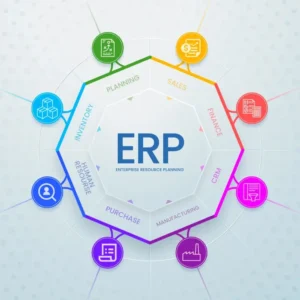
Aerospace and electronic manufacturing companies operate in industries where precision, traceability, quality, and regulatory compliance are critical. From managing raw materials and production schedules to monitoring quality inspections and maintaining complete product records, manufacturers need an ERP system that can handle complex operations without creating additional administrative work.
Traditional ERP systems can manage basic business processes, but modern manufacturing environments require more intelligent capabilities. An AI-powered ERP for aerospace and electronic manufacturing can help organizations connect production, inventory, procurement, quality, finance, and supply chain operations while using artificial intelligence to improve decision-making and operational efficiency.
For aerospace and electronics manufacturers, an intelligent ERP platform can provide better visibility across the entire manufacturing lifecycle, reduce manual processes, improve production planning, and support stronger quality control.
Why Aerospace and Electronic Manufacturers Need Advanced ERP
Aerospace manufacturing involves complex assemblies, strict quality standards, engineering changes, detailed documentation, and long production cycles. Electronic manufacturing also requires accurate inventory management because production depends on large numbers of components, including PCBs, semiconductors, connectors, sensors, and other electronic parts.
Managing these operations through spreadsheets or disconnected applications can result in:
- Inventory inaccuracies
- Production delays
- Manual data entry
- Poor production visibility
- Difficulty tracking components
- Quality control issues
- Procurement delays
- Incomplete documentation
- Higher operational costs
An ERP system for aerospace manufacturing and ERP software for electronic manufacturing brings these processes together in a centralized platform.
How AI Enhances Manufacturing ERP
Artificial intelligence can transform an ERP system from a simple transaction-management platform into an intelligent decision-support system.
AI can analyze large amounts of operational data and identify patterns that may not be immediately visible to production or management teams. This allows manufacturers to make faster and more informed decisions.
AI-Based Demand Forecasting
AI can analyze historical sales, production data, inventory levels, seasonal patterns, and market trends to improve demand forecasting.
For aerospace and electronic manufacturers, accurate forecasting can help determine:
- What materials are required
- When components should be purchased
- How much inventory should be maintained
- Which production resources will be required
This can reduce excess inventory while helping prevent material shortages.
Intelligent Production Planning
Production planning becomes complicated when manufacturers need to manage multiple orders, machines, workers, materials, and delivery deadlines.
An AI-powered manufacturing ERP can analyze production capacity, material availability, machine schedules, and order priorities to support better production planning.
Manufacturers can gain improved visibility into production bottlenecks and make adjustments before they affect delivery schedules.
Predictive Maintenance
Unexpected equipment failures can stop production and increase operational costs.
AI-enabled ERP systems can analyze machine data, maintenance history, production patterns, and equipment performance to identify potential maintenance requirements.
Instead of waiting for equipment to fail, manufacturers can plan maintenance activities proactively.
Complete Inventory and Material Management
Inventory management is especially important in aerospace and electronics manufacturing because production often depends on thousands of individual components and materials.
An ERP for electronics manufacturing can help organizations monitor:
- Raw materials
- Electronic components
- Finished goods
- Work-in-progress inventory
- Spare parts
- Purchase orders
- Stock levels
- Material consumption
With centralized inventory data, teams can quickly determine what is available, what has been allocated to production, and what needs to be reordered.
Component Traceability
Traceability is a major requirement in aerospace and electronic manufacturing.
An advanced ERP solution can maintain detailed records of materials and components throughout the production process. Businesses can track information such as supplier details, batch numbers, serial numbers, purchase records, production usage, and finished-product associations.
This creates a stronger manufacturing traceability system and makes it easier to investigate quality issues or respond to customer requirements.
Quality Management for Aerospace Manufacturing
Quality cannot be treated as a separate activity in aerospace manufacturing. It needs to be integrated throughout the production lifecycle.
An aerospace ERP software solution can connect quality management with purchasing, inventory, production, and supplier management.
Integrated Quality Control
ERP-supported quality management can help manufacturers manage:
- Incoming material inspections
- In-process inspections
- Final product inspections
- Non-conformance management
- Corrective and preventive actions
- Quality documentation
- Inspection records
- Supplier quality information
By maintaining quality information within the ERP system, organizations can improve visibility and reduce dependency on manual records.
Managing Engineering Changes and Product Data
Aerospace and electronics manufacturers frequently deal with product revisions, engineering changes, bills of materials, and production specifications.
An integrated ERP system can help connect engineering information with production activities.
Bill of Materials Management
A centralized Bill of Materials (BOM) management system allows manufacturers to maintain accurate information about components and materials required for manufacturing a product.
When product specifications or components change, authorized teams can access updated information and reduce the risk of producing items using outdated data.
Supply Chain and Procurement Optimization
Manufacturing performance depends heavily on supplier reliability and material availability.
An intelligent ERP system can provide better visibility across purchasing and supply chain operations.
AI can analyze supplier performance, purchase history, lead times, material consumption, and delivery patterns to support better procurement decisions.
Supplier Management
Manufacturers can monitor supplier performance based on factors such as:
- Delivery performance
- Material quality
- Lead times
- Purchase costs
- Order fulfillment
- Quality issues
This can help procurement teams identify supply chain risks and make more informed sourcing decisions.
Real-Time Manufacturing Visibility
One of the biggest advantages of an integrated ERP system is centralized access to business and manufacturing data.
Management teams can monitor important information such as production status, inventory levels, purchase orders, sales orders, quality performance, and financial information through dashboards and reports.
A real-time manufacturing ERP can help decision-makers understand what is happening across the organization without waiting for manually prepared reports.
Benefits of AI-Powered ERP for Manufacturers
Implementing an AI-enabled ERP solution can provide several operational advantages.
Improved Operational Efficiency
Automation reduces repetitive administrative tasks and allows employees to focus on higher-value activities.
Better Production Decisions
AI-supported insights can help manufacturers identify trends, bottlenecks, and potential operational problems.
Reduced Inventory Costs
Better forecasting and inventory visibility can help organizations maintain appropriate stock levels.
Stronger Quality Control
Integrated quality processes improve traceability and make it easier to identify and manage non-conformances.
Improved Supply Chain Management
Supplier and procurement data can be analyzed to improve purchasing decisions and reduce supply risks.
Enhanced Compliance and Documentation
Centralized records make it easier to maintain documentation and demonstrate process control when required.
Choosing the Right ERP for Aerospace and Electronics
Not every ERP system is designed for complex manufacturing environments. Aerospace and electronic manufacturers should evaluate ERP platforms based on their specific operational requirements.
Important capabilities to consider include:
- Production planning
- Inventory management
- BOM management
- Quality management
- Serial and batch tracking
- Material traceability
- Procurement management
- Supplier management
- Maintenance management
- Financial management
- Reporting and analytics
- AI-powered insights
- Role-based access
- Workflow automation
The ERP should also be scalable so the business can support increasing production volumes, new products, additional facilities, and changing customer requirements.
The Future of Intelligent Manufacturing
Manufacturing is moving toward connected, data-driven operations. AI, automation, analytics, IoT, and cloud technologies are increasingly becoming important parts of modern manufacturing strategies.
An AI-powered ERP system brings many of these capabilities together by connecting business data with manufacturing operations.
For aerospace and electronics companies, this means moving beyond traditional ERP functions toward a more intelligent approach to production management, quality, inventory, procurement, and decision-making.
Conclusion
Aerospace and electronic manufacturing require accuracy, efficiency, traceability, and strong operational control. An AI-powered ERP for aerospace and electronic manufacturing can provide a centralized platform for managing complex manufacturing processes while using intelligent insights to improve business decisions.
From AI-driven demand forecasting and production planning to inventory tracking, quality management, supplier management, and component traceability, the right ERP system can help manufacturers build more efficient and connected operations.
Jurysoft provides ERP solutions designed to support the complex requirements of aerospace and electronic manufacturing companies. By integrating essential business and manufacturing processes into a unified system, manufacturers can gain better visibility, streamline operations, improve control, and prepare their businesses for the future of intelligent manufacturing.