Case Study: Improving Supply Chain Visibility Through Integrated Manufacturing ERP
Introduction
For manufacturers managing multiple warehouses, suppliers, and production schedules, maintaining accurate information across departments is essential. When procurement, inventory, and production teams rely on separate spreadsheets or disconnected software, even small data discrepancies can lead to material shortages, excess stock, production delays, and missed delivery commitments.
This case study explores how an integrated manufacturing ERP solution can help address these challenges by connecting procurement, inventory management, and production planning within a unified system.
Note: This is an illustrative case study based on common manufacturing challenges, not a verified customer engagement. The scenario and outcomes should be replaced with actual client information before publication as a real customer case study.
The Challenge: Disconnected Supply Chain Operations
A growing manufacturing company was experiencing difficulties coordinating its purchasing, warehouse, and production activities. Each department maintained its own records, making it difficult to establish a consistent view of material availability and operational requirements.
The procurement team tracked supplier orders using spreadsheets, while warehouse teams maintained separate stock records. Meanwhile, production planners prepared schedules based on material reports that were not always up to date.
These disconnected processes created several operational challenges.
1. Procurement and Production Misalignment
Purchasing decisions were not always aligned with current production requirements. Some materials were ordered too early, while critical components were unavailable when production orders were scheduled to begin.
2. Excess Inventory and Unexpected Shortages
Without a consolidated view of stock levels and upcoming requirements, the company struggled to balance inventory. Certain materials accumulated in warehouses while other essential components ran short.
3. Limited Multi-Warehouse Visibility
Tracking material availability across multiple warehouses required manual coordination. Teams often spent time verifying stock quantities and locating materials before confirming whether production orders could proceed.
4. Supplier Order Uncertainty
Procurement staff lacked a single, reliable view of pending purchase orders, expected delivery dates, and outstanding material requirements. Supplier delays were sometimes identified only after they began affecting production schedules.
5. Time-Consuming Manual Reporting
Employees repeatedly updated spreadsheets, reconciled records, and shared information between departments. This increased administrative work and made it harder for managers to make timely decisions.
The Solution: An Integrated Manufacturing ERP System
To address these challenges, the company considered an integrated manufacturing ERP approach that connected procurement, inventory, production planning, and order tracking.
The objective was to establish a shared operational view, allowing departments to work with consistent information instead of maintaining separate records.
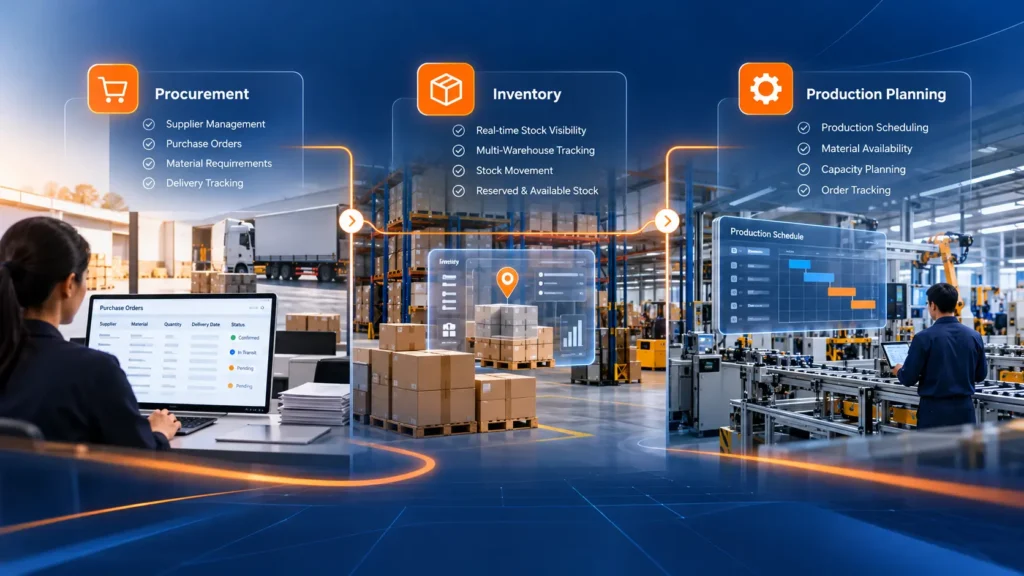
1. Connected Procurement Management
The ERP system linked purchasing requirements with production demand and material availability. Procurement teams could review material requirements, monitor purchase orders, and track supplier delivery schedules in one place.
This helped buyers prioritize critical materials and make purchasing decisions based on operational needs.
2. Centralized Inventory Management
Inventory records were consolidated to provide visibility into stock quantities, warehouse locations, material movements, and reserved inventory.
With ERP inventory management, authorized users could check available stock across locations and identify potential shortages before they disrupted production.
3. Production Planning Based on Material Availability
Production planners could use material requirements, inventory information, and expected supplier deliveries to evaluate production readiness.
This improved coordination between production schedules and purchasing activities, helping teams identify material constraints earlier and plan around potential delays.
4. Improved Supplier and Purchase Order Tracking
Purchase order information, expected delivery dates, and outstanding quantities were made accessible through a common workflow.
Procurement teams could identify overdue or at-risk deliveries and communicate material constraints to production planners before they became urgent issues.
5. Unified Operational Reporting
Management could review purchasing status, inventory availability, production requirements, and order progress through consolidated reports and dashboards.
Instead of waiting for individual spreadsheets, decision-makers had a clearer picture of supply chain activities and emerging operational risks.
How the Integrated Workflow Works
The manufacturing supply chain ERP workflow connects the major operational steps:
- Production demand: Customer orders and production schedules establish material requirements.
- Material availability: Inventory records identify available, reserved, and required materials.
- Procurement planning: Purchasing teams identify shortages and raise purchase orders for required materials.
- Supplier monitoring: Expected deliveries and outstanding orders are tracked against production needs.
- Production execution: Planners coordinate work based on material availability and production priorities.
- Inventory updates: Material consumption, receipts, and stock movements update inventory records.
- Order tracking: Teams monitor production progress and coordinate order fulfilment.
By connecting these activities, the ERP system helps reduce information gaps between departments and provides a more consistent basis for operational decisions.
Expected Business Benefits
An integrated manufacturing ERP solution can support improvements across procurement, inventory, and production operations.
- Better inventory control: Improved visibility into stock levels and warehouse locations helps teams identify excess inventory and potential shortages.
- More coordinated purchasing: Procurement decisions can be aligned more closely with production requirements.
- Improved production planning: Material availability information helps planners identify constraints before finalizing schedules.
- Greater supplier visibility: Purchase order tracking supports earlier identification of delivery risks.
- Reduced manual reconciliation: Shared records can reduce repetitive spreadsheet updates and cross-department verification.
- More informed decision-making: Consolidated reporting helps operations managers identify supply chain bottlenecks and prioritize corrective action.
Actual results depend on implementation quality, data accuracy, employee adoption, supplier coordination, and the company’s existing processes. Quantified improvements should be reported only when supported by measured customer data.
Key Takeaways for Manufacturers
Procurement, inventory, and production planning cannot operate effectively in isolation when manufacturing operations depend on accurate material availability and reliable delivery schedules.
A connected manufacturing supply chain ERP system gives teams a shared view of material requirements, purchasing activities, warehouse stock, and production priorities. This visibility can help manufacturers identify operational risks earlier, coordinate decisions more effectively, and manage increasingly complex supply chains.
For growing manufacturers, integrating these functions is an important step toward improving operational control and building a more responsive supply chain.
Conclusion
Are your procurement, inventory, and production teams working with different versions of the truth?
When departments rely on disconnected records, material shortages, excess stock, and production delays become harder to prevent. An integrated manufacturing ERP solution helps bring these processes together, giving teams the information they need to coordinate purchasing, manage inventory, and plan production with greater confidence.
Explore how Jurysoft can help your manufacturing business connect procurement, inventory, and production planning through a tailored ERP solution.
Visit: https://jurysoft.com/erp/