The digital world’s demand for speedy response in communication has changed the healthcare paradigm. Mobile solutions and tailored applications are streamlining the process of giving care to patients and making the whole thing more accessible, efficient, and customized. It is very important for companies interested in this market to be aware of the various steps involved in the development of efficient and user-friendly healthcare tools. Jurysoft, one of the foremost companies in Bangalore providing mobile healthcare app development services, offers professional app development services to healthcare providers, hospitals, and startups. They provide their customers with a smooth and perfect digital healthcare experience.
Understanding the Importance of Healthcare Mobile App Development
Healthcare mobile applications can be referred to as digital tools but essentially they serve the purpose of creating a connection among patients, healthcare providers, and medical institutions. Efficient development of healthcare software guarantees:
- Accessibility: Patients have the possibility to communicate with their doctors, make appointments, and check their medical records from anywhere.
- Efficiency: Healthcare providers can optimize processes and lighten the load of bureaucracy.
- Engagement: The users’ health habits get more solid with communication, alerts, and individual interpretations of the data.
An example hospital that employs a mobile application is capable of handling appointments, sending out automatic alerts, and offering telemedicine through the app all of which are aimed at minimizing unnecessary trips to the hospital while keeping patient satisfaction at a high level.
Step 1: Define Your Goals and Target Audience
Before developing a healthcare application, it’s essential to understand its purpose and who will use it. Key considerations include:
- Patient-centered applications: Made for users to supervise their appointments, health documents, remind about medications, and teleconsultations.
- Physician-centered applications: Give physicians the ability to monitor the health of patients, control their appointments, and communicate with patients in a secure way.
- Hospital administration applications: Enable hospitals to handle the staff work schedules, billing, inventory, and patient data effectively.
Tip: Perform surveys and interviews with prospective users to identify their difficulties and desires. This makes the application development process user-centric and based on actual requirements.
Step 2: Choose the Right Features
Efficient healthcare tools must balance functionality and usability. Some essential features include:
- Secure login and authentication: Patient data security is a priority, and HIPAA-compliant methods are used.
- Electronic Health Records (EHR) access: Medical records can be viewed and edited in a safe manner by the users.
- Appointment booking and reminders: More patients will show up for scheduled visits and will be more compliant with their treatment.
- Telemedicine and video consultations: Patients can consult doctors from their homes.
- Push notifications and alerts: Patients will be reminded about their medications, check-ups, and health tips.
- Analytics and reporting: Patient progress, app usage, and operational efficiency can be followed.
Example: A diabetes management app can allow patients to log blood sugar levels, receive reminders for medications, and consult a dietitian virtually through the platform.
Step 3: Design a User-Friendly Interface
A difficult or messy interface can easily get on the nerves of users, especially in healthcare where unambiguousness is a must. The Healthcare App Developers in Bangalore emphasize on making user-friendly designs with:
- User-friendly routes: The basic functions should be accessible just after two or three clicks.
- Fonts and color schemes easy to read: It is highly important that people of all ages can use the service.
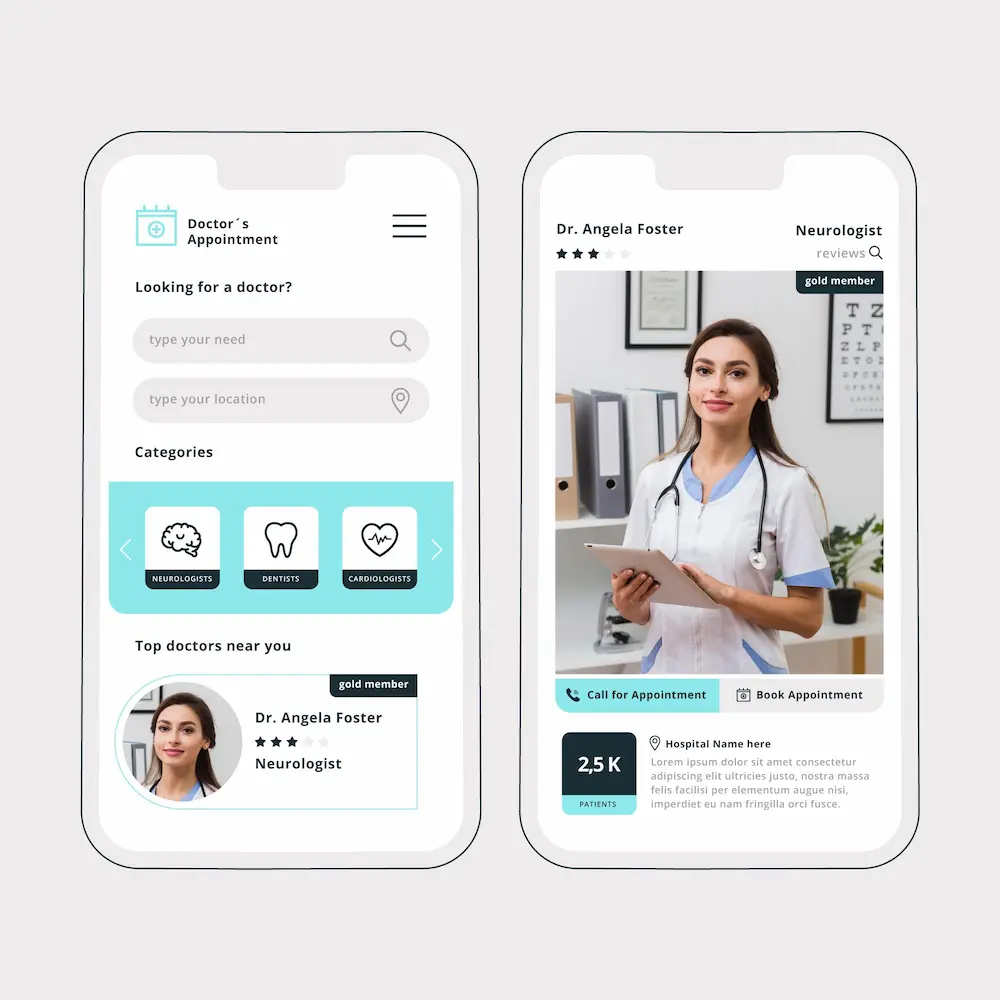
- Customization of dashboards: The patients can instantly view their health and get to know about the appointments coming.
- Elements that allow interaction: the very simple buttons, easy-to-fill forms, and visual data representation all together make the users deeply involved in the process.
Tip: Test prototypes with real users and gather feedback before full-scale development. Iterative testing ensures the app meets user expectations.
Step 4: Ensure Data Security and Compliance
Healthcare applications handle very private and personal data, therefore security is essential. It is required to take into account during the Healthcare Software Development the compliance with the different regulations like HIPAA, GDPR, or local healthcare laws. The main methods consist of:
- End-to-end encryption: Safeguard the information both in storage and during its transmission.
- Role-based access: Guarantee that only the personnel having approval can get to the patient data.
- Regular security audits: Quickly discover and repair the weak points in the system.
Example: An online consultation platform can encrypt all video calls and store patient notes securely, preventing unauthorized access.
Step 5: Integrate Advanced Technologies
To make healthcare tools more efficient and intelligent, consider integrating advanced technologies:
- AI and Machine Learning: They will predict health risks, suggest treatments, or offer chatbots that are available all the time for support.
- IoT Integration: The connection will be made among the wearing devices for monitoring vital signs instantly.
- Cloud Storage: Make certain that the patient records can be accessed on any device with the ability to expand.
- Analytics Tools: Produce insights that can be directly acted upon for healthcare professionals to refine the treatment plans.
Example: A fitness and wellness app can use AI to provide personalized exercise and diet recommendations based on user health data.
Step 6: Test and Optimize the App
Testing is a critical step in Healthcare Mobile App Development to ensure the app functions seamlessly. This includes:
- Functional testing: Check every function if it works as planned.
- Performance testing: Make sure the application operates without any problems or slowdowns.
- Usability testing: Evaluate the application’s user-friendliness from the perspective of the user.
- Security testing: Prove that the confidential health information is still safe.
Tip: Continuous optimization after launch is essential. Gather user feedback and monitor app performance to implement updates regularly.
Step 7: Launch and Support
Launching a healthcare app is not the end—it requires ongoing support and maintenance. Steps include:
- App Store Optimization (ASO): Make sure the app can be found in both Google Play and Apple App Store.
- User onboarding: Set up guides to make it easier for the users to use the app.
- Customer support: Present quick support methods for solving problems.
- Regular updates: Introduce new features, strengthen security, and remove bugs according to users’ feedback.
Example: After launching a telemedicine app, regular updates can introduce new consultation features, integrate insurance management, or improve the interface for better user experience.
Tips for Successful Healthcare App Development
- Join forces with proficient Healthcare App Developers in Bangalore to benefit from their expert knowledge in the field.
- Place user-centered design at the core of your development process to improve patient contentment.
- Treat security and compliance as the main issues from the very beginning.
- Analytics will be your helper in making data-driven decisions for app advancements.
- Conduct widespread testing to reduce mistakes and enhance the performance.
Conclusion
Developing healthcare tools that are not only efficient but also user-friendly necessitates meticulous planning, clever design, strong security measures, and constant updates. Every step, from goal setting through feature selection to technology integration and testing, has a significant impact on the digital solutions aimed at better patient care and more efficient healthcare operations.
For companies and healthcare institutions intent upon creating state-of-the-art digital solutions, Jurysoft, the prominent Healthcare App Development Company in Bangalore, provides professional Healthcare App Development Services and the specialization of Healthcare Mobile App Development. The Healthcare Software Development team consists of professionals who are adept in making your app secure, scalable, and easy to use, thereby creating value for both patients and healthcare providers.
Reach out to Jurysoft today!