Manufacturing businesses face constant pressure to improve production efficiency, maintain accurate inventory, control operating costs, and deliver orders on time. As operations expand, managing these activities through spreadsheets, disconnected software, and manual processes becomes increasingly difficult.
Production teams may struggle with material shortages, procurement delays, inaccurate product costing, and limited visibility into shop-floor activities. Even when a factory is running at full capacity, these challenges can affect productivity and reduce overall profitability.
This is where Manufacturing ERP Software becomes valuable.
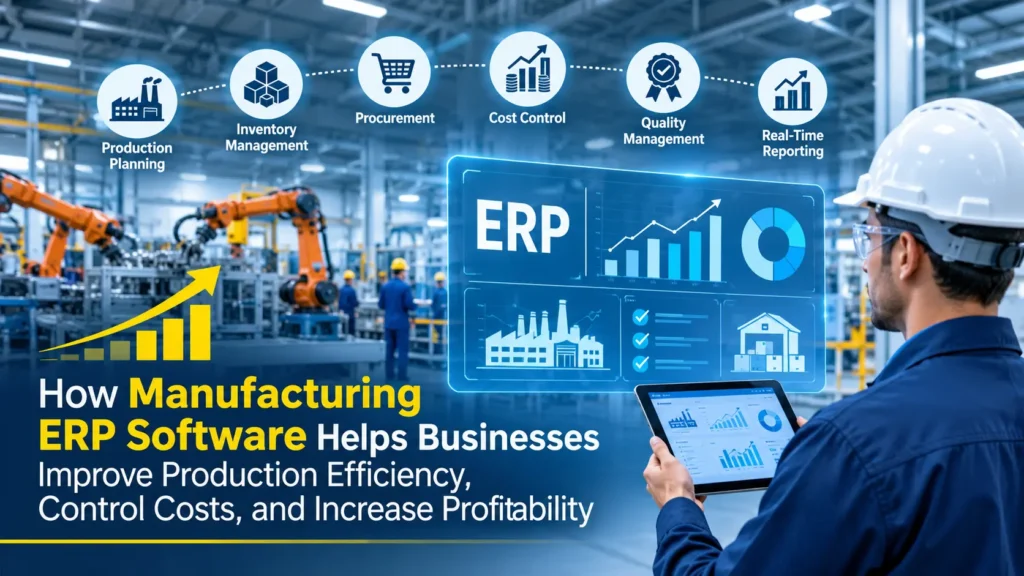
An integrated Enterprise Resource Planning (ERP) system connects production, inventory, procurement, sales, finance, and reporting within a centralised platform. It helps manufacturers coordinate daily operations, access accurate information, and make better business decisions.
Let’s explore how manufacturing ERP software helps businesses streamline operations and achieve sustainable growth.
1. Improve Production Planning and Scheduling
Production planning is one of the most important activities in manufacturing. Businesses must coordinate raw materials, machine availability, labour, production capacity, and customer delivery schedules.
When production planning depends on spreadsheets or manual communication, even a small change can create delays across multiple departments.
Manufacturing ERP software helps businesses organise production activities through:
- Production planning based on customer orders and demand.
- Production scheduling and resource allocation.
- Bill of Materials (BOM) management.
- Work order creation and tracking.
- Monitoring production progress.
- Identifying production delays and bottlenecks.
With better production visibility, managers can identify potential issues earlier and coordinate resources more effectively.
2. Maintain Accurate Inventory and Material Availability
Inventory management directly affects manufacturing efficiency. Excess inventory increases storage and working capital costs, while insufficient raw materials can interrupt production.
An ERP inventory management system provides better control over materials throughout the manufacturing process.
Key capabilities include:
- Real-time stock monitoring.
- Raw material and finished goods tracking.
- Multi-warehouse inventory management.
- Stock movement and transaction tracking.
- Reorder level monitoring.
- Material allocation for production orders.
By connecting inventory with purchasing and production, manufacturers can improve material availability and reduce unnecessary stock accumulation.
This also helps procurement teams make purchasing decisions based on actual business requirements.
3. Improve Manufacturing Cost Control
Understanding the actual cost of manufacturing a product is essential for maintaining healthy profit margins.
However, many businesses calculate product costs using incomplete material estimates or outdated spreadsheets. This can result in inaccurate quotations, poor pricing decisions, and unexpected production expenses.
Manufacturing ERP software helps businesses improve costing accuracy by connecting:
- Raw material costs.
- Bill of Materials (BOM).
- Labour and operational expenses.
- Production-related costs.
- Material consumption.
- Actual production quantities.
By comparing estimated and actual production costs, management can identify cost variations and understand where additional expenses occur.
Accurate product costing also helps businesses prepare more reliable quotations and evaluate product profitability.
4. Streamline Procurement and Purchase Management
Procurement teams must ensure that the right materials are available at the right time and at the right cost.
Without proper coordination between purchasing, inventory, and production, manufacturers may experience duplicate purchases, delayed deliveries, and unnecessary procurement expenses.
An ERP purchase management system helps streamline procurement activities through:
- Purchase requisition management.
- Purchase order creation and tracking.
- Supplier information management.
- Purchase price monitoring.
- Material receipt tracking.
- Coordination between procurement and inventory.
When purchasing activities are connected with production requirements, businesses can make more informed purchasing decisions and reduce avoidable delays.
5. Gain Better Visibility Across Manufacturing Operations
One major challenge in growing manufacturing businesses is the lack of accurate operational information.
Production managers may not know the current status of work orders. Inventory teams may maintain separate stock records, while finance teams work with different cost information.
This creates disconnected departments and makes decision-making difficult.
An integrated manufacturing ERP system brings important operational information into one platform.
Managers can monitor:
- Production progress.
- Raw material availability.
- Purchase order status.
- Inventory movements.
- Manufacturing costs.
- Sales and order status.
- Financial performance.
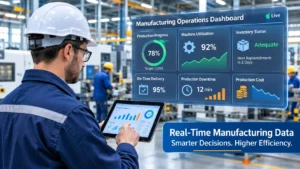
Access to centralised information helps management understand what is happening across the business without waiting for multiple departments to prepare manual reports.
6. Strengthen Quality Management and Traceability
Quality management is particularly important for manufacturers operating in industries where product consistency, compliance, and traceability are essential.
Manual records can make it difficult to identify the source of quality issues or trace materials used in a particular production batch.
ERP software can support quality and traceability processes through:
- Quality inspection records.
- Batch and lot tracking.
- Material traceability.
- Production documentation.
- Inspection status monitoring.
- Serial number tracking where required.
These capabilities help businesses maintain better production records and improve accountability throughout manufacturing operations.
For aerospace, defence, automotive, and other quality-focused industries, reliable traceability can be especially important.
7. Reduce Manual Work and Improve Department Coordination
When different departments use separate systems, employees often spend considerable time entering the same information multiple times.
For example, a sales order may need to be communicated manually to production, procurement, inventory, and finance.
This increases administrative effort and creates opportunities for errors.
Manufacturing ERP software connects these departments through shared business information.
When an order is entered, relevant teams can access the information they need for planning, material requirements, purchasing, production, and financial processing.
This improves coordination, reduces repetitive data entry, and allows employees to focus on more important operational activities.
8. Make Better Business Decisions with Real-Time Reporting
Manufacturing decisions should be based on accurate operational and financial information.
However, when reports are prepared manually, managers may receive outdated information that does not reflect current business conditions.
An ERP reporting system helps bring operational data together to support better decision-making.
Businesses can analyse:
- Production performance.
- Inventory levels and stock movements.
- Procurement expenses.
- Product costing.
- Sales performance.
- Operational expenses.
- Business profitability.
With improved reporting visibility, business owners and managers can identify operational inefficiencies, evaluate performance, and take corrective action.
Why Choose Jurysoft ERP for Manufacturing Businesses?
Managing manufacturing operations requires more than individual software applications for inventory, production, purchasing, and accounting.
Businesses need an integrated system that connects these functions and provides a clear view of overall operations.
Jurysoft ERP is designed to help manufacturing businesses streamline their processes, improve operational visibility, and manage important business activities through an integrated ERP solution.
Jurysoft ERP helps businesses manage key operational areas, including:
- Production Planning: Organise production activities and monitor manufacturing progress.
- BOM Management: Maintain product structures and manage material requirements.
- Inventory Management: Monitor stock levels, material movements, and warehouse operations.
- Purchase Management: Manage procurement activities and supplier-related processes.
- Sales Management: Coordinate customer orders and sales activities.
- Financial Management: Improve visibility into business expenses and financial operations.
- Manufacturing Costing: Understand material costs, operational expenses, and production-related costs.
- Reporting and Analytics: Access business information to support informed decisions.
By bringing these activities together, Jurysoft ERP helps manufacturers reduce disconnected workflows and establish better control over their operations.
Whether a business wants to improve production planning, maintain accurate inventory, manage procurement, or gain better control over manufacturing costs, an integrated ERP solution can provide the operational foundation needed for growth.
Learn more about Jurysoft ERP and its manufacturing ERP capabilities.
Signs Your Manufacturing Business Needs ERP Software
If your business experiences several of the following challenges, it may be time to evaluate your existing systems:
- Production schedules are frequently delayed.
- Raw material availability is difficult to monitor.
- Inventory records do not match actual stock.
- Product costing is calculated manually.
- Procurement and production teams lack coordination.
- Management reports take too long to prepare.
- Different departments maintain separate data.
- Tracking production performance is difficult.
- Business owners lack real-time operational visibility.
These problems can become more complicated as production volumes and business operations increase.
An ERP system helps establish connected processes and gives management better control over daily operations.
Conclusion
Manufacturing efficiency depends on how effectively a business manages its people, materials, machines, processes, and costs.
Disconnected systems and manual processes can create operational gaps that affect production schedules, inventory accuracy, product costing, and profitability.
Manufacturing ERP Software helps address these challenges by connecting essential business functions within a centralised system.
For manufacturers looking to improve production planning, strengthen inventory control, streamline procurement, and gain better financial visibility, implementing an integrated ERP solution is an important step towards operational improvement.
Jurysoft ERP helps manufacturing businesses move towards more connected, efficient, and controlled operations.
Ready to understand where your current manufacturing processes can improve?
Book your FREE ERP Gap Audit with Jurysoft.
Visit https://jurysoft.com/ to explore how Jurysoft ERP can support your manufacturing business.