A manufacturing facility can appear highly productive while quietly losing money through unnecessary material consumption, rejected products, repeated production activities, and inefficient resource utilisation.
Consider a factory producing hundreds of components every day. Production targets are being achieved, machines are running, and customer orders are moving forward. However, the business continues to experience excessive raw material consumption, frequent quality rejections, and unexpected production costs.
These problems may seem like normal manufacturing challenges, but together they can significantly reduce profitability.
Production waste is not limited to discarded raw materials. It also includes machine downtime, unnecessary labour hours, excess inventory, rework, and inefficient production processes. Even small losses occurring throughout daily operations can accumulate into substantial financial costs over time.
One of the biggest challenges for manufacturers is identifying exactly where these losses occur. When production, inventory, procurement, quality, and finance departments operate using disconnected systems, management often lacks a complete picture of manufacturing performance.
This is where Manufacturing ERP Software becomes valuable.
An integrated ERP system connects essential manufacturing activities and provides better visibility into material consumption, production performance, scrap generation, quality issues, and operational costs.
By using ERP Software for Manufacturing, businesses can identify hidden production losses, improve resource utilisation, strengthen manufacturing cost control, and make better decisions to improve overall profitability.
Understanding the Different Types of Production Waste in Manufacturing
Before reducing production waste, manufacturers must understand where it originates. Waste can occur at different stages, from raw material procurement to final product delivery.
1. Material Waste and Excess Raw Material Consumption
Material waste occurs when production consumes more raw materials than required to manufacture a product.
For example, a metal fabrication company may require a specific quantity of steel sheets to manufacture a batch of components. However, inaccurate cutting measurements, incorrect machine settings, or poor production planning may result in excessive material consumption.
Common causes include:
- Incorrect material calculations.
- Poorly maintained Bill of Materials (BOM).
- Improper machine settings.
- Cutting and processing errors.
- Inadequate production planning.
Without accurate material tracking, manufacturers may struggle to determine why actual consumption exceeds planned requirements.
2. Scrap Generation During Production
Scrap refers to materials or finished components that cannot be used or sold because they fail to meet required specifications.
In manufacturing environments, scrap can result from defective raw materials, machining errors, incorrect dimensions, equipment problems, or operator mistakes.
For example, a CNC machining facility may generate rejected metal components because of incorrect cutting parameters. If scrap quantities are not recorded properly, management may underestimate the actual cost of production losses.
Effective Scrap Management in Manufacturing requires accurate recording, classification, and analysis of rejected materials.
3. Rework Caused by Quality Issues
Rework occurs when defective products require additional processing to meet quality standards.
Unlike scrap, reworked products may still be usable. However, correcting defects requires additional labour, machine time, electricity, and sometimes extra materials.
For instance, if manufactured components fail dimensional inspections, employees may need to perform additional machining operations.
Repeated rework reduces production capacity and increases manufacturing expenses.
4. Machine Downtime and Underutilised Equipment
Machines that remain idle because of breakdowns, maintenance delays, material shortages, or inefficient scheduling create production losses.
For example, a production line may remain inactive because a required raw material has not arrived from the warehouse.
Even when equipment is available, poor scheduling and frequent changeovers can prevent manufacturers from using their production capacity effectively.
5. Excess Inventory and Poor Material Planning
Maintaining excessive inventory ties up working capital and increases storage, handling, and inventory management costs.
Materials may also become obsolete, damaged, or unusable when they remain in storage for extended periods.
At the same time, inadequate inventory planning can create material shortages that interrupt production.
6. Labour Inefficiency and Unproductive Workflows
Labour-related waste occurs when employees spend unnecessary time searching for materials, waiting for machine availability, correcting production errors, or completing repetitive administrative tasks.
For example, workers may lose valuable production time because warehouse teams and production supervisors do not have access to updated material availability information.
These inefficiencies affect productivity and increase operational costs.
Why Manufacturers Struggle to Identify and Control Production Waste
Many manufacturing businesses understand that waste affects profitability. However, identifying its actual causes can be difficult when operational information is scattered across different systems.
Some common challenges include:
- Manual production tracking: Employees record material consumption, scrap, and production quantities using spreadsheets or paper-based reports.
- Disconnected systems: Inventory, production, procurement, and finance departments maintain separate records.
- Limited shop-floor visibility: Managers cannot easily access updated information about production progress and resource utilisation.
- Inaccurate material records: Actual material consumption may differ from the quantities recorded in inventory.
- Limited quality reporting: Businesses may identify defective products without understanding recurring reasons for rejection.
- Inconsistent production data: Different departments may use different reporting formats, making operational comparisons difficult.
These issues make Manufacturing Waste Management reactive rather than proactive.
Managers often discover production losses only after reviewing monthly expenses or identifying unexpected inventory differences.
To reduce waste effectively, manufacturers need a connected system that captures operational information and makes it available for analysis.
How Manufacturing ERP Software Helps Identify Production Waste
Manufacturing ERP Software provides a centralized platform for managing production activities, inventory movements, quality processes, procurement, and financial information.
Instead of relying on separate reports, manufacturers can connect operational data and identify where production losses are occurring.
Here are seven important ways ERP supports Production Waste Reduction.
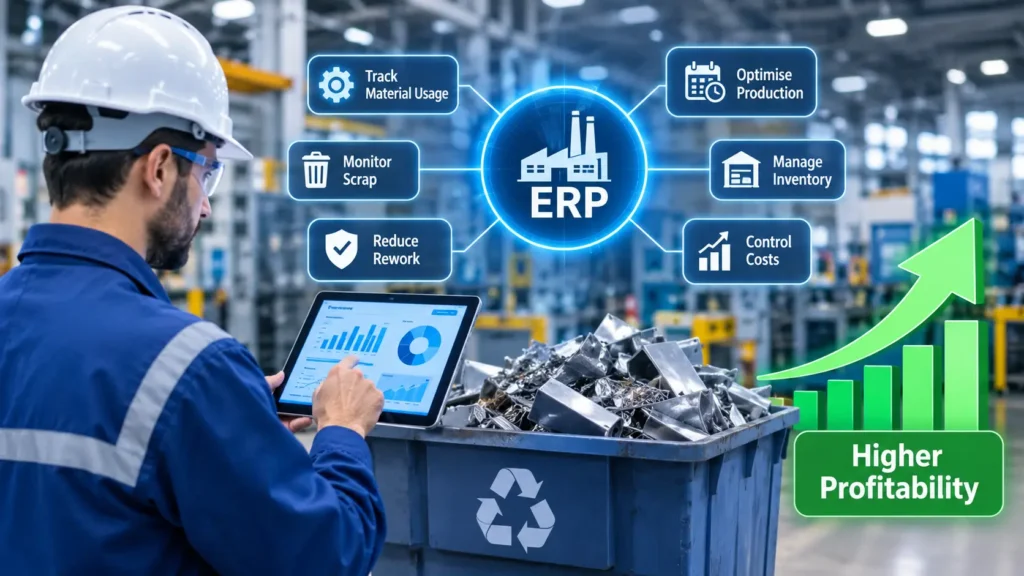
1. Real-Time Material Consumption Tracking
One of the most effective ways to control material wastage in manufacturing is to compare planned material requirements with actual consumption.
ERP systems connect material requirements with production orders and Bills of Materials (BOMs).
For example, a manufacturing company may plan to use 500 kg of steel to manufacture a specific batch of components. During production, the actual consumption may reach 540 kg.
An ERP system can help managers identify this 40 kg variance and investigate whether it resulted from cutting errors, incorrect measurements, material defects, or inaccurate BOM specifications.
Key capabilities include:
- Tracking planned versus actual material consumption.
- Recording material issues against production orders.
- Monitoring material returns and unused stock.
- Identifying unusual consumption patterns.
- Comparing material usage across production batches.
This visibility helps manufacturers improve material planning and reduce unnecessary raw material consumption.
2. Scrap Management and Monitoring
Scrap management becomes more effective when manufacturers systematically record rejected materials and identify why they were generated.
Manufacturing ERP Software can support scrap tracking by connecting rejected quantities with production orders, work centres, machines, material batches, and rejection reasons.
For example, if a particular machine repeatedly generates defective components, production managers can examine scrap records and investigate the underlying issue.
An integrated ERP system can help businesses:
- Record scrap quantities at different production stages.
- Categorise scrap by rejection reason.
- Identify recurring machine-related problems.
- Track material losses against production orders.
- Analyse scrap costs and historical trends.
These insights help businesses move beyond simply recording waste and start identifying opportunities to prevent it.
3. Rework and Quality Management
Quality problems create additional costs because defective products often require extra inspection, processing, labour, and materials.
ERP Software for Manufacturing can connect quality inspections with production records, making it easier to identify where defects originate.
For instance, if a batch of components repeatedly fails dimensional inspection, quality managers can review the associated material batch, machine settings, production records, and inspection results.
ERP-supported quality management can include:
- Incoming material inspections.
- In-process quality checks.
- Finished product inspections.
- Non-conformance reporting.
- Rework order management.
- Defect and rejection analysis.
By maintaining quality information alongside production data, manufacturers can identify recurring problems and take corrective action earlier.
4. Production Planning and Scheduling
Poor production planning can create unnecessary material consumption, machine idle time, excessive changeovers, and inefficient workflows.
Manufacturing ERP Software helps production teams coordinate work orders with material availability, machine capacity, production priorities, and delivery requirements.
For example, a factory may have three production orders requiring similar raw materials. Without coordinated scheduling, employees might perform unnecessary machine changeovers between orders.
An ERP system can help planners organise production sequences more efficiently.
It supports:
- Production scheduling based on available capacity.
- Material requirement planning.
- Work order tracking.
- Production progress monitoring.
- Coordination between departments.
- Identification of potential production bottlenecks.
Better scheduling helps reduce avoidable interruptions and supports improved Production Efficiency.
5. Inventory Visibility and Material Control
Excess inventory and material shortages create different types of operational waste.
Manufacturers need sufficient raw materials to maintain uninterrupted production without purchasing unnecessary quantities.
Integrated Manufacturing Inventory Management helps businesses maintain better control over stock movements.
ERP systems can provide visibility into:
- Available raw material quantities.
- Materials allocated to production.
- Work-in-progress inventory.
- Finished goods inventory.
- Minimum and maximum stock levels.
- Reorder requirements.
- Batch and expiry information, where applicable.
For example, if production requires a specific component that is already available in another warehouse, inventory visibility can help procurement teams avoid unnecessary purchasing.
This improves stock accuracy, reduces excess inventory, and supports better working capital management.
6. Machine and Resource Utilisation
Manufacturing resources include machines, employees, production facilities, and available working hours.
When these resources are not utilised efficiently, businesses lose production capacity and increase operating expenses.
ERP production reports can help managers analyse machine schedules, planned operating hours, recorded downtime, production output, and resource allocation.
For example, if a particular machine frequently remains idle because of material shortages, management can investigate inventory planning and procurement coordination.
By monitoring production activities, businesses can identify:
- Frequently idle machines.
- Repeated production interruptions.
- Machine capacity constraints.
- Unplanned maintenance requirements.
- Inefficient production sequences.
- Labour allocation problems.
When connected to suitable machine data or a Manufacturing Execution System (MES), ERP can provide even greater shop-floor visibility.
7. Production Cost Analysis and Reporting
Production waste ultimately affects the financial performance of a manufacturing business.
However, many manufacturers track material expenses, labour costs, overheads, scrap, and rework separately.
ERP connects these cost elements to production orders and manufacturing activities.
For example, a product may appear profitable based on its estimated production cost. However, actual material consumption, additional labour, machine downtime, and rework may increase its final manufacturing cost.
An integrated ERP system can help businesses compare:
- Estimated versus actual production costs.
- Planned versus actual material expenses.
- Labour costs per production order.
- Machine and overhead expenses.
- Scrap and rejection costs.
- Rework-related expenses.
This enables finance and operations teams to understand the actual cost of manufacturing and identify products or processes that require improvement.
Key Manufacturing Waste Metrics ERP Helps Businesses Monitor
Reducing production waste requires more than implementing software. Manufacturers must also monitor the right performance indicators.
An ERP system can bring operational data together to help management measure production performance and identify recurring losses.
| Manufacturing KPI | What It Measures | Why It Matters |
|---|---|---|
| Scrap Rate | Percentage of production output rejected as scrap | Identifies material and production losses |
| Material Yield | Usable output compared with material input | Measures material utilisation |
| Rework Rate | Percentage of units requiring additional processing | Highlights quality problems |
| First Pass Yield (FPY) | Products passing inspection without rework | Measures first-time production quality |
| Overall Equipment Effectiveness (OEE) | Equipment availability × performance × quality | Identifies equipment-related production losses |
| Material Usage Variance | Difference between planned and actual material consumption | Highlights unexpected material usage |
| Production Downtime | Time equipment remains unavailable during planned production | Identifies lost production capacity |
| Cost of Poor Quality | Financial cost associated with quality failures | Reveals the financial impact of defects |
Manufacturers should define consistent formulas and reporting periods for these metrics.
For example:
- Scrap Rate = (Scrap Quantity ÷ Total Production Quantity) × 100
- Material Usage Variance = Actual Material Consumption − Standard Material Consumption
- Rework Rate = (Reworked Units ÷ Total Units Produced) × 100
- First Pass Yield = (Units Passing First Inspection ÷ Total Units Entering the Process) × 100
- OEE = Availability × Performance × Quality
OEE is particularly useful because it considers equipment availability, operating performance, and production quality together.
Real-World Example: How ERP Helps Reduce Manufacturing Waste
Consider a hypothetical mid-sized metal components manufacturing company supplying parts to industrial equipment manufacturers.
The company experiences increasing production costs despite maintaining consistent customer demand.
Management identifies several operational problems:
- Raw material consumption frequently exceeds planned quantities.
- Scrap generation varies significantly between production batches.
- Finished components regularly require additional machining.
- Warehouse records do not always match actual stock.
- Production supervisors lack a consolidated view of machine utilisation.
Initially, the company manages these activities through spreadsheets and separate departmental software.
Step 1: Identifying Material Consumption Differences
The company implements ERP-based material tracking and connects BOM requirements with production orders.
Production managers can now compare standard material requirements with actual consumption and investigate unexpected differences.
Step 2: Improving Scrap Management
Employees record scrap quantities against production orders and classify rejection reasons.
Management can identify recurring problems associated with particular machines, production stages, or material batches.
Step 3: Reducing Rework Through Quality Tracking
Quality inspection results are connected with production records.
This allows the company to investigate recurring dimensional defects and coordinate corrective actions between production and quality teams.
Step 4: Improving Inventory and Production Planning
Inventory and production planning are integrated.
Production supervisors can check material availability before releasing work orders, while procurement teams receive better visibility into upcoming material requirements.
Step 5: Monitoring Manufacturing Costs
The company begins reviewing material usage, scrap, rework, labour, and production overheads against individual production orders.
Management can now identify which processes contribute most significantly to rising manufacturing costs.
Rather than treating waste as an unavoidable part of production, the company develops a structured approach to identifying losses, investigating their causes, and improving operational controls.
This example illustrates how integrated ERP can support Manufacturing Process Optimisation without assuming that software alone will eliminate production waste.
Business Benefits of Reducing Production Waste Through ERP
Reducing production waste creates benefits beyond saving raw materials. It improves the overall performance of manufacturing operations.
1. Lower Manufacturing Costs
Tracking material consumption, scrap, rework, and machine downtime helps manufacturers identify unnecessary expenses.
Better cost visibility enables management to investigate losses and control production expenses.
2. Improved Profit Margins
When businesses reduce unnecessary material consumption and quality-related expenses, they can improve the profitability of individual products and production orders.
3. Better Raw Material Utilisation
Accurate BOMs, material tracking, and production planning help manufacturers use raw materials more effectively.
4. Reduced Scrap and Rejection Rates
Recording rejection reasons and monitoring quality performance helps identify recurring production issues.
5. Improved Production Efficiency
Better scheduling, resource allocation, and machine utilisation help manufacturers make more effective use of their available production capacity.
6. Better Inventory Accuracy
Integrated inventory management helps reduce stock discrepancies, unnecessary purchases, excess inventory, and material shortages.
7. Increased Production Visibility
Managers gain a clearer understanding of production progress, material consumption, quality performance, and operational costs.
8. Improved Operational Decision-Making
Instead of depending on assumptions or outdated reports, management can use connected operational data to make informed decisions.
How to Choose the Right Manufacturing ERP for Waste Management
Not every ERP system provides the same manufacturing capabilities. Businesses should evaluate their operational requirements before selecting a solution.
For effective Manufacturing Waste Management, consider the following features.
| ERP Feature | What to Evaluate |
|---|---|
| Production Management | Work orders, production scheduling, and progress tracking |
| Inventory Management | Real-time stock visibility and material movement tracking |
| BOM Management | Accurate material requirements and revision control |
| Quality Management | Inspections, rejection tracking, and corrective actions |
| Scrap Tracking | Scrap recording, categorisation, and cost analysis |
| Material Consumption Tracking | Planned versus actual material usage |
| Production Costing | Material, labour, overhead, scrap, and rework costs |
| Reporting and Dashboards | Production KPIs, operational reports, and performance visibility |
Why Integrated ERP Capabilities Matter
Manufacturing processes are interconnected.
For example, a material shortage can interrupt production, increase machine idle time, delay customer orders, and increase operating costs.
If inventory and production systems operate separately, identifying the relationship between these problems becomes difficult.
An integrated ERP platform connects these activities and allows departments to work with consistent operational information.
Manufacturers should also evaluate:
- Whether the ERP supports their production model.
- Whether workflows can be configured around their business processes.
- Whether the system supports batch and serial number traceability.
- Whether it can integrate with existing manufacturing applications.
- Whether reporting can be customised to business requirements.
- Whether the solution can scale as production operations expand.
Jurysoft develops custom ERP solutions for manufacturing businesses, connecting production, quality, inventory, procurement, and operational processes.
Conclusion: Turn Production Waste into an Opportunity for Greater Profitability
Production waste is not simply a shop-floor problem. It is a financial and operational challenge that directly affects manufacturing costs, production capacity, and business profitability.
Excessive material consumption, scrap generation, repeated rework, machine downtime, and poor inventory management can gradually reduce the financial performance of even well-established manufacturing businesses.
The first step towards reducing these losses is understanding where they occur and what causes them.
Manufacturing ERP Software helps businesses achieve this by connecting production, inventory, quality, procurement, and costing information through an integrated platform.
With better visibility into actual material consumption, production performance, quality issues, and manufacturing expenses, businesses can identify inefficiencies and take corrective action.
Jurysoft provides ERP solutions designed to connect manufacturing operations and support better production planning, inventory management, quality control, and cost visibility.
If your manufacturing business is struggling with production waste, disconnected systems, or rising operational costs, explore how Jurysoft can help you build a more connected and efficient manufacturing environment.
Ready to improve your manufacturing operations?
Visit Jurysoft to explore manufacturing ERP solutions designed around your business requirements.
Frequently Asked Questions (FAQs)
1. What is production waste in manufacturing?
Production waste refers to materials, time, labour, energy, and other resources consumed without creating the expected value during manufacturing.
Common examples include excessive raw material consumption, scrap generation, defective products, rework, machine downtime, excess inventory, and inefficient workflows.
Reducing production waste helps manufacturers improve productivity and control operational expenses.
2. How does ERP software help reduce manufacturing waste?
ERP software helps reduce manufacturing waste by connecting production, inventory, quality, procurement, and financial information.
It allows manufacturers to:
- Monitor planned versus actual material consumption.
- Track scrap and rejected products.
- Identify recurring quality issues.
- Improve production scheduling.
- Monitor machine utilisation.
- Analyse actual manufacturing costs.
These capabilities help businesses identify operational inefficiencies and take corrective action.
3. How can manufacturers track scrap and material wastage?
Manufacturers can track scrap and material wastage by recording actual material consumption, rejected quantities, production batch information, and reasons for material loss.
Manufacturing ERP Software helps centralise these records and compare actual material usage against planned requirements.
Managers can use this information to identify recurring waste patterns and investigate their causes.
4. Can ERP software help reduce production rework?
Yes. ERP software can help reduce production rework by connecting quality inspections, production orders, defect records, and corrective actions.
When defects are identified, managers can investigate the associated production stage, material batch, machine, and inspection results.
This helps manufacturers identify recurring quality problems and improve production processes.
5. How does ERP improve resource utilisation in manufacturing?
ERP improves resource utilisation by helping manufacturers coordinate machine availability, labour allocation, production schedules, and material requirements.
Production reports can highlight machine downtime, capacity constraints, idle resources, and scheduling inefficiencies.
This allows managers to make better decisions about production planning and resource allocation.
6. What manufacturing KPIs help measure production waste?
Important manufacturing KPIs include:
- Scrap Rate
- Material Yield
- Rework Rate
- First Pass Yield (FPY)
- Overall Equipment Effectiveness (OEE)
- Material Usage Variance
- Production Downtime
- Cost of Poor Quality
Monitoring these indicators helps manufacturers understand production losses and measure improvement over time.
7. How does manufacturing ERP improve operational profitability?
Manufacturing ERP improves operational profitability by helping businesses identify unnecessary expenses across production, inventory, quality, and resource management.
Better material utilisation, reduced rework, improved production planning, accurate costing, and inventory control can help lower manufacturing expenses and protect profit margins.