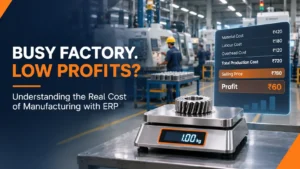
Imagine a manufacturing company receiving a large order from an important customer. The sales team prepares a quotation based on raw material prices and estimated labour expenses. After reviewing the expected production costs, the company offers a competitive price and successfully secures the order.
However, once production is completed and the final expenses are calculated, the actual profit is significantly lower than expected.
What went wrong?
The company may have underestimated electricity consumption, machine operating expenses, material wastage, production overheads, or other indirect costs. Although the quotation appeared profitable, the actual manufacturing cost was much higher.
This is a common challenge in manufacturing businesses. Companies often focus on securing orders and increasing production volumes without having complete visibility into the actual cost of manufacturing each product.
Accurate manufacturing cost calculation is essential for making profitable pricing decisions. Without understanding the complete cost of production, manufacturers risk accepting orders that generate revenue but deliver very little profit.
So, how can manufacturers improve product costing accuracy and protect their profit margins?
Let’s explore.
What Makes Up the Actual Cost of a Manufactured Product?
Calculating the actual cost of a manufactured product involves much more than adding raw material and labour expenses. Manufacturers must consider every resource consumed throughout the production process.
The major components include:
1. Raw Material Costs
Raw materials are generally one of the largest components of manufacturing expenses. These include metals, plastics, chemicals, electronic components, and other materials required to manufacture a product.
Accurate costing should consider actual purchase prices, transportation charges, supplier pricing changes, and material consumption.
2. Direct Labour Costs
Direct labour includes the wages and associated expenses of employees directly involved in manufacturing a product.
The time required for machining, assembly, inspection, and other production activities should be considered when calculating labour costs.
3. Machine Operating Costs
Manufacturing equipment involves operating expenses such as depreciation, maintenance, repairs, and operating time.
A product requiring three hours of machine operation may have a different production cost from one requiring only thirty minutes.
4. Electricity and Utility Expenses
Electricity, water, compressed air, fuel, and other utilities contribute to manufacturing expenses. Ignoring these costs can create significant differences between estimated and actual production costs.
5. Production Overheads
Factory rent, equipment maintenance, quality control, supervision, administrative support, and other indirect expenses must also be considered.
6. Packaging and Transportation
Packaging materials, handling expenses, warehousing, and transportation can increase the final cost of delivering a manufactured product.
7. Scrap, Wastage, and Rework Costs
Material rejection, production defects, machining wastage, and rework consume additional resources. These expenses should be reflected in the actual product cost.
When manufacturers consider only raw materials and direct labour, they may underestimate the complete cost of production and quote prices that fail to generate the expected margins.
Five Common Reasons Manufacturers Calculate Product Costs Incorrectly
Even experienced manufacturing businesses can struggle with product costing when their costing processes depend on outdated information, manual calculations, or disconnected records.
Here are five common reasons.
1. Ignoring Indirect Manufacturing Costs
Some manufacturers calculate product costs by considering raw materials and direct labour while overlooking indirect expenses.
For example, a company manufacturing industrial components may calculate the cost of one component based on its material consumption and assembly labour.
However, machine maintenance, electricity, factory rent, equipment depreciation, and quality inspection expenses are not included.
These expenses do not disappear simply because they are excluded from the quotation.
When manufacturing overhead costs are not allocated appropriately, the company may believe its products are profitable while actual margins continue to decline.
2. Using Outdated Raw Material Prices
Raw material prices can change due to supplier revisions, market conditions, transportation expenses, and purchasing agreements.
Suppose a manufacturer estimates a product using steel purchased at ₹100 per kg. By the time the next production order is processed, the purchase price increases to ₹110 per kg.
If the quotation still uses the previous price, the company may unknowingly reduce its profit margin.
Regularly updating material costs and maintaining accurate purchase records are important for reliable product cost estimation.
3. Not Accounting for Production Wastage
Production rarely follows theoretical material consumption perfectly.
Cutting operations may generate scrap, machining processes may produce rejected components, and assembly activities may require additional materials.
Consider a product that theoretically requires 5 kg of raw material. If actual production consumes 5.5 kg because of cutting losses and wastage, the additional 0.5 kg directly affects manufacturing costs.
If this difference is ignored across hundreds or thousands of units, the financial impact can become substantial.
Manufacturers must track actual material consumption, rejected quantities, scrap, and rework to understand their true production expenses.
4. Incorrect Labour and Machine Cost Allocation
Production costs also depend on how efficiently labour and machinery are utilised.
If a product requires two hours of machine operation but the costing calculation considers only one hour, the estimated production cost will be inaccurate.
Similarly, incorrect labour-hour calculations can create misleading product costs.
Manufacturers should consider actual production time, machine utilisation, setup time, downtime, and labour allocation when determining product costs.
5. Working with Disconnected Data and Spreadsheets
Many manufacturing businesses maintain separate spreadsheets for purchasing, inventory, production, costing, and accounting.
Although spreadsheets can support individual activities, managing multiple disconnected records makes it difficult to maintain consistent information.
For example, the procurement department may update material prices while the costing team continues using an older spreadsheet. Production may record additional material consumption without immediately updating the finance department.
As a result, different departments work with different versions of the same information.
This makes product costing more complicated and increases the possibility of incorrect pricing decisions.
How Incorrect Product Costing Damages Manufacturing Profitability
Incorrect costing affects more than individual quotations. It can influence customer relationships, production planning, financial performance, and long-term business growth.
Some major consequences include:
- Quoting below actual production costs: Manufacturers may accept orders that generate revenue but fail to cover all production expenses.
- Losing profit on high-volume orders: A small costing error becomes financially significant when multiplied across thousands of units.
- Submitting uncompetitive quotations: Inflated cost estimates can result in higher selling prices, making it difficult to win customer orders.
- Misjudging product-wise profitability: Management may continue manufacturing low-margin products without recognising their actual financial performance.
- Making incorrect discount decisions: Without accurate cost information, sales teams may offer discounts that significantly reduce profitability.
- Struggling to control production expenses: Management cannot easily identify where material consumption, labour expenses, or overheads are increasing.
Practical Example: How a Small Costing Error Affects Profit Margins
Consider a manufacturer producing 5,000 industrial components for a customer.
The company estimates the production cost at ₹500 per unit and quotes a selling price of ₹575 per unit.
However, the actual production cost turns out to be ₹530 because of additional material consumption, machine operating expenses, and production overheads.
| Particulars | Estimated | Actual |
|---|---|---|
| Production quantity | 5,000 | 5,000 |
| Cost per unit | ₹500 | ₹530 |
| Total production cost | ₹25,00,000 | ₹26,50,000 |
| Selling price per unit | ₹575 | ₹575 |
| Total sales revenue | ₹28,75,000 | ₹28,75,000 |
| Expected profit | ₹3,75,000 | ₹2,25,000 |
The company expected to earn ₹3.75 lakh but generated only ₹2.25 lakh.
The difference is ₹1.5 lakh, representing a 40% reduction in expected profit.
This example demonstrates how even a ₹30 difference in unit costing can significantly affect manufacturing profitability when production volumes are high.
How Manufacturing ERP Improves Product Cost Accuracy
An integrated manufacturing ERP system helps businesses connect procurement, inventory, production, and finance information within a centralised environment.
Instead of depending on separate spreadsheets and manual calculations, manufacturers can improve product costing through connected operational data.
Here is how ERP for manufacturing supports more accurate cost management.
1. Bill of Materials (BOM) Management
A Bill of Materials defines the raw materials, components, quantities, and specifications required to manufacture a product.
BOM management helps manufacturers understand the expected material requirements for each product.
When BOM revisions are properly maintained, costing teams can work with updated material specifications and quantities.
This reduces the possibility of preparing quotations using outdated material requirements.
2. Real-Time Inventory Valuation
Inventory information directly influences product costing.
Manufacturing ERP software connects purchasing and inventory records, providing better visibility into material receipts, stock movements, consumption, and valuation.
When material costs change, costing teams can use updated inventory and purchasing information according to the company’s costing method.
This supports more reliable product cost estimation and inventory management.
3. Production Cost Tracking
An ERP system can connect production orders with material consumption, labour activities, and manufacturing expenses.
Manufacturers can monitor how much material is issued, how much is consumed, and whether actual production requirements differ from planned quantities.
This helps businesses identify unexpected expenses and improve production cost analysis.
4. Machine and Labour Cost Allocation
Machine operating hours and labour utilisation contribute significantly to production expenses.
Manufacturing ERP systems can help record production activities, resource utilisation, and operational time.
This information supports more consistent allocation of machine and labour costs across different products and production orders.
5. Overhead Allocation
A complete costing approach must include indirect manufacturing expenses.
ERP-based cost management can support the allocation of expenses such as electricity, maintenance, factory overheads, and equipment-related costs using appropriate allocation methods.
This helps manufacturers understand the broader cost structure of individual products.
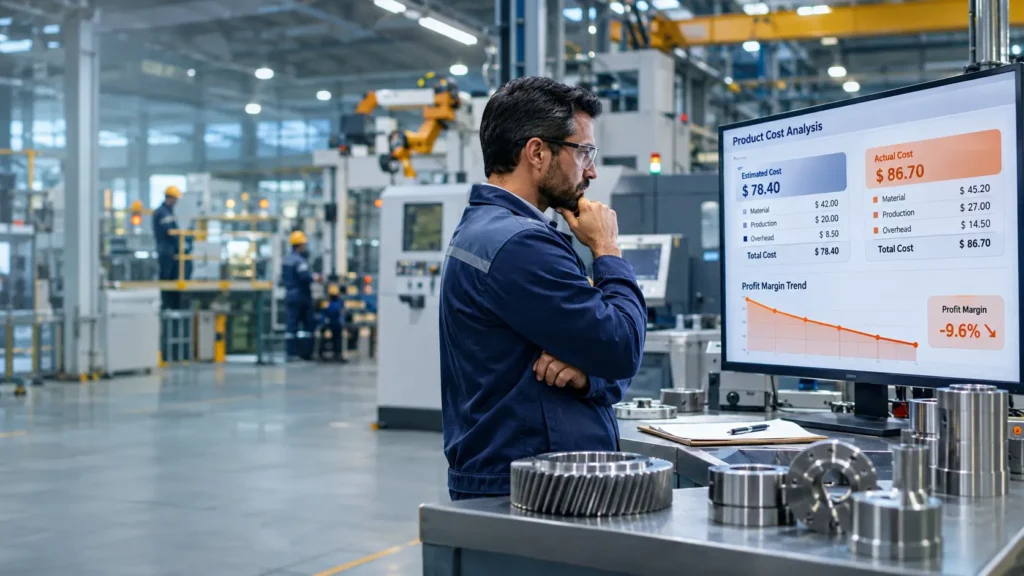
6. Actual vs Estimated Cost Analysis
One of the most useful capabilities of manufacturing ERP is the ability to compare planned production costs with actual expenses.
Manufacturers can identify differences in material prices, consumption, labour hours, machine utilisation, and overhead allocation.
This provides management with better visibility into production cost variations and supports informed decisions about pricing and manufacturing cost control.
Estimated Cost vs Actual Cost: Why Manufacturers Must Track Both
Estimated costing and actual costing serve different purposes in manufacturing.
Estimated costing helps businesses predict production expenses before accepting an order or starting production. Actual costing reflects the expenses recorded during or after manufacturing.
Both are important for effective manufacturing cost management.
| Comparison | Estimated Cost | Actual Cost |
|---|---|---|
| Purpose | Predict production expenses | Measure actual production expenses |
| Material prices | Based on available price information | Based on recorded purchase and costing data |
| Material consumption | Based on BOM and planned quantities | Based on actual consumption |
| Labour expenses | Based on planned labour hours | Based on recorded labour hours |
| Machine costs | Based on estimated utilisation | Based on actual utilisation |
| Overheads | Based on planned allocation | Based on recorded expenses and allocation |
| Business use | Quotation and production planning | Profitability analysis and cost control |
Comparing these two figures helps manufacturers identify important cost variations.
For example:
- Material price variance: Did supplier price changes increase the cost of raw materials?
- Material consumption variance: Did production consume more materials than planned?
- Labour cost variance: Did additional labour hours increase production expenses?
- Production efficiency variance: Did machine downtime or unexpected production delays increase costs?
- Overhead variance: Were electricity, maintenance, or other indirect expenses higher than expected?
Regular cost variance analysis helps manufacturers improve quotations, identify operational inefficiencies, and make better production decisions.
Five Questions Every Manufacturing Business Should Ask Before Quoting a Product
Before submitting a quotation to a customer, manufacturing businesses should evaluate the following questions:
- Have all raw material costs, including updated purchase prices, been considered?
- Are direct labour expenses and machine operating costs included?
- Have scrap, material wastage, rejected components, and rework been accounted for?
- Are manufacturing overheads allocated correctly across products?
- Can we compare estimated product costs with actual production costs from previous orders?
If the answer to these questions is unclear, there may be gaps in the company’s costing process.
Reviewing these areas before preparing quotations can help businesses reduce pricing errors and make more informed commercial decisions.
Conclusion: Accurate Costing Is the Foundation of Profitable Manufacturing
Winning more customer orders does not necessarily mean a manufacturing business is becoming more profitable.
If product costs are calculated incorrectly, higher production volumes can increase financial pressure instead of improving business performance.
Accurate manufacturing cost calculation requires complete visibility into raw materials, labour, machine utilisation, production wastage, and indirect expenses.
Manufacturers need connected information across procurement, inventory, production, and finance to understand the actual cost of every product.
An integrated manufacturing ERP system helps businesses improve costing accuracy, compare estimated and actual production expenses, identify cost variations, and prepare more reliable customer quotations.
Ultimately, understanding the real cost of manufacturing is not just an accounting requirement. It is an important part of protecting profit margins and building a sustainable manufacturing business.
Are You Confident That Your Product Quotations Reflect the Actual Cost of Manufacturing?
Discover how an integrated manufacturing ERP system can help your business improve costing accuracy, gain better financial visibility, control production expenses, and protect profit margins.
Explore how ERP can improve your manufacturing operations and support more profitable business decisions.